
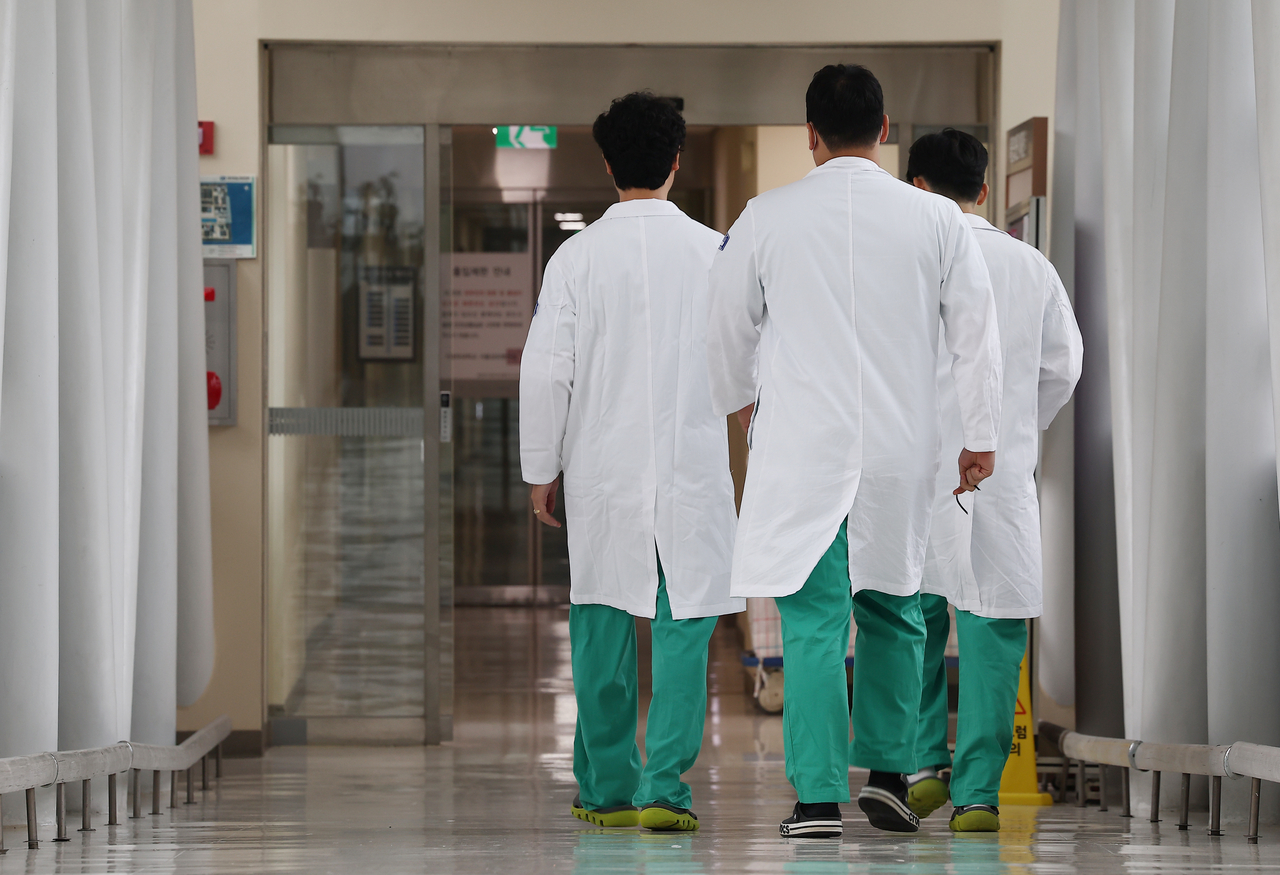
 Doctors walk the hallways of a university hospital in Seoul. (Yonhap)
 Medical expenses for foreign nationals covered by South Korea’s National Health Insurance Service jumped 68 percent over the past five years to 1.6 trillion won ($1.12 billion) in 2024 from 948 billion won in 2019, data from the Ministry of Health and Welfare showed Tuesday.
According to figures compiled by the Health Ministry and the Health Insurance Review & Assessment Service, and disclosed by People Power Party Rep. Kim Mi-ae, the number of foreign patients in South Korea grew from 3.24 million in 2019 to 4.16 million in 2024.
As of August this year, NHIS-covered medical expenses for foreign nationals had already reached 1.1 trillion won.
By treatment type, internal medicine accounted for the largest share at 298 billion won, followed by surgeries (143 billion won), orthopedics (99.6 billion won), obstetrics and gynecology (94.6 billion won) and neurosurgery (65.7 billion won).
During the same period, expenses covered at large hospitals — including dental and oriental medicine services — rose 53.9 percent, from 615 billion won to 946 billion won. Costs covered at local clinics grew even faster, surging 94.1 percent from 333 billion won to 646 billion won.
In comparison, medical expenses for Korean nationals under the NHIS increased by 36 percent, from 66.97 trillion won in 2019 to 90.92 trillion won last year. Although the total amount was roughly 60 times higher than that of foreign patients, the growth rate for Koreans was about half that of non-Koreans.
Government subsidies for the NHIS also climbed 56.4 percent over the same period, from 7.78 trillion won to 12.16 trillion won, maintaining a share of around 11 to 12 percent of the NHI’s annual revenue.
Rep. Kim urged greater transparency in how taxpayer-funded subsidies are used.
“The government must transparently disclose in detail how public subsidies funded by taxpayers’ money are spent, item by item,” she said. “Institutional measures should be swiftly introduced to clearly distinguish and manage medical expenses and benefit payments for Koreans and foreigners, so that taxpayers’ money and health insurance contributions are used fairly.”
The issue of a possible deficit in NHIS spending on foreign patients emerged as a key point of debate during this year’s government audit by the National Assembly’s Health and Welfare Committee.
Rep. Kim noted that 111 foreign patients left the country after receiving medical treatment worth over 10 million won each, with their combined bills totaling 1.8 billion won in NHIS-covered expenses.
Ruling Democratic Party Rep. Lee Gae-ho claimed during an Oct. 14 audit session that “some Chinese nationals are engaging in ‘medical shopping,’ paying less than 20,000 won in premiums while receiving over 70 million won worth of benefits.”
“Koreans pay for the insurance, and foreigners take the benefits,” he said.
The Health Ministry disputed such allegations.
“The overall health insurance balance for all foreign nationals is currently in surplus. While China once recorded a slight deficit, it has recently shifted to a surplus,” Health Minister Jeong Eun-kyeong said during the audit session.
“The government has also strengthened the system by extending the required residence period for health insurance eligibility from three months to six months,” she added.
 Health Minister Jeong Eun-kyeong answers questions during a government audit session held on Oct. 14 at the National Assembly’s Health and Welfare Committee. (Yonhap)
 seungku99@heraldcorp.com