Following the Order of St John’s expulsion from Malta in 1798, high-ranking members of the institution turned on each other to apportion blame for the greatest calamity to befall them for centuries.
In a rare, printed document recently donated to the National Archives of Malta, Camille de Rohan, then Grand Prior of Aquitaine, strongly refutes allegations made by the Grand Prior of Russia that he had had pro-French sympathies and had even supported the failed coup of Mikiel Anton Vassalli in 1797.
This report is extensive and detailed, providing much information about the Order’s structure and day-to-day management in its final days in Malta.
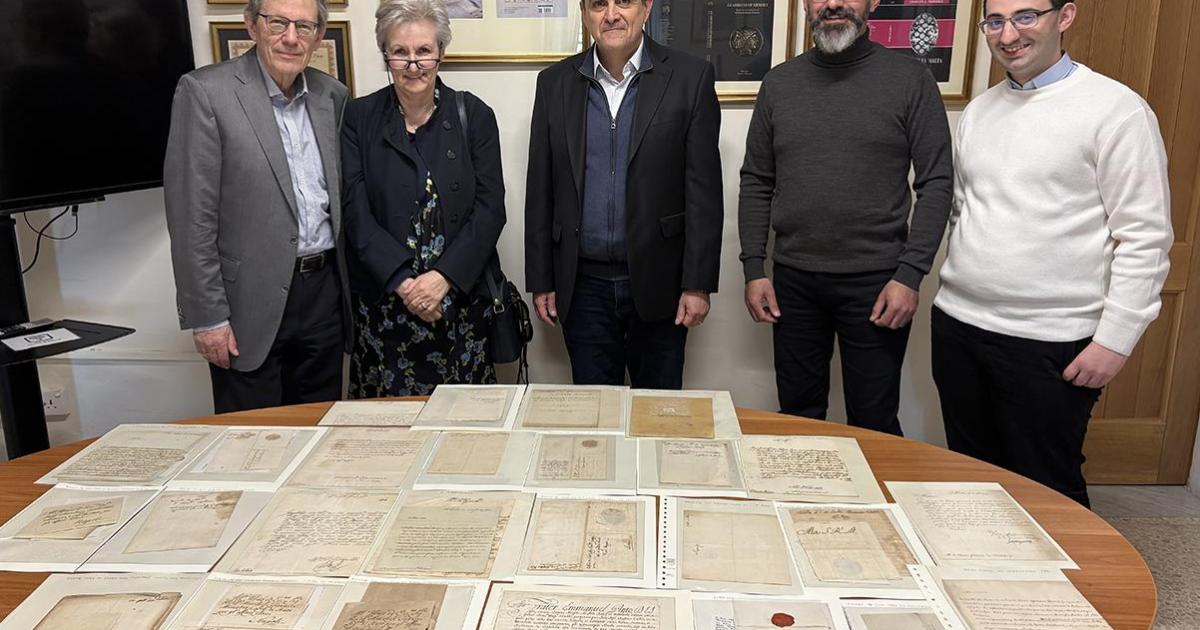
De Rohan’s missive forms part of a 29-document collection connected to the Order of St John donated to the National Archives earlier this year. Between 1989 and 1994, Wolfgang Juncker purchased and acquired these 28 handwritten letters and one printed document.
We can build in our minds a fuller and clearer understanding of the past
This collection then passed onto Christian Launer, who generously deposited it at the National Archives of Malta, ensuring its preservation and accessibility for research purposes.
Except for this one printed document, the remaining 28 are handwritten letters mostly issued by various grand masters of the Order of St John to various powers throughout Europe concerning different issues and in various languages.
These allow modern researchers to not only track the Order’s involvement in various issues but to study the development of diplomatic convention over the two centuries between the collection’s first letter by Grand Master La Cassiere in 1752 and the latest issued by Grand Master Hompesch in October 1797, less than a year before the Order was then expelled from the islands.
A varied collection for a complex Institution
The variety of topics referenced in these letters reflect the chimeric nature of the Order as a religious monastic order with properties throughout Europe, a military crusading force with its own forces and navy and a temporal power with juridical responsibilities.
In correspondence between Cardinal Colloredo and Grand Master Lascaris (08/1637), reference is made to the military assistance offered by the Order to the Republic of Venice, resulting in the capture of the Piazza di Castelnuovo (modern-day Herceg Novi in Montenegro) from the Ottoman Turks.
A century later, it is Grand Master Pinto’s turn to thank Ferdinand VI of Spain for his support in reacting to Mustafà Baxà’s attempt to seize control of the islands, in a clear reference to the failed Slaves Revolt organised that year (12/1749).
Other letters concern the administration of the Order’s many properties which were organised in Commanderies spread throughout Europe and, therefore, within the realms of several independent sovereigns.
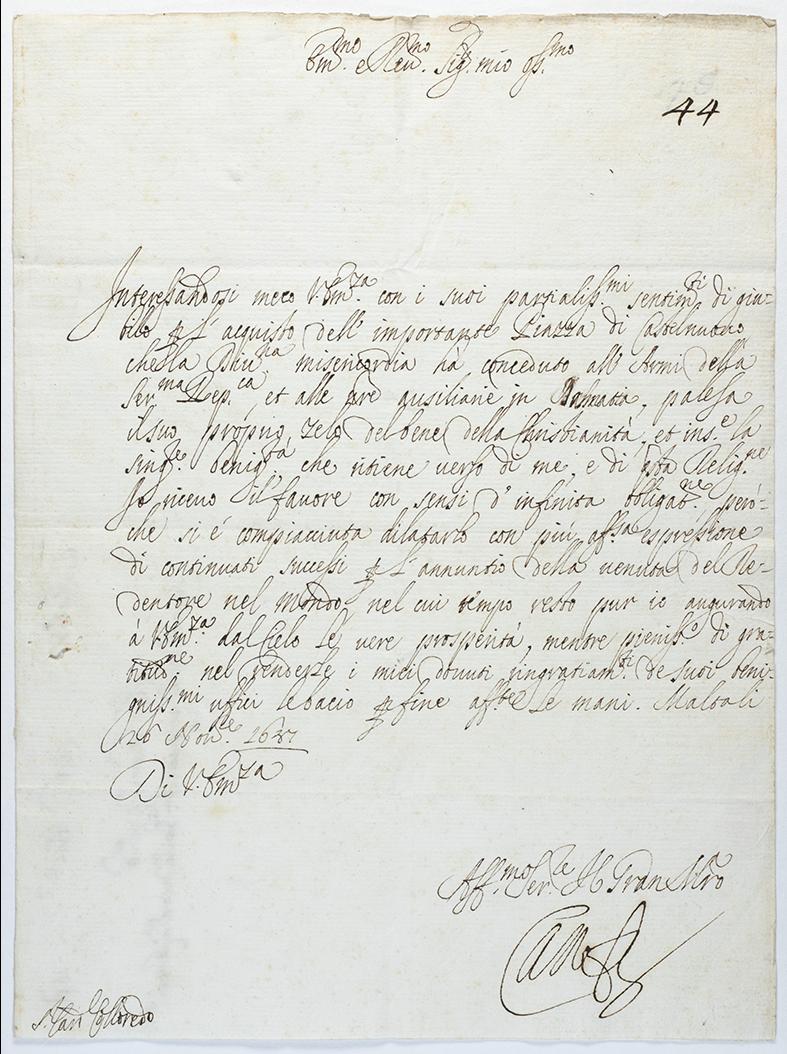 A letter referencing the Order’s involvement in Venice’s capture of the Piazza di Castelnuovo in Dalmatia, dated November 26, 1687.
These issues range from concerns over the imposition of new taxes on the Order’s properties (19A/1780), clarifications of obligations of the Order’s
administrators to the subjects of other powers resident on the Order’s properties (03/1583) and replies to requests for certain properties to be sold and alienated from the Order (04/1587).
The Order’s temporal subjection to the Kingdom of Spain and then Naples as feudal holders of the Maltese islands − but not as a religious order, in which role they answered directly to the pope – can also be gleaned not only in the correspondence accompanying the tribute of Maltese falcons, diplomatically dressed as a mere gift (13/1762; 15/1769; 17/1773) but also in several letters discussing the political intrigues within the royal courts (14/1763; 21/1785).
Diplomatic niceties
A significant share of the collection reflects the diplomatic conventions of the time and situate the Order within the tapestry of powers at play in Europe.
Several are merely expressions of thanks to various political players in Europe for unspecified advocacy (01/1572), recommendations of persons who had rendered valuable service to the Order (24/1792) and the appointment of ambassadors (22/1787).
Although less immediately exciting than letters resounding with the reverb of cannon and musket, these letters are no less valuable and help us to fill in the intricate web of contacts, communication and intrigue creeping over Europe in the early modern period.
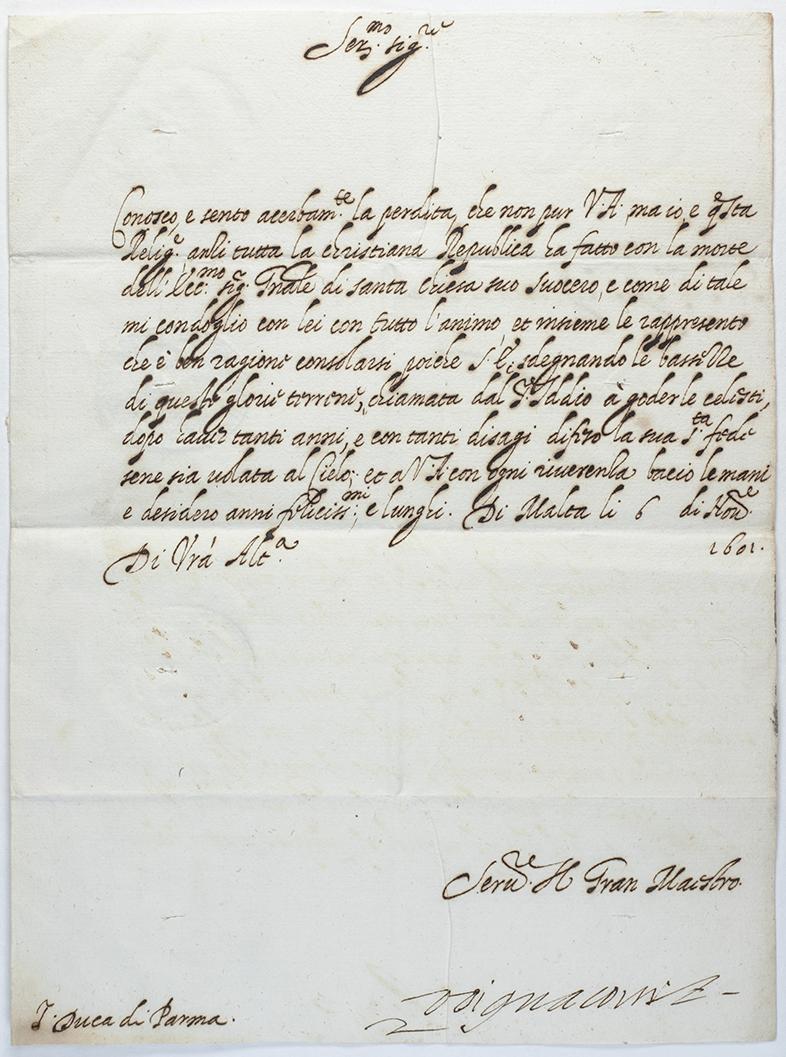 A letter of condolences on the death of Giovanni Francesco Aldobrandini, issued on November 6,1601 and bearing the signature of Grand Master Wignacourt.
The considerable efforts undertaken by various powers to introduce their youngest members into the Order testify to the institution’s enduring reputation and prestige (19B/1598). Meanwhile, Grand Master Wignacourt’s letter of condolences to Ranuccio I, Duke of Parma, following the demise of the latter’s father-in-law, Giovanni Francesco Aldobrandini, shows the Order’s continued involvement in European affairs at state-level.
Aldobrandini had led several daring expeditions against the Ottomans in his role as chief commander of the papal forces (05/1601).
La Machine Electrique
A fascinating letter, in which the Abbot Audin reports on the health of the Grand Prior Toulouse, who had suffered a stroke, mentions the medical treatment that he was undergoing, referring to a certain electrical machine making this 1789 document possibly one of the earliest written mentions of this world-changing 18th-century invention (23B/1789).
Accessible to all
Putting pen to paper, these grand personas in the island’s history come to life in these letters, expressing their aspirations and preoccupations. Reading them, we can build in our minds a fuller and clearer understanding of the past.
Now, thanks to the efforts and generosity of the above-mentioned benefactors, the Christian Launer Collection is available for consultation at the National Archives of Malta where it can benefit all future generations of researchers.
Samuel Azzopardi is a palaeographer within the National Archives of Malta, currently working on cataloguing the archives’ rich legal fonds from the Knights’ period in Malta. His interests range from Latin diplomatics to the transmission and reception of Roman law.