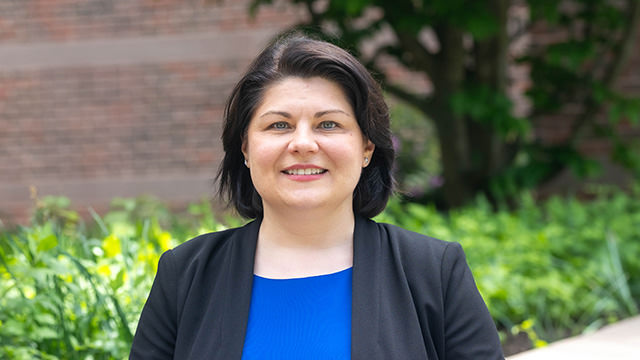
Gavrilița often relies on insights and skills she gained at Harvard Kennedy School. “At HKS, I concentrated on math-based subjects, learning how to do program evaluation, to understand the capital markets—and also negotiations, mobilization, communication, ethics. I use all of this. In fact, the more I advanced in my career, the more I used the less-technical subjects.” HKS case studies and classroom discussions gave her confidence in her decision-making. “I learned strong frameworks that guided me to take decisions not just based on the consequences, but on their moral weight.”
HKS memories rushed back to her in 2009 when she was serving in Moldova’s State Chancellery. Amidst allegations that the governing Party of Communists had committed electoral fraud, a student demonstration ended in tragedy. Says Gavrilița, “I was working for a government that I didn’t support, but I was a public servant. On the 7th of April, a protest turned violent, and a young person was killed by the police. I resigned the very next day.” In this act of civil disobedience, she says her HKS education fortified her. “At that moment, I remembered the case studies and papers about public servants making choices and following their values.”
Even amid turbulence, her government made significant strides against corruption and toward transparency and efficiency. “Reform is very complicated and takes many years. … With Russian interference and the mobilization of those who don’t want the reforms to succeed, it continues to be a fight. But ultimately, the big prize was that we applied for EU candidate status and became a candidate while I was prime minister.”
Gavrilița knows what it’s like to live in a totalitarian society and will do everything she can to sustain democracy. “Ukrainians are sacrificing their lives because they’re choosing between two models—one where an autocratic government can stifle any person, and one where there are systems of checks and balances, freedom, and institutions that can protect the individual.”
The shadow of the Soviet past and autocracy still loom over Moldova. But Gavrilița is hopeful that her country will continue to progress. “I encourage everybody to think about what we can do to make sure that our generation and our children’s generation can live in a free and democratic society.”
—
Portraits by Bethany Versoy