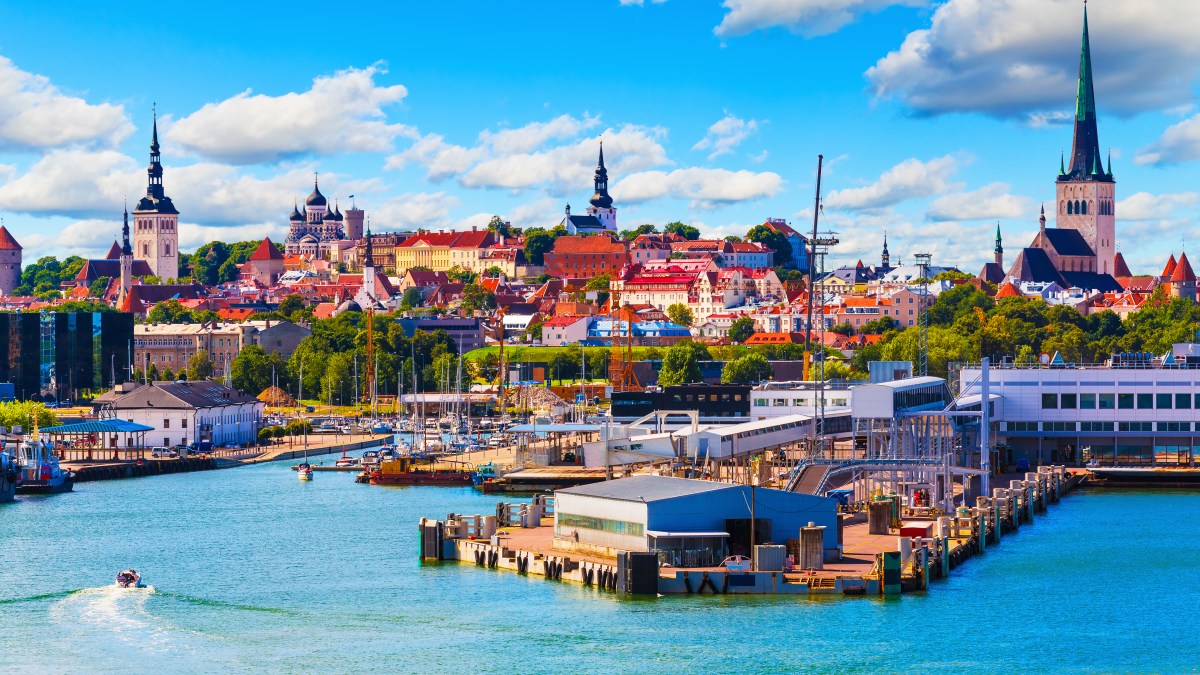
Estonia’s tax system is hailed for its simplicity and low rates. On Monday it was named the top country in the OECD for tax competitiveness for the 12th year running by the Tax Foundation, an international think tank.
In its annual ranking of countries in the group of 38 advanced economies the Tax Foundation credits Estonia’s simple system — including its single income-tax rate — for the nation’s success.
The UK, on the other hand, languishes near the bottom of the rankings in 32nd place, perhaps unsurprisingly — we have one of the most complicated tax systems in the world, with more than 1,000 tax breaks, allowances and reliefs.
While Estonia has a population of 1.37 million compared with our 69.3 million, is there something the UK could learn from this tiny former Soviet republic?
After regaining its independence in 1991, Estonia had to build everything from scratch and made economic growth and attracting investment its priority. One of the key strategies was to have a few simple rules on what people and businesses should be paying in tax, and charging the same rate on income for all became central to its tax system.
Estonia charges a flat 22 per cent tax on income — this includes anything from employment to capital gains, rents and pensions. Someone earning the equivalent of £1 million will pay the same rate of tax as someone earning £20,000. It also has 22 per cent tax rate on corporate income that is applied only to distributed profits.
Estonia gives lower-paid workers a €7,848 a year (about £6,820) tax-free personal allowance, which is reduced once you earn more than €14,400. Anyone whose income exceeds €25,200 has no personal allowance.
So, how does it compare with the UK?
A British couple with a combined income of £140,000 a year, where one earns £110,000 and the other £30,000, would have take-home pay of about £97,500 after paying close to £33,400 in income tax and £4,200 in national insurance for the higher earner, and £3,500 in income tax and £1,400 national insurance for the lower earner.
• The tax traps lying in wait for Britain’s savers
In Estonia a household with the same gross income — roughly €161,000 — would end up with about €124,500 (£108,000) after tax, giving them more than £10,000 extra take-home pay. The Estonian equivalent of national insurance, a social tax that would amount to about €53,000 in this scenario, is paid by the employer on top of a worker’s salary. No deductions are made from their pay.
A survey by the Estonian Tax and Customs Board last year suggested that 65 per cent of respondents did not consider the tax system fair, while 73 per cent said that the system had become more unfair lately.
No stamp duty or inheritance tax
Estonia does not tax property or inheritance, but does have a land tax.
Unlike our stamp duty, which is charged when you buy property, Estonians pay an annual tax on the value of their land, not the buildings or structures built on it — a policy also implemented in Australia. Land owners pay between 0.1 per cent and 2 per cent a year depending on the area and use of the land, with commercial and industrial land levied on the higher band.

After independence from the Soviet Union in 1991, Estonia prioritised growth and investment
ALAMY
This means that if you had residential land in Tallinn with a taxable value of €50,000 and the municipal rate was 0.5 per cent, your annual land tax would be €250. The calculation remains the same whether you own an empty plot or a plot with a €2 million house — only the land value matters for tax purposes.
In Britain, 12 per cent of tax revenues come from property; in Estonia it’s 0.6 per cent.
In the UK, a single person can inherit an estate worth up to £500,000 tax-free, with any value above that usually taxed at 40 per cent. In Estonia, there is no inheritance tax.
Martin Lehtis, the head of tax services at the consultancy firm PwC Estonia, said: “If you inherit something that has already been taxed, [something] that someone has already paid tax on when they bought it, the person you’re giving it to won’t have to pay any tax.”
• Sweden is cutting taxes — why aren’t we?
Estonians also do not pay tax on dividends because companies there are subject to a 22 per cent tax on distributed profits. This means that tax residents typically do not pay personal income tax on dividends from an Estonian company, because the levy has already been paid at the corporate level. Dividends paid by a foreign company, however, are taxed at the regular personal income rate of 22 per cent.
In the UK there is a £500 dividend allowance but above that, a basic-rate taxpayer would pay 8.75 per cent on dividend income, a higher-rate taxpayer 33.75 per cent, and an additional-rate taxpayer 39.35 per cent. The overall OECD average tax rate on dividends is 24.7 per cent.
Higher VAT
To fund its public services Estonia relies on value added tax (VAT) and the social tax that is similar to national insurance. Some 39 per cent of its tax revenues come from VAT compared with 31 per cent in the UK.
The Baltic country put its VAT rate up in July from 22 per cent to 24 per cent until January 2029 to bolster defence spending (Estonia borders Russia). The VAT rate in the UK is 20 per cent.
Hotel services in Estonia have a VAT rate of 13 per cent, while on books and pharmaceuticals it is 9 per cent. Some services, such as healthcare, education and insurance, are exempt. In the UK most food, newspapers and books, children’s clothing and prescription medicines have a VAT rate of 0 per cent. Charity donations, health services, insurance and other financial services are also exempt.
Social security contributions, which raise 37 per cent of Estonia’s tax revenues, are relatively simple. Employers pay a 33 per cent social tax, 20 per cent of which finances public pension insurance and 13 per cent public health insurance. Employees do not make separate social security payments.
In the UK employers and employees make national insurance contributions based on weekly or monthly earnings. Employees pay nothing on the first £242 earned each week, 8 per cent (£58) on the next £725, and 2 per cent on anything above £967.
What can we learn from Estonia?
Estonia’s system works not because it is low tax, but because it is simple and transparent. Adopting some of its basic principles could help to untangle and modernise Britain’s notoriously complex tax code.
One clear example is property taxation. Stamp duty is often described as one of the most hated taxes. The Conservative Party leader, Kemi Badenoch, has pledged to abolish it on the purchase of main homes if she wins the next election. But stamp duty on house sales is a big money-maker for the Treasury, raising £13.9 billion in the 2024-25 tax year, so abolition is unlikely. By the 2029-30 tax year, it is expected to raise £26.5 billion, according to the Office for Budget Responsibility.
The UK could learn from international best practice by replacing stamp duty and council tax, which is based on outdated valuations, with a single proportional property-value tax paid each year. According to experts, such reform would make the system more efficient and could boost economic growth.
• We all hate stamp duty. What’s the alternative?
Alex Mengden, a policy analyst at the Tax Foundation, said stamp duty does lots of economic damage. “It stops transactions. People are less likely to move for a better job and it also increases the cost of building.”
A flat rate of income tax would also simplify the system, but Chris Etherington from the tax firm RSM UK said it could be viewed as unfair. “If we were to have a flat rate of tax similar to Estonia then it obviously would be advantageous to higher earners, but lower earners might feel hard done by because they’re paying proportionately the same amount of tax as somebody who’s earning millions.”
He said there are ways to simplify tax on income and that the present combination of income tax, national insurance and, for many graduates, student loan repayments is unnecessarily complicated.
He said: “National insurance effectively represents another layer of income tax in all but name. We have multiple layers of tax applying to a shrinking workforce. It brings extra complexity and makes it harder for taxpayers to understand what tax they are paying on their earnings.”
He also criticised the cliff edges in the tax system. “For some, it could mean they would be better off financially in the short-term by turning down a promotion and pay rise. The £100,000 threshold can be particularly punitive as it can lead to the loss of valuable childcare benefits, as well as to an effective income-tax rate of 60 per cent.”