Nuclear Medicine Market Size
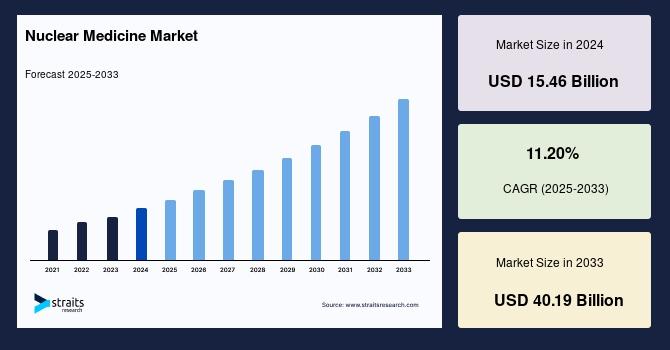
According to a new report published by Straits Research, the global nuclear medicine market was valued at USD 15.46 billion in 2024 and is projected to increase from USD 17.19 billion in 2025 to USD 40.19 billion by 2033, expanding at a CAGR of 11.20% during the forecast period (2025-2033). The market growth is primarily driven by the rising incidence of chronic diseases, technological advancements in nuclear imaging, and increasing R&D investments in radiopharmaceuticals.
Download Exclusive Research Report PDF Sample: (Including Full TOC, List of Tables & Figures, Chart) : https://straitsresearch.com/report/nuclear-medicine-market/request-sample
Rising Prevalence of Chronic Diseases Driving Market Expansion
The growing global burden of chronic diseases, including cardiovascular disorders, cancer, respiratory diseases, neurological disorders, and metabolic syndromes, is fueling the demand for nuclear medicine. According to the Lymphoma Research Foundation, over 100,000 individuals are diagnosed with lymphoma each year in the U.S. alone. Additionally, cardiovascular diseases continue to be one of the leading causes of mortality worldwide, with approximately 18 million deaths in 2018. Nuclear medicines such as Technetium-99m are extensively used for diagnostic imaging in cardiology and oncology, while Iodine-131 and Strontium-89 are widely utilized in therapeutic treatments for thyroid cancer and bone metastasis.
Efforts to Bridge the Demand-Supply Gap of Radiopharmaceuticals
One of the key challenges facing the nuclear medicine market is the short half-life of radioisotopes, which makes storage and transportation difficult. For instance, Technetium-99m has a half-life of less than 12 hours, while Fluorine-18, used in PET scans, has a half-life of just 109 minutes. To address this, leading market players are strengthening their supply chain and distribution networks. Companies such as Jubilant Pharma, Curium Pharma, and Lantheus Medical Imaging have formed strategic partnerships and collaborations to ensure the steady supply of radioisotopes. Government initiatives, such as the American Medical Isotopes Production Act of 2011 and support from the U.S. Nuclear Regulatory Commission, are further helping bridge the demand-supply gap in nuclear medicine.
For more insights and detailed analysis on the Market, visit : https://straitsresearch.com/report/nuclear-medicine-market
Technological Advancements Creating New Growth Opportunities
Rapid innovation in nuclear imaging technologies, including PET (Positron Emission Tomography), SPECT (Single Photon Emission Computed Tomography), CT, and MRI, is contributing significantly to market growth. The use of Gallium-67 in SPECT has improved sensitivity rates in lymphoma detection from 48% to 89%. Similarly, the introduction of cadmium zinc telluride detectors in SPECT systems has enhanced image resolution and reduced isotope usage in coronary artery disease detection. These advancements are offering healthcare providers more precise diagnostic capabilities and promoting the adoption of nuclear medicine globally.
Strong Pipeline and Product Launches Bolstering Market Growth
Leading companies are investing heavily in R&D and new product development to meet the rising demand for targeted therapies and advanced diagnostic solutions. In January 2018, Advanced Accelerator Applications introduced Lutathera®, the first FDA-approved peptide receptor nuclear medicine therapy for gastroenteropancreatic neuroendocrine tumors. Similarly, Norgine B.V. launched Lymphoseek, a next-generation targeted radiopharmaceutical designed for oncological applications such as breast cancer and squamous cell carcinoma. The continuous launch of innovative products and a robust development pipeline are expected to significantly contribute to market expansion through 2033.
Download Exclusive Research Report PDF Sample: (Including Full TOC, List of Tables & Figures, Chart) : https://straitsresearch.com/report/nuclear-medicine-market/request-sample
Regional Insights: North America Dominates the Global Market
North America holds the largest share in the global nuclear medicine market, supported by a high prevalence of cardiovascular and cancer patients, strong domestic radiopharmaceutical manufacturing capabilities, and favorable regulatory frameworks. According to the U.S. Department of Energy, nearly 80% of nuclear diagnostic imaging procedures in the U.S. use Technetium-99m (Tc-99m). The introduction of the Medicare Diagnostic Radiopharmaceutical Payment Equity Act of 2019 has also enhanced access to advanced nuclear medicine diagnostics.
Europe is emerging as a rapidly growing region, supported by increased government funding, clinical trials, and product approvals for key isotopes such as Tc-99m, F-18, and Ra-223. Countries like Germany, the U.K., and France are leading the adoption of nuclear therapies for oncology and endocrine disorders.
In the Asia-Pacific (APAC) region, growth is driven by rising cancer prevalence, increasing healthcare investments, and greater awareness of nuclear medicine benefits. Countries such as China, India, and Japan are witnessing a surge in PET and SPECT scan utilization.
South America and the Middle East & Africa are also experiencing steady growth, led by improving healthcare infrastructure and government support for radiopharmaceutical development.
Market Segmentation Overview
The nuclear medicine market is segmented by type, application, end-user, modality, and region.
♦ By Type: Diagnostic Nuclear Medicine (SPECT and PET) and Therapeutic Nuclear Medicine (Alpha, Beta, and Brachytherapy Isotopes).
♦ By Application: Diagnostic (Cardiology, Oncology, Neurology, Thyroid, and Pulmonary) and Therapeutic (Thyroid, Bone Metastasis, Lymphoma, Endocrine Tumors).
♦ By End-User: Hospitals, Imaging Centers, Academic & Research Institutes, and Others.
♦ By Modality: SPECT, PET, Alpha-Emitters, Beta-Emitters, and Brachytherapy.
For more insights and detailed analysis on the Market, visit : https://straitsresearch.com/report/nuclear-medicine-market
Key Players in the Global Nuclear Medicine Market
Eckert & Ziegler Group
GE Healthcare
Bracco Imaging S.p.A
Bayer AG
Eczacıbaşı-Monrol Nuclear Products
Mallinckrodt plc
North Star Medical Radioisotopes
Sinotau Pharmaceuticals
SHINE Medical Technologies
Global Medical Solutions
Ltd.
Browse More Insights & Reports :
Radiopharmaceutical Market : https://straitsresearch.com/report/radiopharmaceutical-market
Radiation Dose Management Market : https://straitsresearch.com/report/radiation-dose-management-market
North America Clinical Trial Imaging Market : https://straitsresearch.com/report/north-america-clinical-trial-imaging-market
Medical Radiation Detection Market : https://straitsresearch.com/report/medical-radiation-detection-market
Europe Clinical Trial Imaging Market : https://straitsresearch.com/report/europe-clinical-trial-imaging-market
About Us
For over a decade, Straits Research has been a trusted partner to more than 2,000 small and large enterprises, empowering senior leaders and decision-makers with actionable intelligence to navigate complex markets. Our structured syndicate reports, published year-round, cover critical sectors such as chemicals, materials, food and beverage, healthcare, pharmaceuticals, automotive, technology, aerospace, and defense. Combined with our custom research tailored to client-specific needs, we deliver insights that drive business progress and informed decision-making.
Contact Us
Office 515 A, Amanora Chambers,
Amanora Park Town, Hadapsar,
Pune 411028, Maharashtra, India.
+1 646 905 0080 (U.S.)
+91 8087085354 (India)
+44 203 695 0070 (U.K.)
sales@straitsresearch.com
This release was published on openPR.