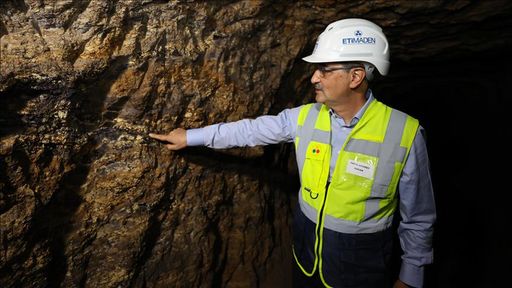
The discovery of vast reserves of rare earth elements (REE) in central Türkiye could position the country as a key player in the global supply chains for clean energy and defence sectors.
The Beylikova site in Eskisehir is estimated to hold 694 million tonnes of deposits, which places the country in the second position globally in REE reserves after China.
REEs are obscure-sounding, yet highly valuable, 17 metals that have become the invisible engines of modern life – from mobile phones, electric vehicles and wind turbine generators to high-tech weaponry like precision-guided missiles.
According to President Recep Tayyip Erdogan, Türkiye is in talks with international companies for possible collaboration to develop the REE sector.
“We aim to become one of the world’s top-five REE producers,” Erdogan said earlier this month.
Türkiye’s find coincides with a growing US-China trade war over REEs. Beijing has restricted exports to Washington, a move that has dealt a major blow to the US, whose auto, phone and weapons manufacturing industries are heavily dependent on Chinese supplies.
“Power in this century will not depend on the size of (REE) reserves alone, but on the ability to refine, process, and apply them across industries,” Mustafa Kumral, dean of the Faculty of Mining at Istanbul Technical University, tells TRT World.
Rare earth elements have gained centrality in global supply chains as they power permanent magnets – metals that generate a magnetic field without electricity.
Permanent magnets make electric motors lighter, turbines more efficient, and precision weapons more accurate.
The magnet suite – which consists of elements like neodymium, praseodymium, dysprosium, and terbium – represents more than 90 percent of global REE trade value, while accounting for only a small portion of the total volume, Kumral says.
Control over these “magnet metals” translates into global economic clout, technological edge, and geopolitical sway, he says.
The discovery of REE reserves comes at a pivotal moment. The critical minerals market is projected to grow from $325 billion last year to $770 billion by 2040.
Countries are racing to diversify away from China’s near-monopoly in this sector, as the Asian giant currently processes about 90 percent of the world’s supply.
For Türkiye, the discovery provides a chance to leapfrog from being a non-player in the REE segment to a high-value innovator, reshaping its role in the multipolar resource race.

Related
Sait Uysal, a mining industry veteran and founder of the Critical Minerals Initiative, calls the REE reserves a “phenomenal gift” but warns that monetising them demands navigating a treacherous value chain.
He tells TRT World that the upstream phase – mining ore and producing basic concentrate – is the “most straightforward” for Türkiye, thanks to its mature mining sector.
The government is already setting up a pilot processing plant to kickstart extraction.
But the midstream hurdle looms largest, he says.
That phase will involve refining the concentrate into high-purity individual elements.
This “extremely complex and capital-intensive process” has long been China’s domain, Uysal says, requiring over a decade of dedicated research and development, hundreds of specialised researchers, and hundreds of millions of dollars in investment.
Türkiye’s plan, he says, should be based on strategic partnership or technology transfer agreements with companies that already possess the critical refining know-how.
Only then can the country advance to downstream manufacturing of magnets for EVs and turbines, leveraging its robust automotive base, he says.
“Fully monetising it hinges on Türkiye’s ability to strategically navigate the immense technical and financial barrier of midstream refining,” Uysal says, adding that international collaboration will be key to unlocking the true value of its REE reserves.
Salih Cihangir, associate professor at Munzur University’s Rare Earth Elements Application and Research Centre in Tunceli, tells TRT World that Türkiye has already progressed beyond basic leaching, which is the chemical process to extract valuable minerals from ore.
The country has achieved “laboratory and, to a lesser extent, pilot scale” production of commercially purified fractions of some elements, he says.
But scaling up from this stage to become a high-value producer of rare earth compounds or REE-containing finished products means achieving a number of milestones, Cihangir says.
These milestones include bulk separation into individual REE oxides, alloy production, downstream manufacturing to utilise high-value REE compounds, and rigorous environmental, health, and safety (EHS) protocols.
“Addressing (EHS protocols) proactively is critical to avoiding delays and ensuring robust time and risk management across the entire value chain,” Cihangir says.