Facebook
Twitter
LinkedIn
Pinterest
Reddit
Email
Print
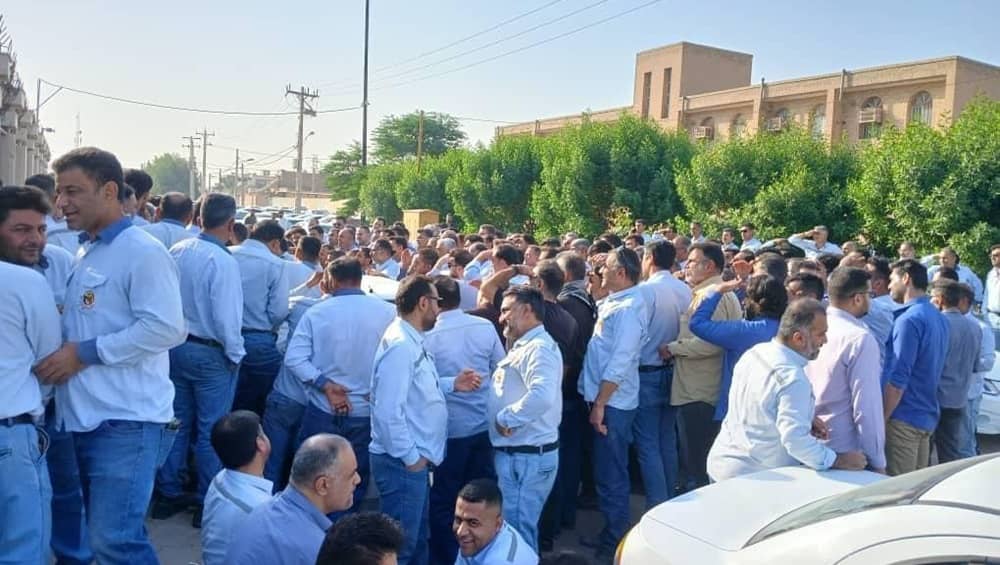 Protest rally by electricity workers in Ahvaz (October 25, 2025)
On October 25, 2025, a firestorm of protests swept across Iran, revealing the explosive state of a society pushed to its limits. The sheer breadth of the demonstrations—spanning essential public services, critical industries, agriculture, and even the digital economy—paints a damning portrait of a ruling theocracy that has failed its people on every front. These are not isolated grievances but interconnected symptoms of a system rotting from within.
The Cry of Essential Workers: “Our Tables Are Empty!”
Those who form the backbone of society are now leading the charge against the regime’s failures. In the city of Fasa, emergency medical personnel, the very people who save lives daily, gathered to protest their meager and delayed wages. Their chants cut directly to the heart of the crisis: “Our tables are empty! Incompetent official, resign!” This cry is more than a demand for pay; it is a political verdict on an illegitimate system.
October 25—Fasa, southern Iran
Emergency medical staff rallied to protest poverty wages and unbearable living conditions, denouncing government incompetence.
They chanted: “Incompetent officials, resign, resign!” and “Enough with promises—our tables are empty!”#IranProtests pic.twitter.com/E4Cx1yQTKN
— People’s Mojahedin Organization of Iran (PMOI/MEK) (@Mojahedineng) October 25, 2025
Meanwhile, in Mashhad, bakers held a rally outside the provincial governor’s office after working for 100 days without receiving their government-promised subsidies. On a banner, they directly addressed the public and exposed the regime’s deceit: “People who watch one-sided reports on TV about bakers’ violations, be aware that the government told us not to collect 40% of the price of bread and promised to pay it, but since late June, they have not paid a single toman.”
Their protest, they insisted, was not to raise the price of bread but to demand their legal share, warning that the people’s most basic food source is now at risk due to government malfeasance. In Ahvaz, workers from the electricity distribution company also walked off the job, protesting wages that have been rendered worthless by hyperinflation.
October 25—Mashhad, northeast Iran
Bakery workers rallied outside the governor’s office, protesting 100 days of unpaid wages and government neglect.
They chanted, “Fellow citizens, support us!”#IranProtests pic.twitter.com/J96vQiBSBH
— People’s Mojahedin Organization of Iran (PMOI/MEK) (@Mojahedineng) October 25, 2025
Corruption Paralyzes Iran’s Economic Engine
Iran’s key industries are being systematically dismantled by graft. At the Haft Tappeh Sugarcane complex, workers entered the fourth day of their strike, protesting a blatant case of corruption. For each worker’s meal, the company pays a contractor 450,000 tomans, yet the food provided is worth a mere 60,000 tomans. This is not mismanagement; it is organized theft.
This pattern of cronyism was also the focus of protests at the Ilam Petrochemical plant. Workers walked out in fury after discovering that “Kahroba Tavan,” a contractor notorious for failing to pay their past wages, had inexplicably won the new maintenance contract. “How can a company that didn’t pay our salaries win the bid again? This is obvious corruption!” one worker exclaimed. A similar scene unfolded at the Goharzamin mining company in Sirjan, where workers went on strike over unpaid bonuses and hazardous working conditions, decrying management’s “hollow promises.”
October 25—Shush, southwest Iran
Workers of the Haft Tappeh Sugarcane Company continued their strike for 14th consecutive day, protesting massive corruption and embezzlement of funds meant for workers’ meals.
“They take 450,000 tomans, give us only 60,000!” workers said.… pic.twitter.com/i7JT6ICuyW
— People’s Mojahedin Organization of Iran (PMOI/MEK) (@Mojahedineng) October 25, 2025
The Betrayal of Producers and the Middle Class
The regime’s failures have now expanded far beyond the industrial sector, pushing producers and the middle class to the streets. In Khorasan Razavi province, poultry farmers gathered in protest after being forced to cull their own chickens. They had paid the government for animal feed that was never delivered, leaving their warehouses empty and their livelihoods destroyed.
The crisis of accountability has also hit consumers. In Tehran, buyers of multiple car brands announced a protest, citing systemic defects in their vehicles and a complete refusal by the companies to address their complaints. In a telling sign of the times, even those who sought refuge in the digital economy have been victimized. Angry users of the Excoino crypto exchange, a platform that advertised with an official government license, rallied outside its headquarters after being blocked from withdrawing their own assets since July. “We trusted a platform with an official license, and now they won’t give us our money or a straight answer!” one protester said.
October 25—Mashhad, northeast Iran
Poultry farmers of Khorasan Razavi protested the lack of animal feed and feed supply corruption. Many were forced to destroy part of their flocks.
They said: “They took our money but delivered nothing—warehouses are empty, no one is… pic.twitter.com/Exfxi2WluS
— People’s Mojahedin Organization of Iran (PMOI/MEK) (@Mojahedineng) October 25, 2025
Students Reject Indignity
Iran’s youth are also refusing to remain silent. In a powerful act of defiance, students at the Iranshahr University of Medical Sciences dumped their inedible cafeteria food into trash bins. Their protest targeted not only the contaminated meals that have caused poisonings but also the oppressive and inhumane conditions in their dormitories, including the recent installation of surveillance cameras in hallways. Their action symbolizes a generation’s rejection of a system that offers them no dignity and no future.
The events of October 25 are not a series of isolated economic complaints; they are a national indictment of a corrupt and illegitimate regime. When doctors, bakers, miners, farmers, students, and investors simultaneously take to the streets with demands that are fundamentally political, it signifies a profound societal rupture. The regime has no social base left to rely on. Its foundational pillars of corruption, repression, and incompetence have alienated every segment of the Iranian population.