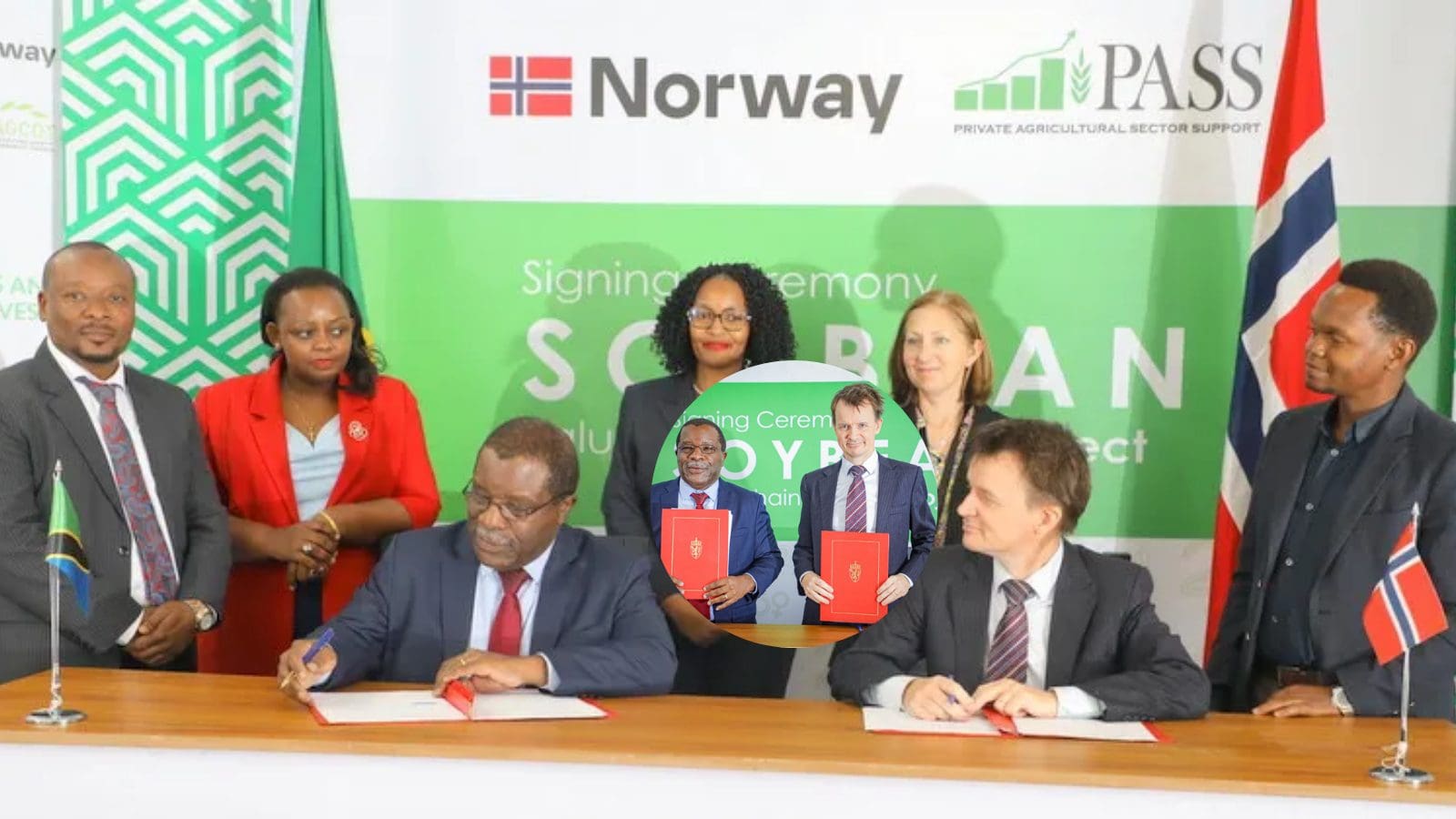
TANZANIA – In a landmark move to boost Tanzania’s agricultural economy, the Royal Norwegian Embassy and the Private Agricultural Sector Support (PASS) Trust have signed a US$4.8 million agreement called the Soybean Value Chain Support Project, aimed at revolutionizing the country’s soybean industry.
The three-year initiative, launched in October 2025, is set to benefit over 21,000 smallholder farmers and position Tanzania as a regional hub for soybean production.
The partnership combines a US$2.4 million grant from Norway with a matching guarantee from PASS Trust, creating a commodity compact financing model that will unlock access to commercial credit for farmers traditionally excluded from formal lending systems.
This financial structure is designed to mitigate risk for lenders while empowering farmers to invest in improved inputs, machinery, and agronomic practices.
The project’s primary goal is to quadruple soybean yields and increase farmer incomes by up to 40%.
By enhancing productivity and competitiveness across the soybean value chain, the initiative aims to reduce Tanzania’s dependence on soybean imports and strengthen domestic supply for food and feed industries.
Key components of the program include technical training for farmers on climate-smart and high-yield practices, Expansion of aggregation centers to streamline post-harvest handling, Support for market linkages and contract farming arrangements, and Facilitation of access to certified seeds and mechanization tools.
Speaking at the signing ceremony in Dar es Salaam, representatives from both Norway and PASS Trust emphasized the transformative potential of the partnership.
Development partners, financial institutions, and agricultural leaders hailed the initiative as a model for inclusive growth and sustainable development.
PASS Trust’s managing director, Yohane Kaduma, described the agreement as a milestone that reflects a shared commitment between Norway and Tanzania toward climate-resilient and market-driven agricultural growth.
Kjetil Schie, Head of Cooperation at the Royal Norwegian Embassy, drew parallels between Norway’s experience using soybeans in sustainable aquaculture and Tanzania’s opportunity to boost livestock, poultry, and fish farming through soybeans.
This partnership goes beyond funding; it envisions a systems-level approach integrating finance, technology, and market linkages to build a sustainable value chain.
Geoffrey Kirenga, CEO of Tanzania’s Agricultural Growth Corridors (AGCOT), noted that existing investments in Tanzanian soybean farming amount to about US$30 million, and this partnership is expected to catalyze tenfold growth to US$300 million within five years.
This initiative is expected to significantly reduce post-harvest losses and expand local processing capacities by 2028, amplifying economic and social benefits for rural communities.
By linking smallholder farmers into structured value chains through innovative commodity compact financing, Tanzania aims to become a regional soybean hub.
The cooperation exemplifies how international partnerships can accelerate agricultural transformation and promote sustainable development with a focus on empowering vulnerable groups and climate-smart agriculture.
Sign up to HERE receive our email newsletters with the latest news and insights from Africa and around the world, and follow us on our WhatsApp channel for updates.