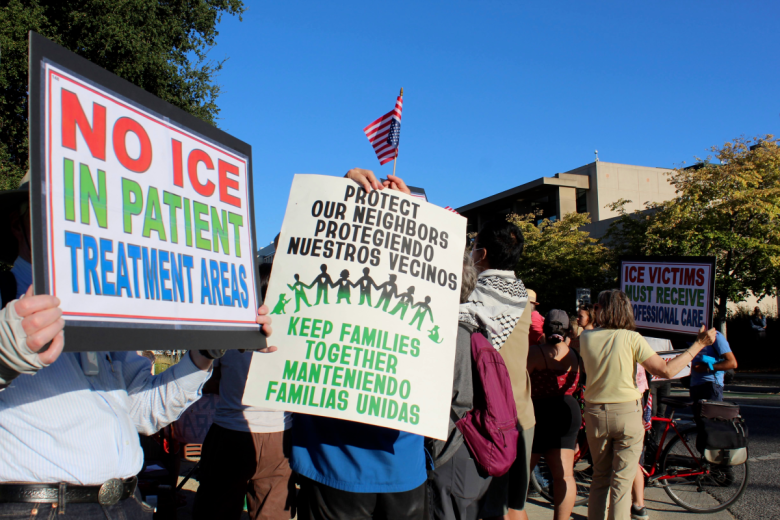
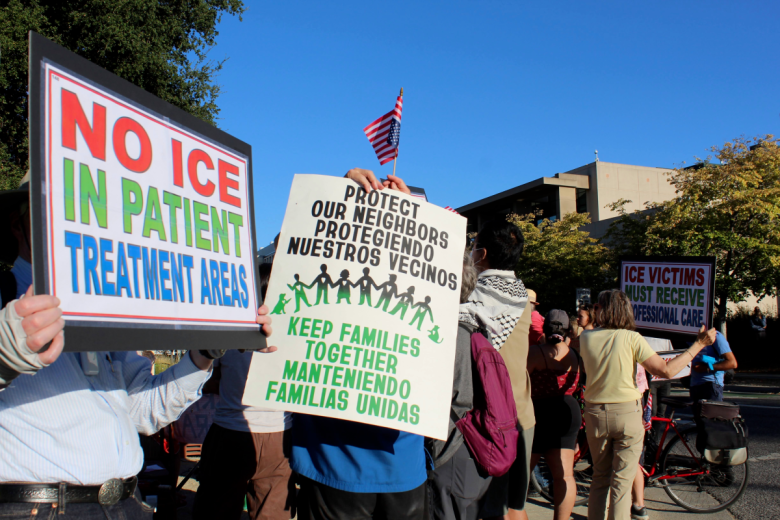
 Stanford medical staff and community members protest on Sept. 2 after a woman arrested by ICE was sent to Stanford Hospital for medical treatment. Photo by Lisa Moreno.
As local leaders prepare for a possible increase in immigration enforcement, legal experts are advising residents to know their rights, remain cautious and document interactions with federal agents and Immigration and Customs Enforcement.
President Donald Trump announced last week that a “surge” of federal agents would enter San Francisco. They arrived at an Alameda Coast Guard base on Oct. 23, where a local pastor was shot in the face with a pepper ball, just hours before Trump called off their deployment.
Despite his wavering commands, San Mateo and Santa Clara county leaders emphasized that they would not welcome increased immigration enforcement.
While the future remains unclear when it comes to the presence of federal agents – local advocates and legal experts have long prepared for the possibility. Since Trump took office in January, they have hosted multiple events throughout the region, advising people to learn their rights.
“One of the things that we and others have really tried to convey is that folks should try to stay calm, to not panic and to be prepared for whatever may happen,” Immigrant Resource Center Legal Program Director Alison Kamhi said in an interview with this publication.
How to interact with ICE
Executive director of the Immigrant Resource Center Eric Cohen recommended that people lean on their Fifth Amendment rights – remain silent and refuse to sign documents – if immigration officers show up at their homes, he said at a January Know your Rights event.
While federal agents may attempt to intimidate people, they should remember the following nine steps if ICE is at their residence, Cohen said.
1. Remain silent
Cohen urged people to exercise their right to remain silent, no matter what questions an agent is asking. If someone tells an agent they are from Mexico or don’t have documentation with them, it may be enough evidence to deport someone, he said.
“If you don’t say anything, what kind of evidence do they have? Nothing,” Cohen said.
2. Don’t open door, check warrants
“You have the right not to let anyone into your house unless they have a warrant, an arrest warrant or a search warrant,” Cohen said at the event.
Agents could identify themselves as immigration police, ICE or federal police and often attempt to enter someone’s home by showing “fake” or “clay” warrants, he said. Unless a warrant is signed by a judge, which is extremely rare and should be physically verified, a person should not open their door. If the warrant is valid, the person should exit their home and close the door behind them.
If someone wants to hand a note to an officer, or read a document, they should slip them under the door, or show them through the window, he said.
3. Contact an attorney
“Before you make any decisions, if you’re picked up, you want to talk to an attorney, because that attorney might help you figure out whether there’s some defenses,” Cohen said.
While everyone has the right to legal defense, people are not appointed a free attorney in immigration court, he said. If arrested, people should refrain from offering any information to federal agents without a lawyer.
People can call various Bay Area nonprofits like the Immigration Legal Resource Center, International Institute of the Bay Area or any rapid response hotline for help finding representation.
4. Don’t sign anything
Upon an arrest, federal agents often urge people to sign a voluntary departure, Cohen said, which allows the government to deport someone without an immigration court hearing.
Everyone has the right to refuse signing documents.
“They’re going to try to cajole you, try to convince you, try to threaten you to sign them, because it’s easier for them,” he said. “It’s less costly for them. It helps their numbers”
5. Show red card
Red cards list the rights of any person not to speak to federal officials or sign any documents under their Fifth Amendment rights, as well as their right to deny agents entrance to their homes without a warrant signed by a judge.
Flashing a card through their window is a safer way for people to communicate with agents that they do not wish to further interact with, Cohen said.
Red cards are available for print and distribution via the Immigration Legal Resource Center website.
6. Don’t show false documents
Federal agents are good at sniffing out fraud, Cohen said, and showing fake documents like green cards can signal that person is not a resident.
7. Don’t run, remain calm
While confrontation with law enforcement can be stressful, Cohen advised people to try their best to remain calm and avoid running from officers who are often posted around the perimeter of a residence or workplace.
“Running can be proof that you might not be here legally, because who else would run?” he said.
8. Make a family plan
Anyone who might be at risk of arrest should plan care for their children, coordinate with someone to oversee their finances and manage any other responsibilities, Cohen said.
Children can only be released to emergency contacts, so their information should always be up to date, according to San Mateo County officials.
9. It’s your decision
While each person, documented or undocumented, has constitutional rights to remain silent, refrain from signing documents or opening their doors, Cohen said, at the end of the day, it’s each person’s decision whether or not they want to sign a departure form.
ICE has also been known to target people at workplaces, but businesses also have distinct laws to protect its employees.
There are private and public areas within most workplaces, and federal agents cannot enter a private zone without permission or a judicial warrant. Public areas typically include dining rooms, lobbies and parking lots, and private areas include kitchens, offices and storage rooms, according to the California Collaborative for Immigrant Justice.
 Alison Kamhi, legal program director for the Immigration Legal Resource Center, is now running for a seat on the Palo Alto Board of Education. Courtesy of Alison Kamhi
Employers do not have to identify their workers or disclose whether or not they’re working at the time. If agents do enter, workers do not have to identify themselves or hand over documents.
“Have your red card in your pocket,” Cohen said. “You show it, you don’t say anything.”
The protocol to safe interactions with immigration officers during a traffic stop are more tricky, because people don’t have the same rights that they do in their house. For example, if an officer has reasonable suspicion for pulling someone over, they are able to request to see their identification.
Legal experts advise people not to run or escalate the situation and remain calm in any case, Kamhi said.
While on the street or in public settings, agents may ask someone for their name or to verify their identity among other questions, she said.
“But you can ask agents to identify themselves and what agency they represent,” Kamhi said. “You can ask if you’re free to go, and if so, you can walk away without saying anything else. If they say, ‘No, you’re not free to go,’ then you have the right to remain silent, and silence is golden.”
While protesting or witnessing events where federal agents are present, Kamhi said, it’s important people do what makes them feel safe and properly document the situation.
How to report ICE
Lawyers and advocates advised people to confirm ICE sightings with experts like rapid response networks before posting to social media in order to prevent spreading unnecessary fear among immigrant communities.
A rapid response network or hotline is typically composed of a group of local volunteers, lawyers and community leaders, who quickly work to verify ICE sightings and activate legal support when someone is arrested. They can also help people locate their family members.
There are various hotlines in the region:
San Mateo County rapid response hotline: (203) 666-4472
Santa Clara County rapid response hotline: (408) 290-1144
San Francisco rapid response hotline: (415) 200-1548
Civilians often mistake undercover police or SWAT activity with immigration enforcement, which causes “terror” and affects the health of immigrant communities, San Mateo County Rapid Response Network representative Nani Friedman said in a previous interview.
“It affects their economic life, whether they’re able to go to work,” Friedman said. “It affects their ability to pay bills. It affects their physical health and their mental health.”
The administration relies on this hysteria to encourage people to voluntarily leave the country, Kamhi said in a previous workshop.
“They will be banking on the fear and confusion that that causes,” she said.
In cases people do believe they are encountering federal agents, experts advise them to remain silent and take videos for documentation purposes.
But even if residents can confirm an ICE sighting with rapid response, they should avoid posting videos of arrests without speaking to legal experts or the person in the video as it could negatively harm legal cases and cause more trauma for the person arrested, Friedman said.
People can also create “phone-trees,” where they set up a chain of calls among families and neighborhoods in order to spread the word about confirmed immigration enforcement sightings, Cohen said.
How to prepare for ICE
There are steps people can take to feel safer under a looming threat of increased immigration enforcement, including creating a phone-tree and a family plan, printing red cards and even clearing past legal offenses from their record.
Record expungement cannot directly prevent deportation, but may display good conduct in immigration cases, according to legal experts. San Mateo and Santa Clara counties both offer free record expungement through their public defender programs.
People can call 408-535-4290 to make an appointment to discuss expungement with Santa Clara County legal officials and call 650-298-4000 to connect with San Mateo County representatives.
While there has been an influx of expungement requests under the current administration, San Mateo County prioritizes people in immediate danger of deportation, managing attorney for the county’s private defender program Mitri Hanania said at a July immigration training event.
“Everybody has constitutional rights, and it doesn’t feel very powerful, because a lot of people’s constitutional rights are being violated, but thankfully, people are trying to defend those rights,” East Palo Alto Legal Services Executive Director Katrina Logan said at the event.
Most Popular