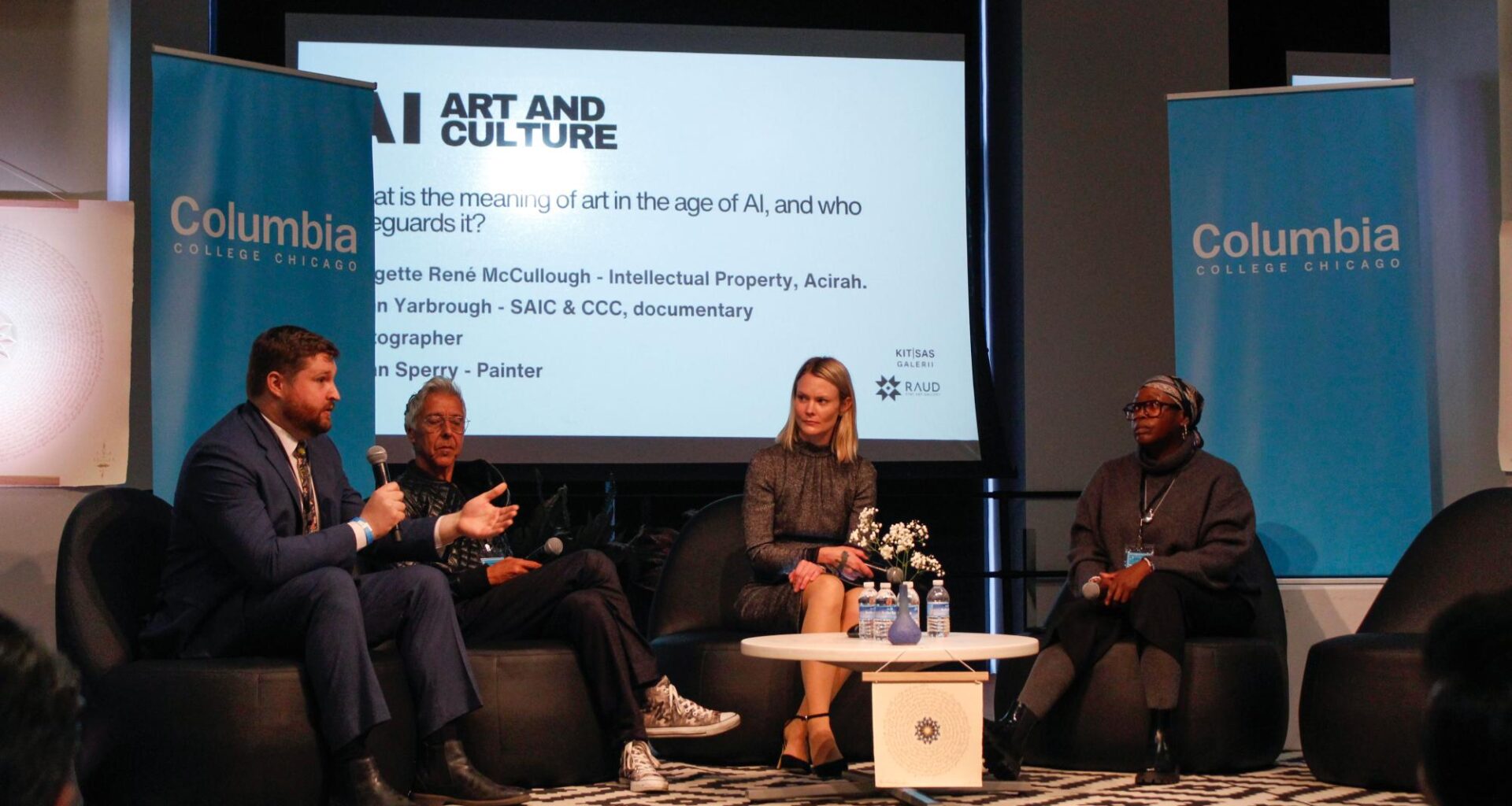
Artists, educators and technologists from Estonia and Chicago gathered at Columbia’s Conaway Center on Tuesday, Oct. 28, to discuss how artificial intelligence is reshaping creative practice, classrooms and culture.
The event took place during the official visit of Estonian President Alar Karis and his delegation to Chicago.
The one-day event, “AI in Art, Culture, and Education,” was the first U.S. program hosted by the Estonian-American Raud-Tartu initiative, a cultural diplomacy project co-founded by Columbia alum Liina Raud to connect Estonian and American artists and educators through creative collaboration.
“At its core, EART celebrates how art continues to express the human spirit in an increasingly technological world — honoring authenticity, emotion and cultural heritage while embracing innovation and global transformation,” said Raud, who graduated from Columbia in 2023 with a degree in photography.
Estonia, a Baltic country west of Russia, has made artificial intelligence a national priority as part of a broader drive to modernize government, boost economic competitiveness and prepare its citizens for a digital future.
“AI is not a single technology — it is a vast field of experimentation and contestation,” Raud said. “It is changing how knowledge is formed, how creativity is practiced, and how culture itself is produced.”
Dylan Yarbrough, a part-time photography instructor at Columbia and the School of the Art Institute of Chicago, spoke on a panel about AI’s integration and impact in the classroom. He said that while students can benefit from regulated use of AI, he worries that some may “take the easy way out” and “outsource their learning.”
“I think that if you’re using [AI] in a very narrow way where the student only has access to a very particular type of function that’s helping them grow and think more deeply, I think it’s great,” Yarbrough said.
Michael Moriarty, one of the panelists and a member of the Chicago Teachers Union Foundation, echoed that concern, adding that AI should help and support teachers, not replace them.
“The best people that use AI are people who are strong with discussions and good questions,” Moriarty said. “They know how to ask the right questions, and that’s a skill that needs to be developed.”
Oleg Shvaikovsky, an Estonian AI investor and land leader of the AI Leap 2025 program, an Estonian educational innovation program, emphasized the importance of critical thinking in digital learning.
“If a student is getting an explicit answer to the question and just copy-pasting it and sending it to the teacher, then there is no learning happening,” Shvaikovsky said.
By guiding students through the process of getting an answer through a series of prompts, Shvaikovsky believes that “learning is happening in between.”
Pilsen-based artist and panelist Bryan Sperry said he “steals” from generative AI by repainting the digital images the technology creates and later copyrighting the paintings he made.
“AI is stealing everything from us, so I’m stealing everything I can from the AI,” Sperry said. “It’s a little way to say ‘f u’ to the system.”
For many attendees, the discussions held at the event created new ways of thinking about how AI influences art and education.
“I feel like the event was very insightful, and it highlighted a bunch of hardships and advantages about AI,” said Kari Mohammad, a junior business marketing major.
Allison Leahy, associate professor in the School of Fashion, attended the panel to seek “another set of opinions and perspectives” on the usage of AI.
Columbia’s AI policy does not prohibit the use of artificial intelligence in the classroom and encourages instructors to put language about AI use in their syllabi. However, it considers unauthorized use of AI by students to be cheating.
“I feel like it’s an ever changing topic and I think it’s important from a global perspective to just get more insight from subject matter experts,” said Lahey, an associate director in the School of Fashion.
Ariana Sanchez, a senior graphic design major, said the event was insightful because it featured multiple perspectives from the panelists.
“I think it was a productive conversation in learning how we can be more productive with AI as it’s something that is just going to be continuing to progress,” Sanchez said.
Copy edited by Brandon Anaya