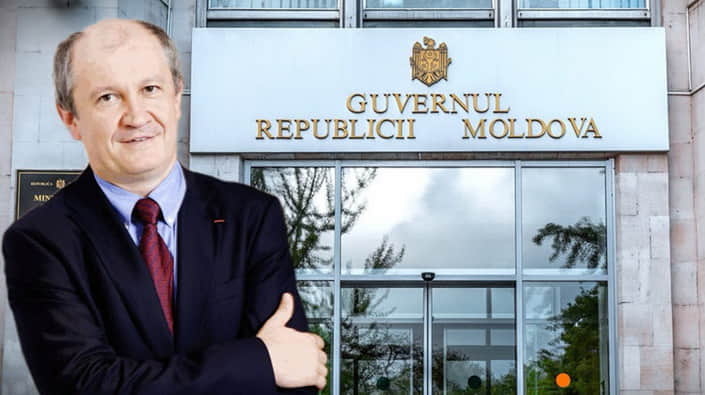
The Moldovan parliament is set to officially approve the composition of the new government this week. Maia Sandu has chosen the prime minister and determined who will be in the cabinet. Officially it is the prime minister, not the president, who appoints members of the government in Moldova, but the political reality is somewhat different.
Moldova’s new prime minister will be a special one, including where Ukraine is concerned.
The previous prime minister, Dorin Recean, headed the government for 21 months and led the ruling party to a triumphant election victory, but immediately after the elections, he announced that he was stepping down and going back to business.
His successor is Alexandru Munteanu, a physicist and financier, lecturer and investment banker. It’s a choice that has surprised many in Moldova. Sandu has decided to give the premiership to a candidate who is not a member of her party and has no plans to become one, who has never been involved in Moldovan politics, and who for a long time did not even see himself living in Moldova, though he never fully severed ties with it. Even now, he admits he is not sure whether he will stay in Moldova after serving as prime minister.
The incoming prime minister lived in Ukraine for about 20 years. His main business operations are based in Kyiv, and he was there when the full-scale Russian invasion began.
There is an understanding in Chișinău that Munteanu’s government will be temporary.
The prime minister is expected to play the role of a kamikaze.
The times call for unpopular, perhaps even painful reforms, and a prime minister with no political ambitions will find it easier to take the reputational hit.
Munteanu could be the man to start tackling the Transnistrian issue. Incidentally, there will also be a new deputy prime minister for reintegration. The position will now be held by a government official whose recent career has also been linked to Ukraine – Moldova’s former ambassador to Kyiv, Valeriu Chiveri.
Why Maia Sandu is changing the prime minister
First of all, it’s important to explain how key decisions are made in Moldova. As many people know, the driving force in the country’s politics is President Maia Sandu – even though according to the constitution Moldova is a parliamentary republic, and the powers of the president are very limited.
It was Sandu who chose Munteanu as the next prime minister. In his very first interview, Munteanu admitted that the president personally called him to offer him the post, and that this happened even before Moldova’s Constitutional Court had certified the election results.
The “consultations” the president held with parliamentary groups late last week, which were supposed to be decisive in choosing the head of government, were purely a formality, and the participants made no secret of that.
Moreover, it was not until 24 October, about two weeks after the prime minister’s candidacy had been approved and ten days after the entire country learned about it, that the pro-presidential Action and Solidarity Party (PAS) formally completed the process by adopting a faction decision to nominate Munteanu for the post. After that, Maia Sandu was able to approve the decision she herself had proposed and officially confirm the candidate for prime minister. There is no doubt that parliament will support this candidacy. PAS holds a single-party majority in Moldova’s legislature, and party discipline is absolute.
This story clearly demonstrates who makes the key state decisions in Moldova.
Overall, the search for a new prime minister was a forced step. After PAS’s triumph in the elections, it would have been logical to keep the existing government, including Prime Minister Dorin Recean, who headed the party’s electoral list. However, Recean now says he informed the president that he would resign regardless of the election outcome.
European Pravda has learned from several sources that Recean actively assisted in forming the new government team.
However, Maia Sandu personally negotiated with the candidates for the post of prime minister, and Munteanu wasn’t at the top of her list. Shortly after PAS’s election victory, many Moldovan media outlets reported, citing sources, that the government could be headed by businessman Vasile Tofan, who had backed PAS and the government before the elections and is officially one of the party’s sponsors. Sandu’s administration later confirmed that an offer had indeed been made to Tofan, but he had declined to join the government.
“Exporting candidates” from Ukraine to Moldova
The choice of Alexandru Munteanu as the next prime minister came as a complete surprise to ordinary Moldovans and to most politicians – and it wasn’t only because his name had not appeared among the likely candidates.
The main question being asked in Chișinău was “Who is he?” Before mid-October, very few people in Moldova had even heard of him.
The incoming prime minister has maintained an almost non-existent public profile, in stark contrast to Tofan, who is well-known in Chișinău and whose potential candidacy had been widely discussed. Munteanu has, however, been personally acquainted with both President Sandu and Recean for many years.
Still, Munteanu and Tofan have several traits in common.
One of them is a strong connection with and understanding of Ukraine.
Since Moldova has only two neighbours, Ukraine and Romania, Ukraine is of huge importance to Chișinău. Now, with both countries sharing aspirations for EU integration and the context of the full-scale war, this importance has grown even further. This factor seems to have played a role in the selection of candidates for prime minister.
Vasile Tofan, for instance, is better known in Ukraine as Vasyle Tofan, a senior partner at Horizon Capital, a Kyiv-based investment firm focused on the Ukrainian and Moldovan markets. In an interview with NewsMaker last summer, Tofan explained that he spends most of his time in Kyiv, where he moved 15 years ago, although the Moldovan branch of the business he manages remains significant.
Alexandru Munteanu’s situation is fairly similar, but until recently his connection with Moldova has been even more tenuous.
According to his personal Facebook page, which is open only to friends, the incoming Moldovan prime minister moved to Kyiv 20 years ago. He lists Kyiv as his place of residence, and his profile photo is of several flags, with Moldova’s flag in the centre.
This small detail reflects rather accurately what Ukraine and Moldova mean to Munteanu.
The heart of Munteanu’s business interests is in Kyiv, where he founded and runs 4i Capital, an investment company focusing on the Ukrainian and Moldovan markets. Over the past two decades, and particularly in recent years, he has learned Ukrainian, but he has not become Ukrainian in terms of either citizenship or identity.
Munteanu has confirmed that he holds three citizenships – Moldovan, Romanian and US (he says he was also eligible for French citizenship but declined) – but is not a Ukrainian citizen. Top officials holding multiple citizenships is neither problematic nor publicly criticised in Moldova.
So what connects Munteanu to Moldova beyond his passport, his place of birth, and his profile picture?
The kamikaze prime minister
For the 61-year-old incoming Moldovan prime minister, Chișinău is his hometown. It is where he was educated and later taught at a university.
It was at university that he met his predecessor, Dorin Recean. Munteanu had been his lecturer, and the two became friends.
Munteanu was active in advocating a pro-Western orientation for Moldova long before it became mainstream.
For many years, he has been the president of Alliance Française de Moldavie, a centre for language and culture that is part of an international network supported by the French government. The position is not a daily management job but a representative one, ensuring high-level connections. For example, it was recently reported that in August, Munteanu attended a private informal meeting between members of the Moldovan elite, Maia Sandu, and the leaders of France, Germany and Poland, who were visiting Chișinău.
Munteanu is also a founder-member of AmCham, the American Chamber of Commerce in Moldova. It’s said in Chișinău that some years ago, Munteanu used to introduce himself at meetings as “a Moldovan-American”, emphasising that he belonged to the diaspora rather than Moldova’s active domestic community. Statements like this might have been politically damaging for a prime ministerial candidate in Ukraine, but they are not considered problematic in Moldova.
A telling detail: Munteanu does not own a property in Chișinău, because it is not his city.
After he accepted Sandu’s offer and hastily arrived in Chișinău, he stayed in a hotel for about a week before renting an apartment near the government building.
In an interview with TV-8, presenter Anatolie Golea asked Munteanu whether he had any plans to buy a home in Moldova now that he was becoming the country’s prime minister. Munteanu said he did not, explaining that he does not view his appointment as head of government as a move back to Moldova.
Paradoxically, Munteanu’s lack of strong ties to the country – and the fact that he does not seek to build a personal political future in Moldova – may actually be an advantage.
It removes the political “brake” on implementing painful reforms.
And that’s exactly what Moldova’s president expects the new prime minister to do.
Explaining her choice, Maia Sandu highlighted the key points on which candidates were selected: “We decided that the prime minister had to be an economist… We need someone who will try to revive the economy and attract more investment,” she said in an interview with RliveTV.
But the task goes beyond simply talking with investors.
Munteanu has acknowledged that his mission includes carrying out reforms, including some that face public resistance.
“The unpopularity of a measure does not mean that the measure is bad,” he added in the TV-8 interview.
For instance, administrative-territorial reform is clearly necessary. Moldova inherited from Soviet times an extremely inefficient territorial structure divided into small, unsustainable districts (some of the smallest have fewer than 30,000 inhabitants). Redrawing district boundaries, however, is always an unpopular move that is met with public outrage, which is why successive governments have consistently avoided it.
Now Moldova faces a historic opportunity to carry out such reforms. The parliament has just been elected and is not yet consumed by thoughts of the next election. The government is now led by an investment banker who doesn’t care about being popular, does not seek a political career, and has long proven through his actions that he is willing to invest his time in Moldova’s European future.
Even if it means taking steps that society is not yet ready to accept, this prime minister can assume responsibility – even at the cost of destroying his own political prospects, which he never planned to pursue anyway.
But the overarching mission of the new government may well turn out to be the reintegration of Transnistria.
Russian occupation and cooperation with Ukraine
The new Moldovan government is still drawing up its programme. The only thing known for sure is that it will be based on the party’s main election pledge – to complete EU membership negotiations by 2028.
For Ukraine, the good news is that Munteanu understands the depth of the mutual dependence between Ukraine and Moldova on their shared path towards EU accession.
European and international cooperation will remain an area of continuity in Munteanu’s cabinet. That is beneficial for Ukraine, since communication channels with the current officials are already well established.
Cristina Gherasimov will remain deputy prime minister for European integration. Mihai Popșoi will continue as foreign minister – and incidentally, he speaks Ukrainian quite well. Anatolie Nosatîi will stay on as defence minister, and Vladimir Bolea will continue as minister of infrastructure. In short, practically the entire part of the government responsible for cross-border cooperation with Ukraine will remain unchanged.
The new deputy prime minister for reintegration, who will be responsible for the Transnistria issue, also had to be brought in from Kyiv.
The position will be held by Valeriu Chiveri, Moldova’s ambassador to Ukraine, whose diplomatic posting is now coming to a close. He reportedly arrived in Chișinău on Sunday for an interview with the incoming head of government.
It is important, however, to dispel the false impression that Munteanu, lacking a political team in Chișinău, is somehow “bringing in his own people from Kyiv”. That isn’t the case. Several sources in both Kyiv and Chișinău have confirmed that the decision to appoint Chiveri was made by Moldova’s top leadership.
Negotiations with him on the appointment began even before the elections. And even after Dorin Recean announced his resignation, he continued to stay in contact with those taking over government roles – a very positive and (for Ukraine) quite unprecedented example of continuity.
Those who know Chiveri personally confirm that he is well-versed in the Transnistrian issue. This dates back to his time at Moldova’s Ministry of Foreign Affairs more than a decade ago, when he dealt with OSCE-related matters. His work in Ukraine during the full-scale war (Chiveri was in Kyiv on 24 February 2022) has also deepened his understanding of the Russian threat.
Even before it became a mainstream view, Chiveri repeatedly stated that he believed reintegration was possible and that Ukraine would play a key role in the process. He said as much back in December 2015 in an interview with Radio Liberty Europe’s Moldovan service, suggesting that Russia would eventually be forced to withdraw from Transnistria.
Incidentally, Valeriu Chiveri met with Ukrainian Foreign Minister Andrii Sybiha before leaving Kyiv and informed him that he would be dealing with the Transnistria issue. This suggests an openness to cooperation.
But is Moldova’s top leadership ready to cut the Transnistrian knot?
There are some positive signs.
Alexandru Munteanu recently stated on TV-8 that “the issue of reintegration is a priority for the government” – a rather unusual thing for a Moldovan official to say, given that Chișinău has consistently ignored this problem for years, realising that it would produce no political benefits but would certainly cause headaches.
Munteanu is ready for this.
He made another remark that contradicts previous official statements from Chișinău but fully corresponds to reality.
“It is clear that for European integration, the existence of this region [uncontrolled Transnistria] is a problem,” he said.
This is true. And the fact that Chișinău has begun speaking about it openly is very positive.
Brussels has indicated to the Moldovan authorities that, unlike Ukraine, Moldova is expected to reintegrate Transnistria before its EU accession becomes a formal agenda item. This could be the driver that pushes Maia Sandu into initiating this exhausting but necessary stage of the process.
In this scenario, Munteanu and Chiveri will be the ones tasked with implementing it operationally – and that is clearly good news for Ukraine.
Sergiy Sydorenko,
Editor, European Pravda
If you notice an error, select the required text and press Ctrl + Enter to report it to the editors.