Haaland has been sent home from Norway duty, and the federation’s wording has raised more questions than it answered. Between cautious phrasing and a quietly dramatic exit, the story isn’t just about a sore muscle — it’s about modern football’s fragile balance.
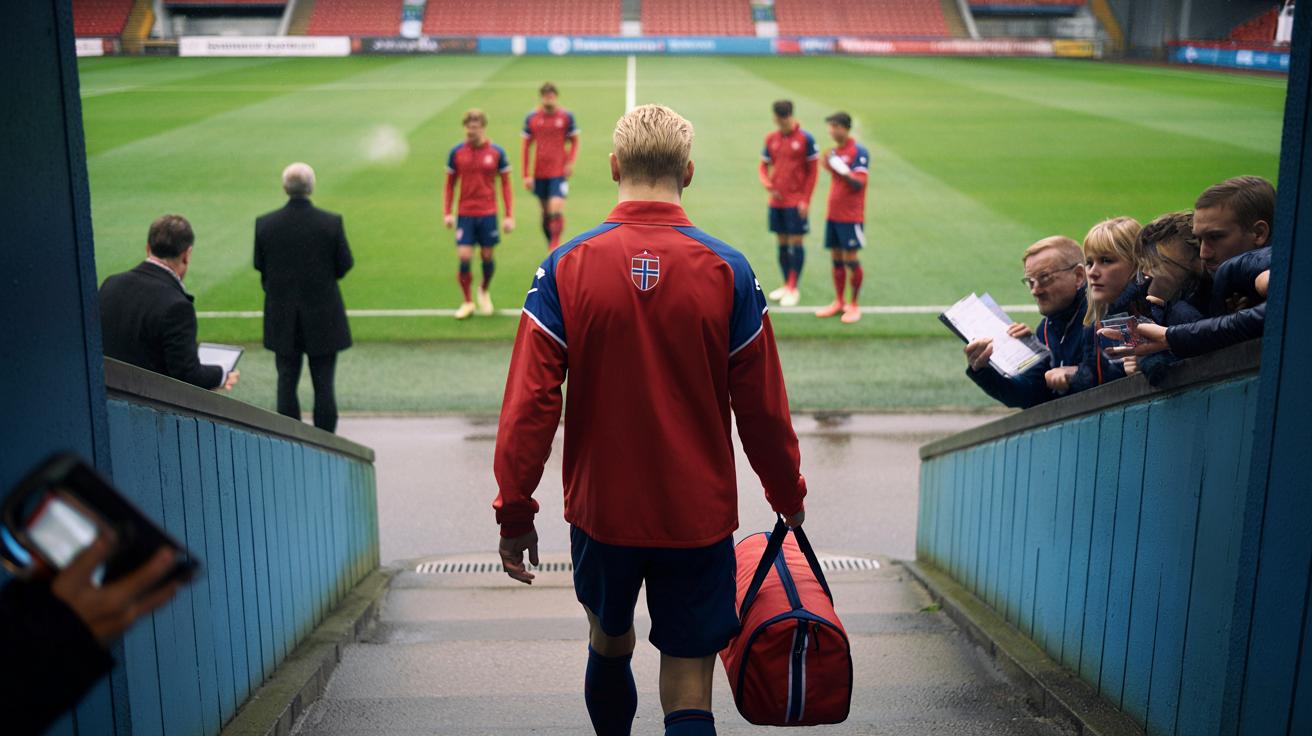
The news didn’t break with fireworks. It arrived like a cloudy Oslo afternoon: flat light, cool air, a push alert that made people glance at their phones and then at each other. On the edge of the training pitch, boots thudded into turf, but all eyes drifted to the tunnel where a zipped kit bag moved briskly out of view.
A staffer tapped a tablet. A coach folded arms, then unfolded them. Fans who’d waited with shirts and pens shuffled, hoping for a wave that never came. We’ve all known that moment when the thing you came to see simply slips away.
Norway later issued a few crisp lines that shifted the mood from worry to riddle. The striker was released from camp, they said, “after assessment.” That last phrase is doing a lot of work.
Norway’s unexpected call
You could almost hear the brakes squeal. Norway’s statement was careful, almost clinical, yet the decision felt bold: let the star go, right now, rather than carry the will-he-won’t-he story for days. **The wording avoided drama, but the timing screamed it.** Two sentences, maximum. No extra context, no speculative medical jargon, no hint at a return date. Just a door quietly closing before the match window even opened.
For supporters, that brevity lands like a thud. When a national team releases a player early, it often signals one of two things: a genuine knock, or a strategic call to prevent a small issue from becoming a big one. Norway didn’t use the word “injury.” They went with “assessment,” a term teams lean on when the line between caution and crisis is still pencil-thin. Fans read it and start filling the gaps with guesswork.
Look coldly at the incentives and it adds up. International breaks compress travel, training, sleep, and pressure into a short window. A striker who sprints, wrestles, and turns on heavy legs is a strain risk. **Sending him home early can be the smartest move in the room.** It spares the federation a selection headache, respects the player’s long season arc, and, yes, keeps the relationship with his club on a friendly footing. *Sometimes preservation is the bravest selection of all.*
How to read the statement (and what it means)
There’s a practical way to decode these communiqués. Start with verbs: “assessed,” “managed,” “monitored” usually means borderline availability. Next, watch for absolutes that are missing: no “out for X weeks” suggests fluidity, not finality. Then check the travel detail — “released from camp” versus “continues individual training” are different beasts. One implies the chapter is closed. The other leaves the door ajar.
Let’s be honest: nobody trawls federation PDFs every day. What trips fans up is over-weighting the first headline and under-reading the fine print. If the player has been allowed to go home, that’s a stronger signal than any vague “we’ll see” in a presser. The common mistake is to assume a dramatic absence in one game means a dramatic absence in the next. Bodies don’t follow our timelines. Recovery is messy, nonlinear, and often surprisingly quick.
“Between ‘fit’ and ‘available’, there’s a canyon — and most of it is risk tolerance.”
What we know: Norway released the striker after assessment, ending his involvement this window.
What we don’t know: whether the issue is pain, load, or a flagged metric on testing.
What matters next: training images, club briefings, and whether he joins full sessions on his first day back.
Short-term impact: Norway lose their focal point; others must step into shots and space he normally occupies.
Club angle: travel cut, minutes preserved, but scrutiny intense around the first game back.
The bigger picture
The modern striker’s calendar is a stack of dominos, not a straight line. One heavy week knocks into the next, and international windows pile travel on top of tiredness. Norway’s decision lives in that reality. It reads like soft power — protect the asset, respect the player, avoid the headline of a minor problem turning into a layoff. On a human level, it’s also a kindness. No-one wants to be the guy warming a tracksuit while the cameras hunt for a limp.
Soyons honnêtes : personne ne fait vraiment ça tous les jours. The routine of “play, fly, repeat” looks glamorous until you count the sprints and the sleep debt. For Norway, there’s a footballing cost, of course. The plan without Haaland is a different plan — more collective runs, more second balls, more patience. For the club waiting back home, it’s a nervous relief. Relief at fewer minutes. Nerves about what “assessment” might still reveal on a tighter, more controlled pitch.
There’s also the emotional undertow. On a cold week when a country wanted its spearhead, caution feels like theft. Yet it’s probably wisdom. The truth is the margins at elite level are razor-thin, and they’re getting thinner with every extra game added to the calendar. The unexpected statement from Norway doesn’t say everything, but it says enough: this is an era where saving a player for tomorrow is sometimes the most patriotic act today.
Key points
Details
Interest for reader
Norway released Haaland from camp
Short, measured statement citing an assessment and early departure
Explains the “why now?” and signals immediate impact on national fixtures
Wording hints at caution, not crisis
No explicit injury diagnosis or timeline; risk management vibes
Helps fans and fantasy managers interpret the likelihood of a quick return
Club-country balance is in play
Protecting long-term output over short-term appearances
Frames the bigger picture: performance, scheduling, and player welfare
FAQ :
Why was Haaland sent home by Norway?After an assessment in camp, Norway opted to release him rather than keep him in a grey area. It points to caution around load or a minor issue.
Is he injured?The statement didn’t use the word “injury.” That usually means it’s either very minor, load-related, or simply unresolved without imaging.
How long will he be out?No timeline was given. Early release often accelerates recovery by cutting travel and match minutes.
Will he be ready for his club’s next game?Watch first training back. If he’s with the main group quickly, availability rises sharply.
Why was Norway’s statement described as unexpected?Because of the timing and the decisiveness. Ending the debate early, without theatrics, isn’t the usual script.