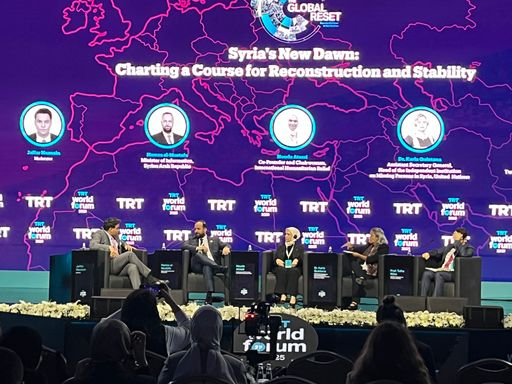
A year ago, Hamza al Mustafa of Syria – then an academic and researcher – addressed an august gathering in Istanbul, talking about the fractures of his war-torn homeland.
Back then, Syria’s future was uncertain, with whispers of disintegration hanging in the air. And Mustafa’s thoughts at the TRT World Forum 2024 reflected his anxiety.
On Friday, Mustafa returned to TRT Forum’s 2025 edition in a new role: as Syria’s newly appointed minister of information, tasked with steering the media landscape in the post-Assad regime.
“I’m here to represent my new Syria…In 14 years of civil conflict, Syria has had a lot of division. The ousted regime invested in this division as a survival strategy,” he said, while taking part in a panel discussion titled ‘Syria’s new dawn: Charting a course for reconstruction and stability.
Mustafa represents the Syrian Transitional Government led by President Ahmed al Sharaa, which has been operating under a temporary constitutional declaration that covers a five-year transition period since opposition forces toppled the decades-old Assad regime in December 2024 in a lightning-quick offensive.
The discussion, which drew a packed audience of diplomats, scholars and activists for its 90-minute intensity, focused on Syria’s most stubborn problem: fragmentation.
For decades under the Assad regime’s iron-fisted rule, the country had been engineered to splinter along sectarian, ethnic and communal lines.
The Assad era was marked by widespread atrocities – war crimes, enforced disappearances, and torture – that left deep scars on Syrian society. Power and resources funnelled to a narrow Alawite elite, while Sunnis, Druze and other groups were marginalised.
Taking part in the discussion, Talha Kose, president of Türkiye’s National Intelligence Academy, said the governance system in Syria under the Assad regime was “designed to be fragmented”.
“It was a divide-and-rule kind of system,” he said, noting that all power and resources were set aside for a single group of people.
“Other groups have been silenced. Their identity, their rights have not been recognised. So that has generated distrust among the population,” Kose, a Turkish expert on Middle Eastern security, said.
He urged the new Syrian government not to repeat Lebanon’s tragic mistake of formalising and institutionalising sectarian quotas into a “confessional” straitjacket, which eventually fuelled cycles of civil strife.
In the Lebanese confessional system, political and institutional power is proportionally distributed among religious sub-communities.
“Syria must not institutionalise the sectarian and other divides the way Lebanon did in the past,” he cautioned.
Instead, Kose urged the creation of inclusive institutions — political, social, educational, religious and even military — to rebuild Syria.
“You have to institutionalise this inclusivity of all groups,” he said. “It will be difficult because there’s a strong mistrust among the communities, but you can only bring this trust gradually,”
Related
Responding on behalf of Sharaa’s transitional government, Mustafa said that Syria would chart a path different from Lebanon. “Foreign forces have always tried to divide Syria into small fragments,” he said, referring to the French mandate in the last century when colonial carve-ups sowed early discord.
“But Syrians reunited after the end of the French mandate,” he said.
He recalled how doomsayers had predicted the balkanisation of Syria as recently as a year ago. Yet the Syrian people, weary of the Assad era’s “survival strategy” that engineered rifts along sectarian and ethnic lines, chose unity over division.