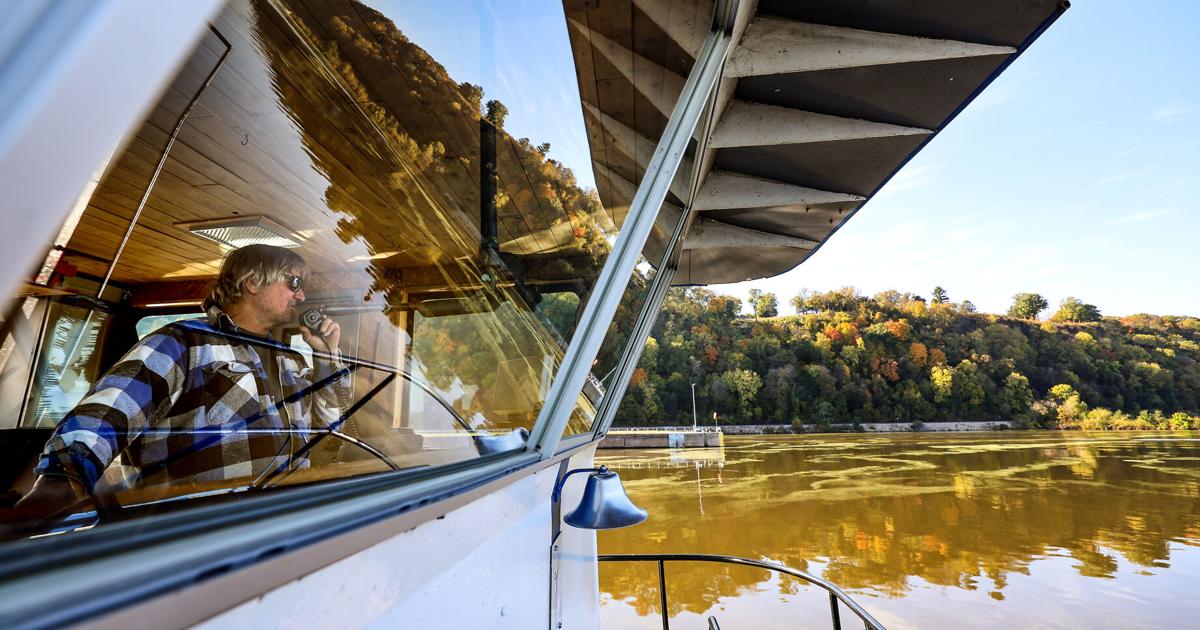
He’s available day and night, but on this morning the mildest of bad weather — fog — kept tugboat captain Don Dixon onshore.
An ARTco — American River Transportation Co. — towboat, the Coral Dawn, was boxed in by the fog up past Finley’s Landing and waiting for a clearer view to navigate the bend in the Mississippi River.
For 19 years, Dixon’s Tug Service has helped guide the big downstream towboats through Mississippi River Lock and Dam No. 11, the Army Corps of Engineers outpost at the north end of Dubuque.
Dixon rarely takes a day off, and for eight to nine months a year, he’s on call for whatever time towboat pilots need him for a little insurance on navigating the locks.
By lunchtime, the fog had lifted for crystal-clear skies and the Coral Dawn was within sight of the lock. Laden with 12 barges of grain and bound for St. Louis, the huge assembly would have had a risky entry into the lock without the tug service.
Dixon’s deckhand, Jarrell Wardell, unhooked the ropes that tied the boat to the shortwall of the lock, and Dixon piloted his tug, the Lisa Nicole, a few hundred yards until he was on the river side of the Coral Dawn.
Dixon and Wardell are just two of the many people in the tri-state area who make their living from an old source: the Mississippi River, which rolls past the city without a second thought to many residents.
“Thank you, Donnie. If we don’t use you in the lower water, we won’t use you in the higher water,” said the Coral Dawn pilot over the radio, in a thick southern drawl. In riverspeak, he could handle the calm waters today, but calling on Dixon keeps the tugman in business for when the river’s swollen and the current is swifter.
The big boat’s crew of mates and deckhands moved about on their long journey from St. Paul, Minn., to St. Louis and took positions around the boat, ready to get to work with ropes and winches as needed.
The Lisa Nicole bumped against the Coral Dawn and pushed it toward the Iowa bank, working against the current. The captain of the Coral Dawn worked his rudders to steer the boat the opposite way to keep the big boat guided toward the narrow lock. The lock is 110 feet, while the three-barge wide assembly is about 105 feet.
The boat slid straight into the lock without error. The front barges were tied against the side of the lock by the lockkeepers while the deckhands worked to unhook the barges in the middle. Not all 12 barges can fit in the 600-foot lock, and the Coral Dawn must be split in two to pass through, a process that takes 90 minutes.
Only the initial nose into the lock needs tug assistance, so Dixon docked the Lisa Nicole back on the lock wall and headed home until the next towboat comes down river.
Industrial harbor
Dubuque’s riverfront is increasingly seen as a tourist destination, with casinos, the National Mississippi River Museum & Aquarium, Grand River Center, the Port of Dubuque Riverwalk and a picturesque dock for touring riverboats.
But every day, hundreds of tri-state-area workers still rely on the flow of the river for their livelihoods, as the ability to haul huge volumes of commodities, particularly for agriculture, gives the Mississippi River a lasting edge over rail and truck.
In 2021, 8 million tons of freight, valued at $1.5 billion, moved through Iowa’s navigable rivers, keeping more than 200,000 trucks off the road. A standard 15-barge towboat can haul the same as 206 railcars with six locomotives or 1,050 semi-truck loads.
The Upper Mississippi is 1,300 miles long from forested Lake Itasca in northern Minnesota to the Ohio River at the tip of Illinois, but only the last 850 are navigable, thanks to a series of locks and dams constructed nearly a century ago. A small amount of traffic also works the Missouri River, which flows less predictably without a lock system.
A 2021 Illinois Marine Transportation System Plan found 452 people working in the marine sector on or off the ports of East Dubuque, Ill., and Savanna, Ill., along with another 1,153 employed doing business with the port, collectively adding $164 million to the state GDP. Iowa numbers were unavailable, but the amount of business is similar.
In 2019, a report from East Central Intergovernmental Association showed the twin ports of Dubuque and East Dubuque moved more than 1 million tons of grain and 645,000 tons of fertilizer, but these quantities fluctuate from year to year, and action at the port has been down amid the ongoing trade war with China, which slapped retaliatory tariffs on American grain.
Newt Marine Service still does a small amount of activity at the South Port, but most river commerce in Dubuque has crossed the river or retreated to the area between the Canadian National railroad bridge and the outlet of the Bee Branch into the Peosta Channel.
Flint Hills Resources receives liquid asphalt by barge on Dove Harbor, and global agribusiness company Bunge operates a grain elevator at the east end of Seventh Street. A dock for salt is on the channel along with liquid fertilizer. The city of Dubuque owns the land along the river and leases it to industrial tenants.
Bunge operates the salt terminal, where road salt is unloaded both for private sellers and the city of Dubuque, which maintains a salt shed with 10,000 tons of salt — a two-year supply.
Dubuque saves about $8 per ton buying the salt directly off the river compared to purchasing it from the Iowa Department of Transportation. It then sells the salt to other Dubuque County municipalities, covering the city’s handling costs but pricing it less than the state charges.
“I love the partnership with the other communities. It allows us to save more for them,” said city Public Works Director Arielle Swift.
In October, Swift said, the city received shipment of three barge loads, or about 4,500 tons, to refill the shed.
At Bunge’s grain operation on Seventh Street, farmers truck grain to the barge for southward shipment. The elevator has a market radius of about 40 miles before running into competition from other river ports or rail-based elevators such as those in Cedar Rapids, Iowa.
“The river used to be more of the market than it is today,” said Heath Thomas, who manages the river terminals for Bunge at Dubuque and Prairie du Chien, Wis.
He said traffic peaked in 2016 and has been up and down since then. This year has been down from the 2010s but better than last year. Thomas said a lot had been coming over from Grant County, Wis., which has easy access from U.S. 61/151.
The Dubuque elevator and its 16 employees have been handling 50 to 100 trucks per day through summer and fall, enough to fill two barges to send down river. The elevator has the ability to handle 200 trucks per day, and it did before the pandemic. A second barge dock stands to unload dry fertilizer, but Bunge removed a storage shed for the product and fertilizer now must go directly on truck or railcar.
Thomas said 99% of grain heads out on the river from the Dubuque terminal, but with export shipments down, Thomas said they were facing stiffer competition from domestic users of grain, such as ethanol plants.
“Ethanol plants need the grain,” he said. “We can only pay what we can based on the market.”
Shift to Illinois
Four miles downriver, Logistics Park Dubuque in East Dubuque has 90 acres for port activity, with several additional acres providing the new, more spacious home for Newt Marine, which moved its headquarters and the vast majority of its operations across the river in April after 60 years in the South Port of Dubuque.
Newt employs 100 people and has a long list of river activities on its agenda, with a focus on keeping the river clear for commerce: building weirs and dredging. It also operates a tug guide service for towboats passing through the gap in the railroad bridge at Dubuque and recently won a bid to operate a ferry next spring in Lansing, Iowa, during a bridge replacement project. Newt repairs and inspects boats on drydocks and built a large enclosure to bring work indoors.
“We do a lot of work for the Corps of Engineers and the (Department of Natural Resources),” said Newt fleet manager Steve Cavanaugh. “We built barges for the Corps of Engineers.”
Rising lease rates from the city of Dubuque have led to a gradual shift of local marine operations to the Illinois side of the river. Tucked into the sloughs of the Mississippi at the end of Barge Terminal Road, the harbor serving Newt and Logistics Park has a quarter-mile manmade channel dug in the 1980s to provide access to the river for tugboats and barges.
Logistics Park, a subsidiary of Alliant Energy, has two barge docks for fertilizer and one for grain. A fourth dock once built for coal now stages a pair of local tugboats for ARTco, a subsidiary of Archer Daniels Midland, which services the local harbors.
On Monday, port crews were unloading just one barge of fertilizer, ammonium sulfate, and transferring the product onto portable conveyor belts for storage inside a shed.
The fully intermodal facility has access to the rail system via Canadian National, which heads east to Chicago and west across Iowa. Trucks also file out on U.S. 20, where an ongoing Illinois Department of Transportation project is improving safety and access to Barge Terminal Road for semis.
“We just receive material. We don’t have any assets,” explained Joe Bitter, the Logistics Park general manager. “It’s dry material that’s not time-sensitive.”
ADM, The Mosaic Co. and Nutrien Ag Solutions are all able to compete on the market at Logistics, but each requires its own holding sheds. Bunge leases an elevator at the terminal, and Logistics finds space for anything else it can find a market for, such as cottonseed that’s brought up and mixed into animal feed and “choice white grease,” which is shipped back down to the Gulf of Mexico for use in biofuel. The grease is a waste product that Kerper Boulevard gelatin manufacturer Rousselot diverts from landfills.
On the west side of the terminal, a yard engine worked a rail spur unloading product that comes in by rail from domestic sources, such as Florida’s fertilizer industry and tank cars of liquid petroleum, which is rebottled and put on trucks for distribution across the area.
Two dozen trucks were lined up ready to enter the gates, which open at 7 a.m. weekdays. Despite the backlog, Bitter wishes it were busier. He expected 70 trucks to come Monday, but in a good year, it might be twice that. With the Mississippi River set to close for ice in six weeks, he wants his crews to be busy unloading barges and sending material out on trucks.
“It’s quiet around here, and it shouldn’t be,” Bitter said. “It feels like the farm economy is not very healthy right now.”
The semis rolled through across two railroad tracks and up a dusty private road to a weigh station at the Logistics office, where the office staff at Logistics directed drivers to a large list of pickup sites on the port campus, including storage sites for seven to 10 different fertilizers for three different companies.
Bitter said local river commerce activity could be broken into three components — construction companies such as Newt Marine that keep the river clear, land-based handlers such as his company, and boat operators such as ARTco that move barges between docks and mooring cells, locations on the open river that are easier to access by the big through-line towboats.
The catchment for Logistics’ fertilizer operation goes out 150 miles, as the terminal feeds fertilizers to farm elevators across northwest Illinois, southwest Wisconsin and eastern Iowa. The individual fertilizer types, such as potash or ammonium sulfate, get blended at these facilities for farmer pickup, though ADM does have a facility to sell blended fertilizers directly for farm operations.
Once the river freezes, Logistics lays off about half its blue-collar workforce but keeps them on the company health insurance plan until they return to work in the spring. Rail operations, such as a terminal for bottled propane gas, run throughout the winter, along with its large deposit of salt, which is sold off to government agencies.
Until then, Bitter held out hope that farmers would open their pocketbooks so fertilizer orders could come into port and go out on truck.
“We ebb and flow with what the farmers are doing,” he said. “When farmers feel good about the market, they buy more fertilizer.”
Iowa State University economics professor Chad Hart said there was some reason for optimism. Although soybean yields were down, commodity prices have been ticking up betting that a deal could be reached with China on tariffs, or Congress would give farmers some relief. On Thursday, China agreed to buy 25 million metric tons of soybeans.
“A lot of farmers do apply their fertilizer in the fall after the crops are off,” Hart said. “There’s speculation we’ll either see an improvement on price or some government support to provide a floor to farmers.”
Retaliatory tariffs on U.S. soybeans had put American growers at a disadvantage to Brazil in the Chinese market. At the same time, Chinese demand on Brazilian soybeans has helped increase sales of U.S. soybeans in secondary markets, including Europe, Mexico and North Africa. Corn and soybean prices have plummeted from a few years ago but are about the same or higher than last year.
Tariffs on foreign fertilizers, much of it coming from Canada and the Caribbean, have also put a dent on sales. Many farmers stockpiled fertilizers before these tariffs took effect.
“The ag economy has been in recession for the last 18 months; there’s a lot less movement coming up and down the river,” said Hart, who added that corn yields had increased but not enough to make up for the crash in the soybean market.
Paul Rohde, the Midwestern vice president in St. Louis at the Waterways Council, an advocacy group for river commerce, said 2012 to 2018 were “rockstar” years on the river, but traffic has been in a slump the past six years.
“COVID took a good chunk of traffic away from the river,” Rohde said. “Traffic is slower and slower to recuperate.”
Through towboats
On the long river, several big companies dominate towboat traffic — ARTco, Marquette Transportation Co., Kirby Corp. and Ingram Barge Co.
Dubuque was retired towboat captain Mike Conklin’s port of call throughout his 40 years on the river, the last 35 with Ingram and the last 30 as a captain.
His work was not for the casual boat enthusiast — at Ingram, Conklin worked 28 days on and 28 days off, developing a rhythm consistent to the river’s current. Training was arduous and designed to weed out less committed mariners, but he worked his way up from deckhand to first mate to pilot to captain. “It’s a constant training to keep people on task,” he said.
“We lived on the boat, and the boat would travel all of the time,” he said, with active duty rotating on a six-hour schedule, with off-time spent sleeping, eating and tending to chores such as laundry and reading books. “The farther into the trip, the more time was spent sleeping.”
Each boat had nine people on board, including a cook.
“They’re like a football team,” Conklin said. “They work really hard, and they consume a lot of food.”
Conklin holds his longest employer, Ingram, in high regard, but earlier companies he signed on with were not always as scrupulous.
“I got trapped on a boat for 60 days,” he said. “They promised there’d be somebody to replace me in Cairo (Ill.), and there wasn’t anybody there. I quit and had to take a train home.”
For Ingram, Conklin worked most of the river systems of the Mississippi River watershed, including the Illinois, Ohio, Tennessee and the Lower Mississippi, which is a very different animal than the upper river, where towboats pile on 40 barges versus the 12 to 15 upriver.
“It can be docile, or it can be wilder than a marsh hare,” said Conklin, who said he once raced through Memphis, Tenn., at 22 miles per hour as the current caught his towboat. “Twenty-two miles per hour is basically out of control.”
Because of the dams, travel on the upper river takes five to six days either way between St. Louis and St. Paul, cruising along at 5 to 6 miles per hour. While a towboat can travel to New Orleans from St. Louis in three to five days, it can take three weeks to make it upriver against the current.
He’d spend a month learning to abide with a ship and crew, then another month relaxing as a family man. It broke his first marriage, causing him to take a year off mid-career. In that downtime, he helped Dubuque secure a gambling riverboat in New Orleans — the Diamond Jo.
While on leave, he met his current wife, Julie, and they made it work the rest of his career.
Local tugs work harbors
ARTco uniquely employs both long-haul towboat crews who live on a boat and short-haul tugboat crews who come home each night.
But hours are still long with a schedule that’s not for everybody.
Jake Slater, first mate of the Rose M, said he works 12-hour days for seven days, then off for three. Working the day shift now, when he comes back after his three days off, he’ll work a seven-day night shift.
“The river don’t stop,” Slater said. “If it does, we won’t be in business.”
ARTco provides towing services for ports up and down the Upper Mississippi and Illinois rivers and is the primary servicer for the ports of Dubuque and East Dubuque.
“Our tugs work ’round the clock, but the terminals are just daylight hours,” said Ron White, the local ARTco fleet manager.
White has 45 years with the company, and 18 as the fleet manager. He’s kept his captain’s license from the days he worked the tugs.
“I never left the boats because I disliked it,” he said. “I just wanted a different challenge.”
His company employs 15 to 20 people directly on the two tugboats. They occasionally travel downriver to Clinton, Iowa, or upriver to smaller docks at Clayton and McGregor, Iowa, — a 12-hour trek, requiring a crew change at the end.
But 90% of the work is done between Dubuque and East Dubuque.
The Rose M headed down the channel from the East Dubuque harbor to the main river, chased by seagulls and its sister tug, the Gold Cup, close behind.
The controls in the Rose M pilot house are a little more elaborate than Dixon’s Lisa Nicole but operate by the same logic: a throttle to push for speed and two pairs of bars for steering the rudder rather than a captain’s wheel.
On the main river, captain Nate Fure, of Cassville, Wis., guides the boat upriver to ARTco’s mooring cell, where old barges are anchored to an island and used to tie down empty barges.
Dubuque used to allow barges to moor conveniently off the floodwall near the Star Brewery building, but with a nod to tourism, barge parking was moved to this island in the river south of the city.
The big towboats drop off and pick up barges here, while the small tugboats pick them up for more nimble maneuvers to docks on both sides of the river.
A third, much smaller boat, the Cleaning Lady, is working the barges at the mooring cell, sanitizing them for reuse. The Gold Cup moves to assist the cleaning crew, while the Rose M picks up an empty barge to deliver to Bunge at the elevator on Seventh Street in Dubuque.
Slater and the deckhand, Joe Burns, have to step gingerly onto the barge to loop cables from the tug onto a cavel and tie the two together. Winches on the boat help tighten them down.
The Rose M crew is in the home stretch. In another five rotations, the river will freeze on the Upper Mississippi and shut down transportation north of the Iowa-Missouri state line.
The towboat companies will race to get any grain barges below the freeze line for potential use on the Lower Mississippi or the Illinois River, which stays open year-round to Chicago. ARTco’s anchor barges are moved off the island and drydocked in East Dubuque.
The Rose M and the Gold Tug head home to Cassville, where ARTco maintains a shipyard for servicing tugboats in winter, docking them for any needed repairs.
Veteran managers such as White will have plenty of work to do in the off-season. Slater planned to head to St. Louis to keep working where the river stays open. Fure planned to sit back and enjoy the time off at home.
“I save for it so I don’t have to work,” he said.