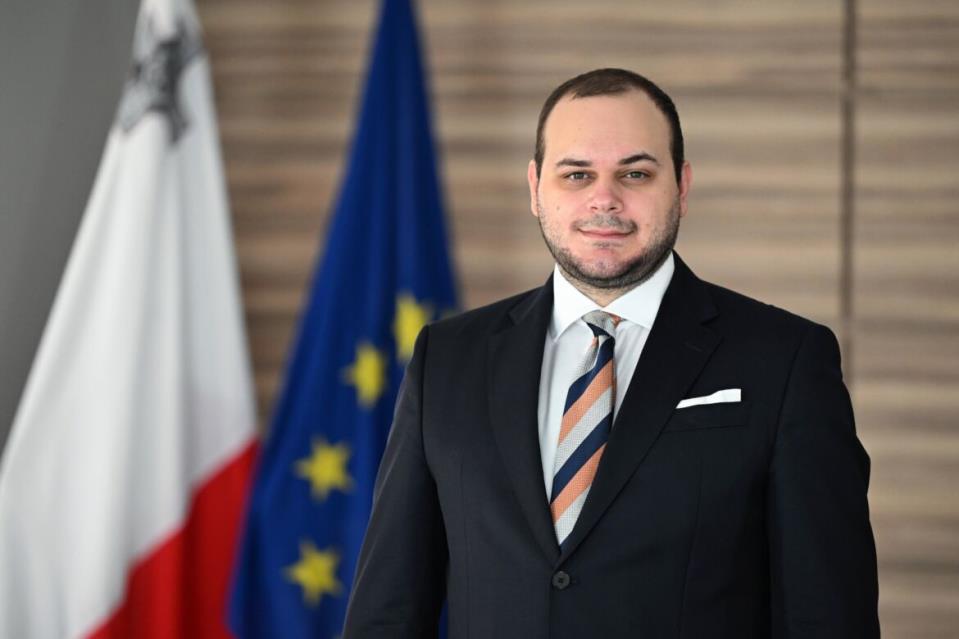
Kyle Patrick Camilleri
Sunday, 2 November 2025, 07:30
Last update: about 1 hour ago

The recently-appointed CEO of the Malta Council for Economic and Social Development (MCESD) Brendan Zerafa has told The Malta Independent that in his view, social development is not under-represented within Malta’s main advisory council. He also did not entertain the idea that the size of the MCESD Council should be expanded to add more permanent members to its discussion table.
Zerafa said that he is “very confident that trade unions, employer organisations, the government and all council members are well informed when it comes to social wellbeing” as this subject is very often discussed in the Council. He added that the Civil Society Committee represents this facet sufficiently as it is made up of various sectors which tackle social issues.
On the prospect of adding more permanent voices within the MCESD Council, Zerafa said that during its discussions, the country’s principal advisory body does not limit itself, and it is common practice for it to invite outside parties to take part in specific meetings.
“If we’re going to discuss mental health for example, it goes without saying that we’ll be inviting mental health experts,” he said.
The MCESD is Malta’s national consultative council and advises the Maltese government on social and economic matters. The MCESD is made up of members from different principal stakeholders that represent different socioeconomic segments, such as trade unions and employer bodies, together with the government.
The MCESD Council’s primary role is to give advice, feedback, and recommendations to government across a broad array of issues – either on its own initiative or upon government request.
The MCESD Council is made up of the General Workers’ Union – GWU; UĦM Voice of the Workers; the Confederation of Malta Trade Unions – CMTU; the Malta Employers’ Association – MEA; the Malta Hotels and Restaurants Association – MHRA; the Malta Chamber of Commerce and the Malta Chamber of SMEs; Forum Unions Maltin – For.U.M.; the Civil Society Committee – CSC; the Gozo Regional Committee – GRC; the Ministry for Finance – MFIN; the Central Bank of Malta and a Ministry representative.
MCESD’s inaugural CEO
Zerafa was named as the inaugural CEO of the MCESD on 30 August, shortly after Parliament approved to introduce this role within the country’s highest-level advisory council. Zerafa is also serving as the MCESD council’s secretary.
Prior to his appointment, Zerafa worked as a policy consultant and held roles within the Office of the Prime Minister and the Ministry for Foreign Affairs. At 31 years of age, he had also served as a government representative within the MCESD Council, though is widely known for his commentary on international (and mostly American) politics.
Last November, Zerafa was one of two Maltese political experts approached by this newsroom to speak about the implications behind US President Donald Trump’s election to a second term in the White House.
As MCESD CEO, Zerafa has a self-described “comprehensive” role. Simply put, he is entrusted with its overall administration and the organisation of its council, which involves drafting its council’s agenda and act as its advisor on “necessary matters”. Before MCESD had a CEO, up until this summer, these matters took up the time of the MCESD Council.
In his role, Zerafa has full responsibility to lead the MCESD’s administration (under the direction of the permanent secretary for social dialogue), manage the Secretariat, assign duties to staff, oversee all logistics for MCESD Council events and meetings, and is legally tasked to come up with strategies for the implementation of the council’s objectives. Hence, he assists the council, its committees, and sub-committees, and ensures that all members have all the information and research required to take informed decisions.
As CEO, Zerafa is not a voting member on the MCESD Council.
One of Zerafa’s first orders of business in this role, he said, was organising an event for social partners where they could provide feedback for the Secretariat. He said he was “very satisfied” with the feedback received.
He disclosed that social partners want the MCESD to strengthen its research capabilities – which is something it is working on – as well as help it become more in-tune with what is happening abroad. Zerafa said that “as someone who counts international affairs as one of his passions, this was music to my ears”. He confirmed that the MCESD is planning initiatives to concretely address these priorities.
Is the MCESD just a talking shop?
While featuring some of the most notable stakeholders in the country for matters of economic and social importance, the MCESD is often criticised for acting as nothing short of a talking shop.
Zerafa told this newsroom that the MCESD Council itself sometimes debates this point, and views differ between different members.
In this regard, the CEO recounted how “recently, one council member remarked that it is unfair to dismiss the MCESD in this way, noting that the facts speak for themselves”. As an example, the council member observed that the Covid-19 support packages were first agreed upon in this forum.
On the contrary, Zerafa observed how another council member admitted that “yes, in a sense the council is a talking shop, because its very role is to discuss and provide advice”. However, this member stressed that it is up to social partners themselves to see that their “talking” actually translates into meaningful outcomes.
On this, Zerafa noted that “the MCESD is a consultative council by design”, meaning that it is not mandated to govern or legislate, but only to advise, give sound recommendations, build consensus, “and work to persuade the government that the positions agreed within the council should be seriously taken into account”.
In this regard, with the government having a pre-set position on subjects at hand, how influential is the MCESD in influencing government policy and proposed policy outcomes?
Zerafa said that while this holds true, “in Malta, the government’s views can evolve as well, as they have done on a number of issues. It is, however, up to us to give the government enough good reasons as to why there should be this evolution”.
Citing an overseas example, CEO Zerafa noted how Barack Obama shifted his stance on gay marriage – opposing it as a senator in 2004 but later supporting marriage equality as US President in 2012 as “his views evolved in line with broader social realities”.
Young Shapers Forum
The bill that introduced Zerafa’s chief executive role in late August also gave life to a new forum within the MCESD: the Young Shapers Forum. This is a forum made up of adolescents between 11-15 years of age whose members will be selected by the Commissioner for Children. Once set up, these pre-teens and teenagers will have the opportunity to be part of the government’s decision-making process.
During this interview, Zerafa was asked about this Forum – specifically, why are the opinions of secondary school students being considered within the country’s strongest social dialogue forum, which can feature very technical discussions? In addition, why not grant this opportunity to older, more informed youths?
Zerafa said that while one can argue that consultation can be very formal with youths at university level, he argued that “consultation with adolescents can give you access to raw and unfiltered access to their reality, which would otherwise be difficult to obtain”.
He also remarked that the MCESD discusses medium- and long-term issues, and with that, the stakeholders at this table thought it would be fruitful to invite the younger generation who will inherit these issues.
“It follows naturally that their voices should also be heard. Shouldn’t MCESD keep in touch with the younger generation, so that when it gives its advice to government, it makes sure that it is representing the unrepresented,” Zerafa said.
Zerafa noted that as a 31-year-old man, he is still considered as a youth by Maltese standards, however, his perspective is “very different from that of Generation Alpha adolescents”, that is, those born from 2010 onwards. He added that from his experience speaking with these youths at the last Public Service Expo, he is confident that Generation Alpha’s concerns are not the same as their older peers.