
Where are Europe’s fastest growing major cities?
European cities have faced a turbulent decade and a half as the continent has been hit with a series of shocks. From the Eurozone crisis to the war in Ukraine, with Covid-19 in between, the continent has suffered a sustained period of difficult economic conditions. But, despite these challenges, a number of cities have experienced fast rates of growth.
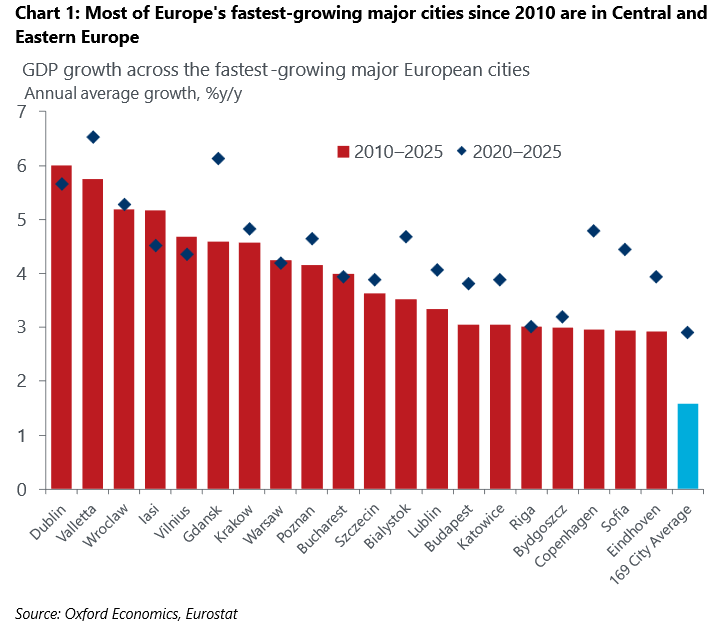
The standout performers have been Dublin and Valletta, Europe’s two fastest growing major city economies over the past 15 years. The Irish and Maltese capitals grew at 6.0% and 5.7%, respectively, over this period. Outside of these two, however, Western European cities were rare participants in the top 20. Copenhagen, one of Europe’s consistently strong performers, was 18th. Eindhoven, the Netherlands’ fifth-largest city and the birthplace of Philips electronics, was 20th.
As Western Europe has struggled, cities in Central and Eastern Europe have dominated the top of the growth tables, taking eight of the top 10 places. Poland stands out as a particularly strong performer—of the 20 fastest growing major European cities, half are Polish. Wroclaw was Poland’s fastest growing city, with its 5.2% growth rate placing it third overall. The remainder of the top five is rounded out by Iasi, Romania’s third-largest city located close to its border with Moldova, and Vilnius, the Lithuanian capital.
For many of the fastest-growing European cities—including Dublin, Iasi, Vilnius, and Poland’s Gdansk—productivity (the amount of output per input) has been the main driver of growth. In Central and Eastern European cities, this represents catch up growth relative to more productive cities in Western Europe. Through technology adoption and improved business processes, they have been able to close the gap between themselves and Europe’s wealthier cities. In Western Europe, on the other hand, cities are more reliant on increasing employment as a means of growth. This is the case in London, Amsterdam, and Luxembourg, where employment continues to grow as workers are attracted by high standards of living and strong job opportunities.
Which sectors are driving growth?
Regardless of whether it’s employment‑led or productivity‑led, service sectors have been key to growth across the top performing major European cities. This represents a shift away from growth that is reliant on the manufacturing sector. Manufacturing is still important—in 10 of the 20 fastest growing cities, it was either the largest or second‑largest growth contributor. But this is largely high‑tech, not traditional, manufacturing. For instance, ASML in Eindhoven is one of the world’s key suppliers of equipment for producing semiconductors.
The importance of services‑led growth is highlighted by the fact that the business service sector (including ICT) is the main growth contributor for 15 of the top 20 fastest growing cities. Although this is mainly through ICT‑related industries, other sectors have played a role. This includes both wholesale & retail trade and professional services sectors. We’ve also recently highlighted the increasingly important transport and logistics market across Central and Eastern Europe. This is particularly the case in Poland, which is becoming a European logistics hub.
Even when we exclude cities in Central and Eastern Europe, and look at the strong performers in Western and Northern Europe, the same trends are at play. There are several smaller cities in Western Europe that have overachieved relative to their peers, primarily through service sector growth that has enabled their productivity to drive them forward. Brighton and Hove, on England’s south coast, is home to a number of global finance and IT firms. The same is true for Aarhus, Denmark’s second‑largest city. And Toulouse, in the south of France, has strong ICT, aerospace and aeronautical industries.
At the other end of the scale, Cambridge, Bordeaux, and Nantes barely improved their productivity levels between 2010 and 2025. But the strength of their employment gains enabled them to grow at an above average rate, and notably faster than their Western European peers. Again, these employment gains have primarily been in business service sectors.
Which cities are growing the fastest since 2020?
Many of Europe’s fastest growing cities have maintained their strong growth trajectories in recent years. But the strongest performing cities since Covid-19 are in Spain, with popular tourist hotspots such as Mallorca, Malaga, and Tenerife all experiencing a rapid change in growth rates. Each of these three cities has grown over 6% annually between 2020-2025—this is three times as fast as they had in the decade leading up to Covid-19.
Although their popularity as tourist destinations has played a clear role in the performance of Spanish cities, there are a number of additional factors in Spain’s favour. These include growing technology and finance sectors, a more liberal immigration regime that attracts high skilled workers and takes advantage of remote working trends, and the strength of its renewable energy industry that enabled relative insulation from high electricity prices elsewhere in Europe.
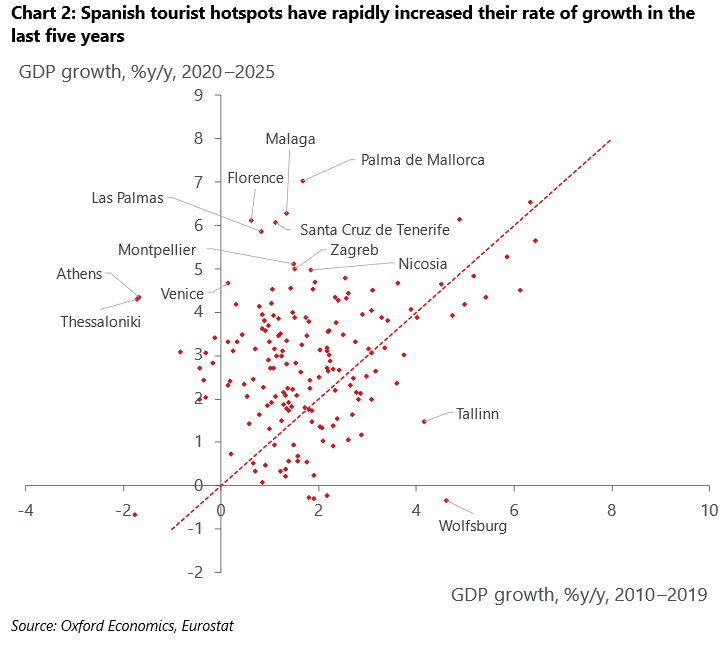
Spanish cities may be growing the fastest, but which cities had the largest jump in growth since Covid-19? Unsurprisingly, given the depths to which the Greek economy sank in the wake of the global financial crisis, Athens and Thessaloniki (Greece’s two largest cities) have seen the biggest change in performance over the last five years. Both economies contracted between 2010 and 2019, yet have grown healthily in recent years. On the other hand, some of Germany’s industrial powerhouses have disappointed recently. Wolfsburg, Braunschweig, and Leipzig, cities exposed to the auto industry through their reliance on Volkswagen, BMW, and Porsche, have struggled as the German automotive sector has declined.
Although European cities, particularly in Western Europe, have struggled over the last decade and a half, there have been some positive growth stories. Central and Eastern European cities, most notably in Poland, have posted strong growth figures, whilst Dublin and Valetta have capitalised on tech-led growth. Looking ahead, however, new challenges are emerging. From artificial intelligence to ageing populations, the pressures facing European economies continue to mount. How European cities respond to this is key to look out for.
Contact us
If you would like to find out more about our services, please fill in the form and let us know a bit more about you and what you’re looking for. A member of the team will be in touch with you as soon as possible.
By submitting this form you agree to be contacted by Oxford Economics about its products and services. We will never share your details with third parties, and you can unsubscribe at any time.