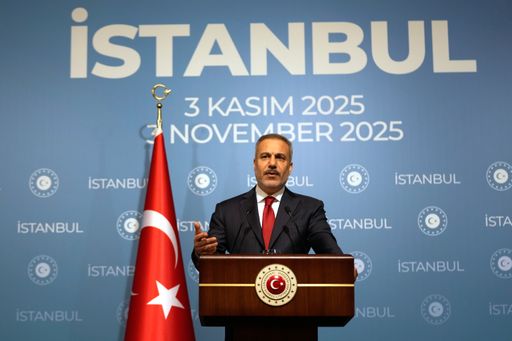
Turkish Foreign Minister Hakan Fidan has stated that countries would determine troop deployment to Israel-besieged Gaza based on the wording of a forthcoming UN Security Council (UNSC) resolution.
“What the countries we’ve spoken with have said is this: they will decide whether or not to send troops based on the content of the definition in the resolution expected from the UN Security Council,” Fidan told a news conference on Monday regarding potential Turkish participation in the proposed international stabilisation force in Gaza.
Fidan, who hosted a meeting on Gaza in Istanbul attended by foreign ministers from Indonesia, Pakistan, Saudi Arabia, and Jordan, and representatives from the United Arab Emirates and Qatar, said a key issue emphasised by countries is the establishment of a force whose mandate and legitimacy are defined within the framework of a UNSC resolution.
“Countries will largely decide based on the mandate and authorities of the international stabilisation force. I believe it would be difficult for them to send troops if the mandate conflicts with their own principles and policies,” he added.
Fidan said Turkish President Recep Tayyip Erdogan’s remarks on the issue “clearly show” that Türkiye is ready to step up for peace and make any necessary sacrifices.
“However, it is also important that the resulting documents and framework are, frankly, of a nature that we can support. Therefore, our diplomatic contacts and efforts on this issue are continuing,” he added.
He underlined that, in the process of defining the force’s mandate, first a general consensus must be reached on a draft, and then it must be approved by the UNSC without being vetoed by the council’s permanent members, adding that Türkiye and partner countries are continuing their efforts at every stage of the process.
RELATEDTRT World – Israel sabotaging Gaza ceasefire, needs to be held accountable: Türkiye’s Fidan
‘Sensitive’ process
Highlighting that this is a sensitive process, Fidan said: “We need to be very careful during this process.
“Any step taken to resolve the Palestinian issue should not create a structural basis that, while solving a current problem, may cause new difficulties in the future. We are paying close attention to this.”
Asked how governance in Gaza will be shaped and the international community’s views on the matter, Fidan said: “Essentially, there is a consensus among us on this issue. Neither we nor the Palestinians have any problem with it. Israel and other influential international actors, however, have a different perspective. Diplomatic negotiations, disputes, and groundwork are currently underway to reconcile these two differing views.”
Fidan highlighted the importance of the text to be drafted and the system to be established, including whose priorities will be addressed.
“Our principle is that Palestinians should govern themselves, and the Palestinians should ensure their own security,” he added.
He urged the international community to provide diplomatic, institutional, and economic support to implement this effectively, noting that some adjustments need to be made carefully and that they are seeking more creative solutions.
“Currently, there is a ceasefire, but when you try to move toward a more lasting solution, the deeply opposing differences at the core of the Palestinian issue resurface. These are disagreements that have remained unresolved for years.
“In addition, after two years of genocide and war, a new mindset and security perception have formed,” Fidan said, adding that resolving these issues with a new system will take time and that they will continue working with partners.