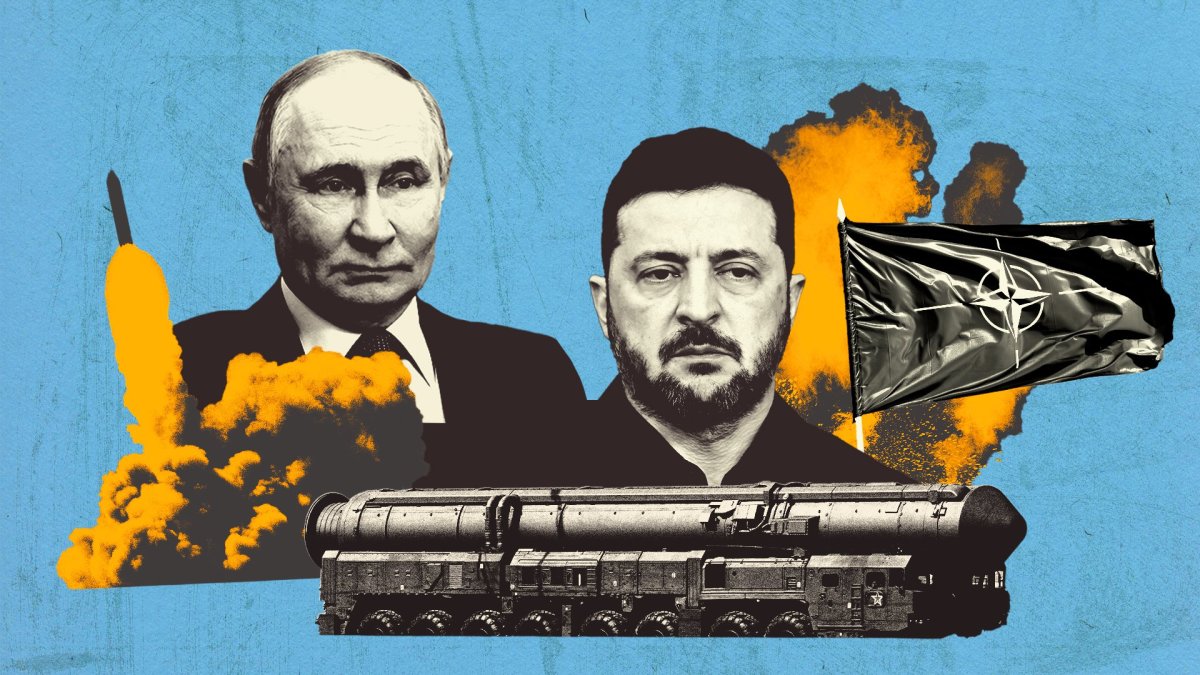
Nuclear weapons are both the ultimate deterrent and the ultimate threat. The same weapons that are capable of preserving peace can also trigger global devastation.
There hasn’t been a nuclear attack since 1945, when the United States dropped atomic bombs on Japan, yet nuclear weapon advancements and testing remain a priority for many nations. Just last week Donald Trump called on US military leaders to resume testing nuclear weapons in order to keep pace with other countries such as Russia and China.
So, as technology advances and global tensions increase, the question grows more urgent: are nuclear weapons protecting or dooming us? Documentarian James Jones, academic Dr Tim Stevens and Sky News’ Diana Magnay offer their perspective.
When you watch the massive bulk of Russia’s RS-24 Yars intercontinental ballistic missile roll its way on huge 16-wheel lorries across the cobbles of Moscow’s Red Square, its hulking, sinister exterior lodges itself in the pit of your stomach.
It is both chilling and somehow awesome, the highlight – if you will – of the annual Victory Day parade, designed to instil pride in the Russian people at their military prowess, the bearers of the ultimate in superpower weaponry, and to remind everyone else that Russia is not to be messed with.
This is the point of deterrence: you would be mad to mess with us, and we with you – but you can never quite be sure either way. Appropriate, given the acronym which sits at the heart of deterrence theory – the potential for mutually assured destruction (MAD) if one nuclear power were to launch nukes at another.
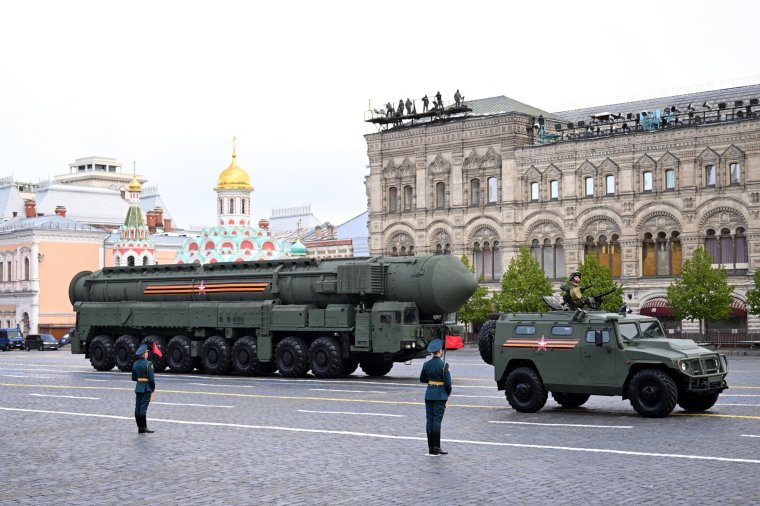 A RS-24 Yars intercontinental ballistic missile system on Red Square during the Victory Day military parade in central Moscow (Photo: Natalia Kolesnikova/AFP)
The Yars ICBM is capable of lobbing a nuclear payload halfway across the globe, many times the order of magnitude of “Little Boy” and “Fat Man”, the names of the only two atomic bombs ever used in warfare, dropped on Hiroshima and Nagasaki, respectively, and it is not even the most powerful weapons system in Russia’s nuclear arsenal.
The premise of MAD is that the consequences of going nuclear against a nuclear adversary would be so cataclysmic that it is not and never would be worth it. The brinkmanship lies in the rhetoric, in the bluff and counter-bluff, as much as the actual weaponry. Vladimir Putin, Cold War stalwart that he is, is very good at that.
As far as Russia’s interests in Ukraine are concerned, nuclear coercion has served Putin well. Nato, arguably, has been wary of intervening more concertedly to stop Russia’s illegal invasion in part because of Moscow’s nuclear capabilities and Putin’s frequent and thinly veiled threats to use them. The Kremlin’s announcement last month that it had successfully tested its long-awaited “Burevestnik” nuclear-capable cruise missile, which flew a whopping 8,700 miles and which Russia calls “invincible”, is a case in point, timed, presumably, in response to the latest round of sanctions on Russia.
Many Ukrainians believe that had they not been persuaded to give up their Soviet-era nukes in exchange for security “assurances” promised them by the United States, France, the UK and Russia in the 1994 Budapest Memorandum, promises they failed to uphold either in 2014 or 2022, Russia might have been deterred from invading.
It is why Ukrainian President Volodymyr Zelensky is so keen now on legally-binding security guarantees and preferably Nato membership, which would see Ukraine brought under the fold and supposed protection of Nato’s nuclear umbrella. But Russia cannot countenance Nato membership for Ukraine (not that it is up to them) and Nato is hardly enthusiastic at the prospect, so Ukraine remains caught at Russia’s mercy, capable of hitting back hard but only through conventional, if rapidly evolving, weaponry.
China is watching all this closely. Its nuclear triad was on full display at the huge military parade that Chinese President Xi Jinping presided over in Beijing in early September. Nato estimates China will have 1,000 nuclear warheads by 2030, nothing yet on the nuclear arsenals of Russia or the United States but heading that way.
Should Xi decide to invade Taiwan, he will make his own assessment of whether Russia’s nuclear sabre-rattling in 2022 facilitated its advance, preventing a more determined international resistance. In a recent interview with The Economist, Nato secretary general Mark Rutte said he was sure that in the event of an invasion of Taiwan, China would call on Russia to launch an attack in Europe to distract from goings on further east. “It is my absolute conviction it will not be a one-front war,” he said.
Deterrence does not manage to ensure there will be no war, but it has – to date – prevented wars from going nuclear and maintained a wary balance of power between the world’s nine nuclear states. It is 80 years since the atomic bombs at Hiroshima and Nagasaki. That is eight decades where the world’s major powers have not gone to war with one another – not a bad track record.
That doesn’t mean we couldn’t all try a bit harder. Deterrence is not foolproof. It depends on the most human of emotions – fear of what your adversary might do and a desire to stay alive, which stops you from nuking them first. We could help ourselves out a bit more through much stronger safeguards. The great Cold War-era arms control treaties have now mostly collapsed or expired and there seem to be no real efforts being made to revitalise them or to incorporate either the new nuclear actors involved or the potential impact of AI in nuclear warfare.
The last Soviet leader, Mikhail Gorbachev, was so scarred by the catastrophe at the Chernobyl nuclear reactor in 1986, which happened under his watch, that he resolved to push much harder on arms control, writing in his memoirs that it had “made me re-evaluate many things – including how little separated our planet from nuclear catastrophe”. That is still the case today. Which is why we must continue to build robust guardrails around the most powerful weaponry ever made, to ensure it works to protect us, not condemn us to nuclear armageddon.
Diana Magnay is an international correspondent for Sky News
Perspectives
Are nuclear weapons protecting or dooming us?