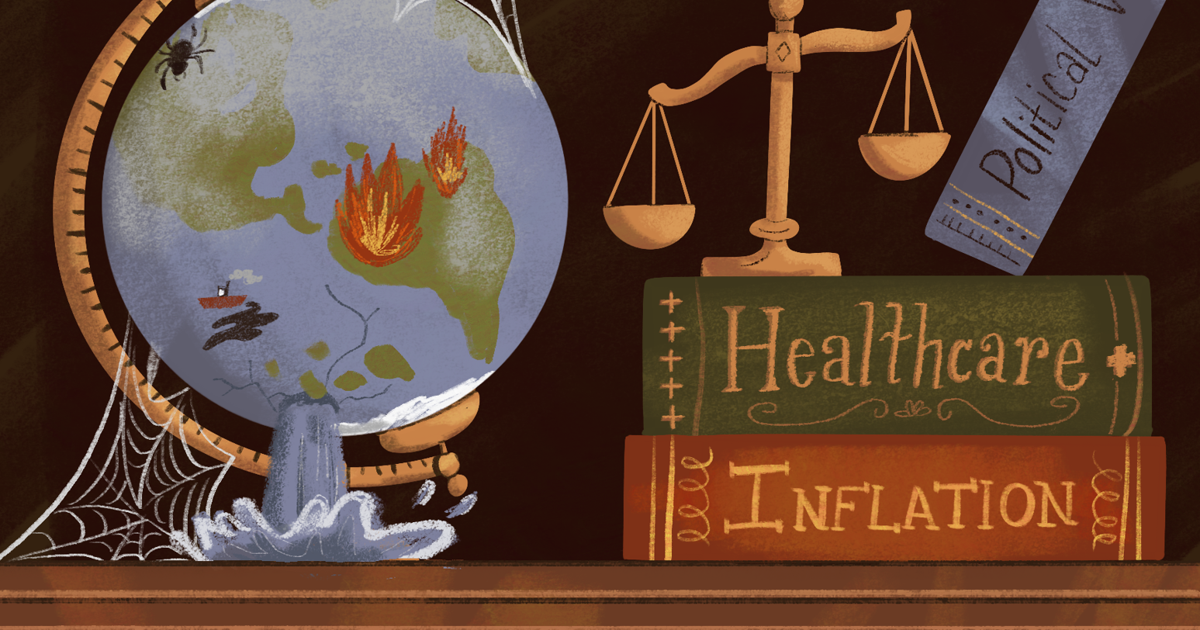


As political tensions dominate news headlines and governments wrestle with international conflict and economic instability, the urgency of addressing climate change often seems to fade into the background.
While the Antarctic ozone hole is healing due to global efforts to reduce ozone-depleting substances, there is still plenty of work to be done.
The Shorthorn Editorial Board believes that students and lawmakers should be more environmentally aware. People should acknowledge, advocate and vote for policies that work toward addressing climate change issues.
As the planet gets warmer, communities are having to deal with the repercussions.
The Central Texas floods on the Fourth of July was one of the deadliest flood events in American history, recording more than 100 people dead, according to Yale Climate Connections, a nonpartisan news service from Yale University.
The natural disaster started hundreds of miles to the southeast in the Gulf of Mexico. The body of water has gotten several degrees Fahrenheit hotter due to climate change, turning into a puddle of fuel for hurricanes barreling toward the Gulf Coast, according to the news service.
These increasingly severe weather events are not isolated incidents but symptoms of a warming planet.
At a Glance
The Issue: Although there have been strides in remedying climate change with policies to heal the ozone layer, the work is far from finished.
We Think: Students and lawmakers should focus more on being environmentally aware even in uncertain times.
Take Action: Students should advocate and vote for policies that acknowledge and work toward addressing climate change issues.
Earlier this year, the Trump administration’s Department of Government Efficiency (DOGE) significantly reduced National Oceanic and Atmospheric Administration staff, research capacity and data-sharing capabilities, including weather forecasts, according to the Center for American Progress.
The consequences of such policy decisions become clear when looking at how communities struggle to prepare for, respond to and are affected by disasters.
Intensifying weather conditions continue to affect Texas. The seasonal temperature outlook for December through February 2026 predicts that Texas weather will likely be above normal seasonal temperature, according to the National Oceanic and Atmospheric Administration’s seasonal temperature outlook.
Although fewer counties have experienced level D4, or exceptional drought, across Texas compared to October 2024, much of the state is sitting at D0, or abnormally dry conditions, according to the U.S. Drought Monitor, created by the National Drought Mitigation Center and other agencies.
Some of the historically observed impacts under a D0 category nclude grass fires increasing, surface water levels declining, planting being postponed and producers starting supplemental feeding for livestock, according to the monitor.
At the same time, extreme weather beyond the United States is also growing in intensity.
On Oct. 28, Hurricane Melissa, a catastrophic Category 5 storm, made landfall in Jamaica and became one of the strongest Atlantic storms on record.
The hurricane killed 28 people in Jamaica, at least 31 in Haiti and at least two in the Dominican Republic, according to BBC News. Thousands of people were also evacuated, and more than 60,000 homes were damaged or destroyed in Cuba.
These global and regional climate patterns serve as a stark reminder that the consequences of insufficient climate action are far-reaching and immediate.
In the aftermath of a 2017 river flooding in Texas’ Hill Country, officials in Kerr County considered supplementing the local word-of-mouth system with sirens and river gauges, along with other modern communication tools, according to The New York Times.
In May, county commissioners discussed a flood warning system being developed by a regional agency as something they might be able to use, according to The New York Times.
The change did not happen. There were no sirens and no early flooding monitors. Instead, there were only text alerts from the National Weather Service that came too late for some residents and were dismissed by others.
Rob Kelly, Kerr County judge, said in an interview with The New York Times that the county did not have a warning system because it was expensive and residents were resistant to new spending. This resistance highlights how policy priorities shaped by both elected officials and voters can have life-or-death consequences in the face of climate-related disasters.
Without proper warning systems, residents rely on those same word-of-mouth systems that may only help those nearby. As storms and floods intensify, the cost of inaction grows heavier. The need for informed, proactive participation in shaping environmental policy has never been more critical.
These local challenges mirror a broader national issue. Decreased funding and staffing at various weather services further emphasizes the importance of public awareness and civic engagement. Understanding how dangerous climate change is and its effect on natural disasters is crucial in helping communities prepare and respond more effectively.
Preparedness requires more than individual awareness: It demands collective civic action through advocacy and voting for policies that strengthen climate resilience and protect vulnerable communities.
The next flood, fire or drought won’t wait for hesitation. Residents should push for leadership that recognizes the realities of climate change.
The Shorthorn Editorial Board is made up of editor-in-chief Pedro Malkomes; managing editor Leslie Orozco; copy desk chief Rachel Kenealey; news editor James Ward; associate news editor Taylor Sansom; engagement editor Sairam Marupudi; design editor Haley Walton; and illustrator Lillian Durand. Copy editor Tara Erry was not present for this discussion.