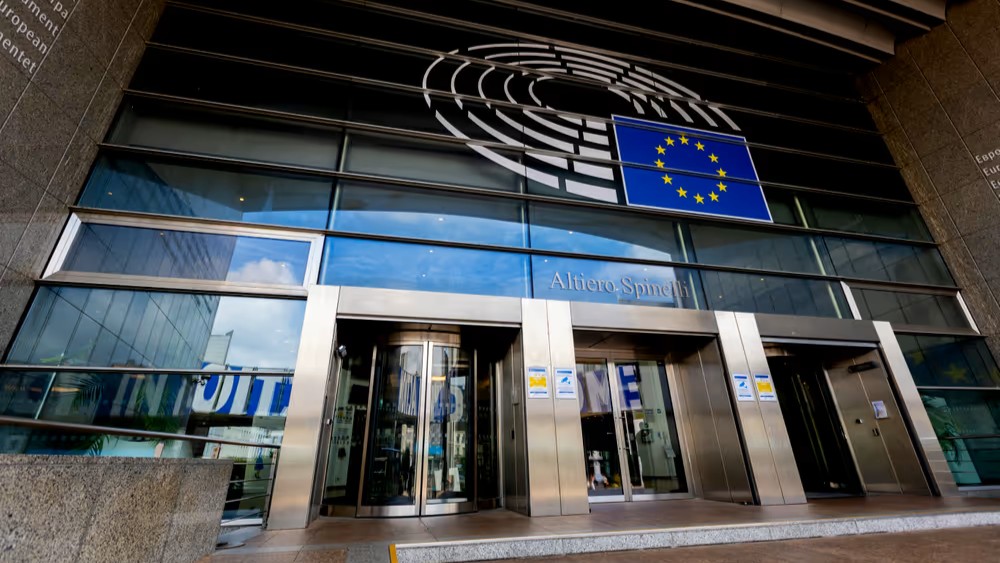
Several voices from Europe’s political right have strongly rejected what they call an “aggressive green ideology” after the EU Environment Ministers’ Council on Wednesday, November 5, struck a deal on the 27-nation bloc’s next big emissions-cutting targets—in time for next week’s UN COP30 climate summit.
EU countries agreed to target a 90% cut in greenhouse gas emissions by 2040 compared to 1990 levels.
Brussels’ top green official, Teresa Ribera, warned that abandoning such targets would be a sign of “weakness and incoherence”—which many believe to be quite the opposite of the truth—and that doing so would bring “enormous economic and human costs.”
Greenpeace said the final compromise “falls significantly short” of what is needed from the bloc of 450 million inhabitants and relies on what it described as “offshore carbon laundering.”
However, Mateusz Morawiecki, former conservative Polish prime minister, for example, slammed the adopted proposal as “suicide of the European economy.”
Austrian MEP Roman Haider (FPÖ/PfE) declared that the outcome of the EU Environment Ministers’ Council meeting can only be described as a catastrophe for Europe. He argued that everyday life in Europe—from driving to housing—is becoming increasingly unaffordable and warned that the new target is “completely unrealistic.” Haider said the plan risks inflicting serious harm on the European economy while doing little, if anything, to influence global climate trends.
Ondřej Knotek, the European Parliament’s lead negotiator on the EU’s 2040 climate target, also a Patriots for Europe MEP, called for the complete rejection of the proposed goals already back in July.
The EU has already adopted binding targets for 2030 and 2050. Our key global competitors do not have the same approach. We are being forced to focus on climate adaptation while we should be talking about security, defence, and other important issues.
Knotek and the Patriots group argue that the proposed 2040 target, though presented as a step towards climate neutrality, is in fact a costly and unproven risk. “No major economy outside the EU has a similar legally binding target for 2040. The EU is once again trying to lead the way down the wrong path—without anyone following.”
The Czech MEP added that adequate responses to climate change are necessary, but that Europe should not adopt unilateral measures that jeopardize economic stability and people’s living standards. He highlighted Czechia, where the proposed target could raise household climate-related costs by as much as €3,700 per year.
After the European Union unveiled its latest target in July, János Bóka, Hungary’s Minister for European Union Affairs, also called the proposal “unrealistic” and “extremely harmful.”
Brussels once again sees things backwards: the green transition will not be driven by unrealistic climate targets, but by a strong and competitive European economy.
Robert Telus, former Polish agriculture minister and member of the opposition PiS party, has previously agreed with the criticism, calling the deal a “threat to national sovereignty.” He warned that it would damage Polish agriculture, industry and the labor market, while paving the way for non-European states to dominate the EU market.
In Sweden, officials from the governing Christian Democrats (KD) have also voiced their concern, saying that “the debate on the EU’s 2040 climate targets must not end up in an opinion corridor where the purists are forced to stand uncritically behind an extremely narrow emissions curve–regardless of its consequences–simply to avoid being labelled climate deniers.”