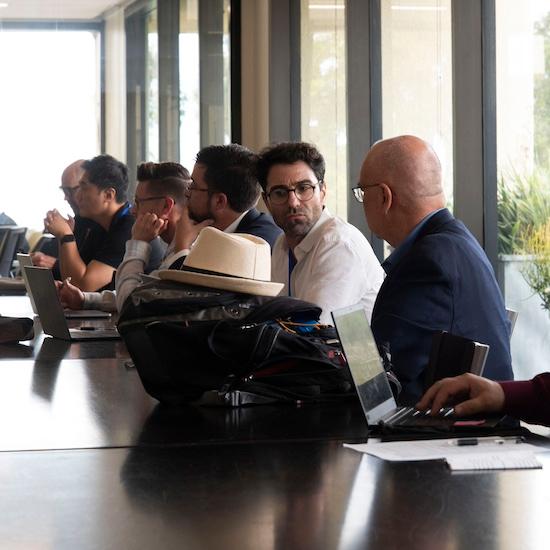
On Friday, September 26, 2025, Pepperdine University hosted its annual faculty conference,
where professors and administrators from all six schools of the institution gather
each year for a time of fellowship, celebration, and learning.Â
“It was truly exciting to see a robust and engaged gathering of the full academic
community at the 2025 faculty conference,� said Jay Brewster, the University’s provost
and chief academic officer. “The event successfully celebrated the enduring atmosphere
of collegiality, which extends to all corners of our campus. In the process, it reinforced
our commitment to providing Pepperdine students with dedicated teachers and mentors
capable of helping them navigate an ever evolving world.�
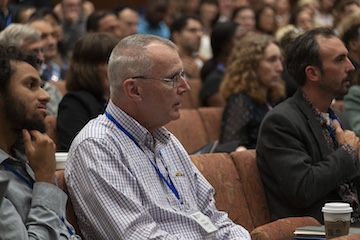 The 2025 faculty conference united University professors in learning
This year the daylong event addressed the rapid development of artificial intelligence
(AI) and recommended that University faculty members take a human-centered approach
to integrating AI into the classroom. With keynote addresses and panel discussions
from experts in the field and breakout sessions relating to each of Pepperdine’s diverse
academic disciplines, the 2025 conference helped prepare University professors to
employ AI in their work by launching  an important dialogue focused on technology,
pedagogy, and faith.
“AI is everywhere. It’s revolutionizing every industry, including higher education,
and it’s already prevalent here at Pepperdine,â€� says Lila Carlsen, Pepperdine’s vice
provost and chair of the faculty conference. “This conference was an opportunity to
learn not just the nuts and bolts of AI, but how we can use such powerful technology
in a way that is fully aligned with our values as an institution. It was an opportunity
to reassert the student as the center of our enterprise and to continue pursuing knowledge
and truth in our fields at the very highest level.�
Pepperdine hosted notable scholars and practitioners of AI at the 2025 conference
to help bring this important conversation to campus. James A. Landay, Stanford University
professor of computer science and director of its Human-Centered AI Institute, and
Ramesh Srinivasan, University of California, Los Angeles (UCLA), professor of information
studies and director of the UC Digital Cultures Lab, offered keynote addresses on
using AI in furthering humanistic pursuits.Â
A panel discussion featuring Jennifer McCaney, executive director of UCLA’s biodesign
program; William Hsu, UCLA professor of radiological sciences and bioengineering;
and Kyle Forrest, Deloitte’s future of HR leader, shared how recent AI developments
could benefit the industries of healthcare, business, and scientific development.
The panelists offered recommendations for how institutions such as Pepperdine can
use AI to benefit those they serve.Â
Carlsen organized the prestigious cohort of speakers in collaboration with Fabien
Scalzo, associate professor of computer science at Pepperdine’s Seaver College and
director of the Keck Institute for Data Science. Together, Carlsen and Scalzo recruited expert speakers who could help faculty members
recognize the potential benefits of AI in the classroom.Â
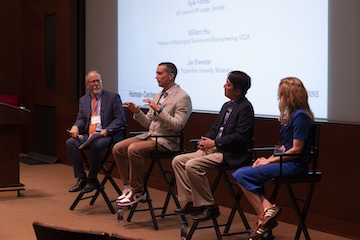 External experts and University leaders discussed the topic of AI
“With the faculty conference, we wanted to provide ideas and examples of what can
be done in the classroom with AI to benefit student learning,� says Scalzo. “AI is
disrupting the way we teach, and we wanted to provide inspiration for faculty members
to play a part in shaping how AI is being used.�
Beyond the keynote and panel discussions, the conference curated breakout sessions
that covered a variety of topics. Speakers offered commentary on how AI relates to
subjects such as Christianity and creativity, personal purpose, business, and the
humanities. Faculty members were also invited to attend a beginners’ workshop on how
to start using AI in their research. These breakout sessions, like the rest of the
conference, were designed to help Pepperdine be on the cutting edge of technological
standards.
“As Christians, we see the image of God in each other, and we would never want a tool
to diminish or to replace the importance of that value that orients everything, from
how we treat each other to how we design our courses,� says Carlsen. “However, if
we don’t adapt, we will be left behind. It is important to remember that God is the
ultimate creator, and we are cocreators with God. With AI, we can use innovative new
technologies to be more productive and effective creators.”
Pepperdine’s IT Department officially approved the use of Google Gemini and Zoom AI
companion by faculty, staff, and students in September, and the faculty conference
followed the University’s release of this new suite of AI products. Both of these
tools are private to the University, meaning none of the data imported into the respective
software systems will be available to train or refine the larger AI models. This institutional
development marks an exciting new step as Pepperdine prioritizes enhancing student
and faculty literacy in AI.Â
“Pepperdine is dedicated to equipping our students with the ability to go forth from
campus, pursue their given vocations, and make an immediate, positive impact in the
world,� said Brewster. “Thanks to Dr. Carlsen and Dr. Scalzo’s leadership, the 2025
faculty conference advanced that mission forward. By covering the concept of human-centered
AI, it took one of the most prevalent and important topics in our society and shed
light on how Pepperdine faculty members can engage and adapt to become better educators.�