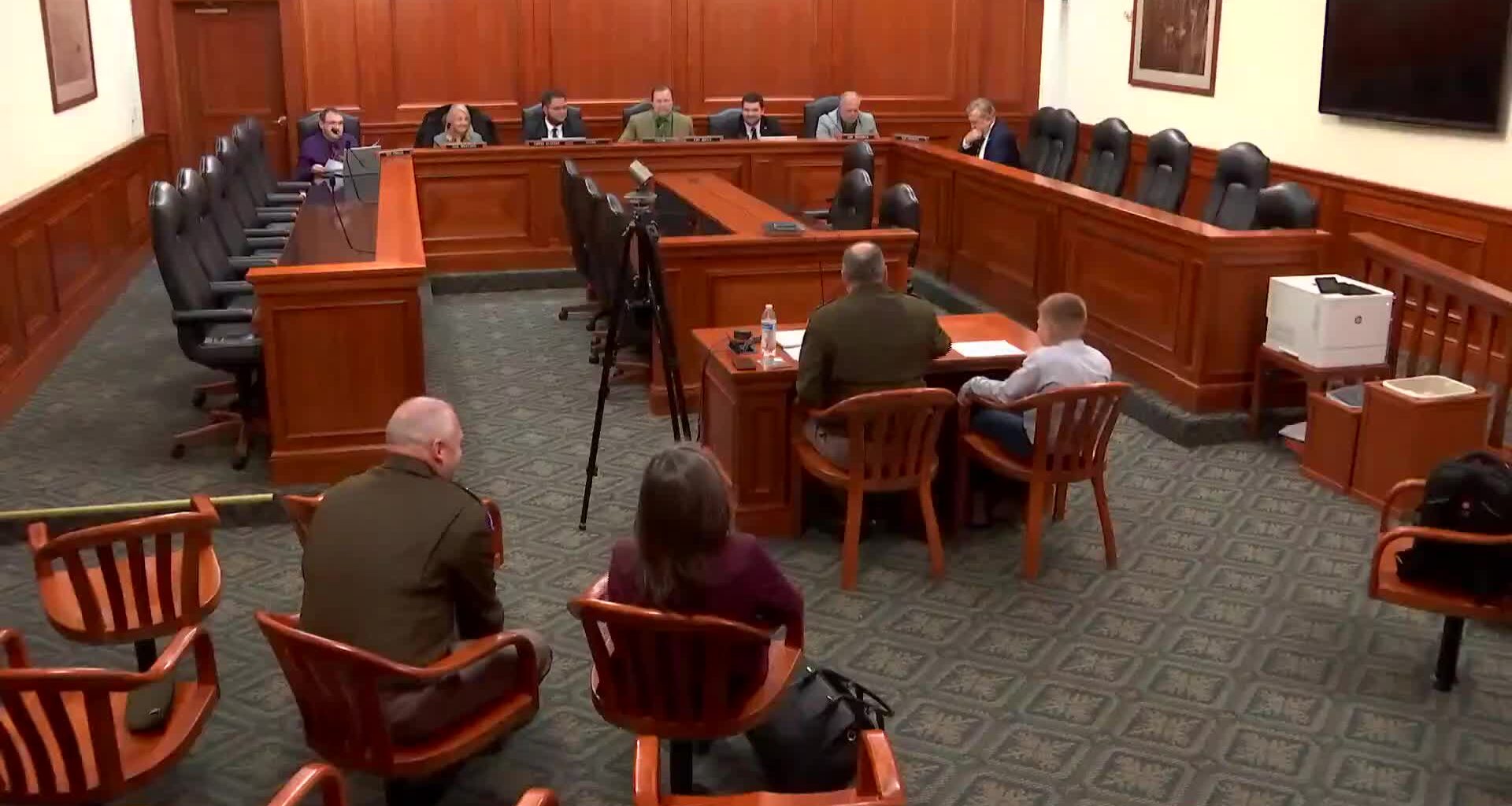
Rogers told the committee the Guard trains and operates across the state with a force of roughly 10,500 members — about 2,500 in the Air National Guard and about 8,000 in the Army National Guard — and maintains a presence in 41 Michigan communities, including large facilities at Selfridge Air National Guard Base, Battle Creek and Alpena. He described Camp Grayling as the nation’s single largest reserve-component training site with 148,000 acres and access to 52,000 additional acres for specialized training.
“Project NITRO” — a National Guard timing-assurance pilot Rogers said is running in 10 states — would provide an alternate timing signal to back up GPS-dependent systems, he told the committee. Rogers said the department’s initial estimate for deploying a Michigan implementation is about $8.5 million up front and roughly $500,000 per year to maintain the system.
Rogers warned that precise timing is central to banking, utilities, communications and critical infrastructure, and that disruption of GPS timing could “be a massive disruption to our quality of life and our ability to function.” He said federal rollout of NITRO-like capabilities is slow and that waiting for federal funding could leave the state vulnerable for years.
On uncrewed aircraft, Rogers urged lawmakers to fund radar and tracking infrastructure to achieve air-domain awareness — the ability to detect, identify and attribute drones and other unmanned aircraft. That capability, he said, is a precondition for Federal Aviation Administration approval of beyond-visual-line-of-sight (BVLOS) commercial drone operations and also is required to identify nefarious drone activity.
“If we have the ability to see our airspace in three dimensions and be able to track it and build it out across major geographic areas, we will not only be first of a kind in the nation to do that, but we will have a unique ability to track drone operations,” Rogers said.
Rogers described Northern Strike, Michigan’s marquee multicomponent exercise, as a national-scale event that in the last year drew roughly 7,800 participants from 35 states and 10 nations. He said Michigan’s training environment is unique because it permits simultaneous operations across land, maritime, air, space and the electromagnetic spectrum — a factor leaders use to attract multinational and industry partners.
Rogers also recounted a counterintelligence incident at Camp Grayling in which five people identified as Chinese nationals were detected attempting to collect information on training activities; he said FBI investigators identified the individuals and they ultimately fled the country. Rogers said such probing is “fairly routine” and highlighted the importance of detection and interagency coordination.
He told the committee the U.S. domestic drone-manufacturing base lags the People’s Republic of China in scale and price point, and urged policies that would encourage U.S. production so supply chains and data flows are under U.S. control. Rogers said Chinese-made drones have been restricted from some U.S. military uses because of data-backhaul concerns.
Committee members asked whether the state should fund an initial corridor pilot (Rogers suggested a Traverse City–Alpena corridor) and whether there are legislative hurdles to approving state-level drone corridors or timing systems. Rogers said no statutory barrier appeared to block such a program, but that the primary limitation is the capital cost to deploy the necessary technical sensors and radars and to secure FAA approvals for BVLOS operations.
At the end of the meeting Representative Menser moved to approve the committee minutes from Oct. 29; the chair said there was no objection and the minutes were approved.
The briefing covered operational readiness, multi‑domain training and specific homeland vulnerabilities — cyber attacks and lost GPS timing among them — and Rogers asked legislators to consider near-term investments to bolster resilience while the department continues interagency partnerships with MEDC, MDOT Aeronautics, the Office of Future Mobility and Electrification and federal partners.