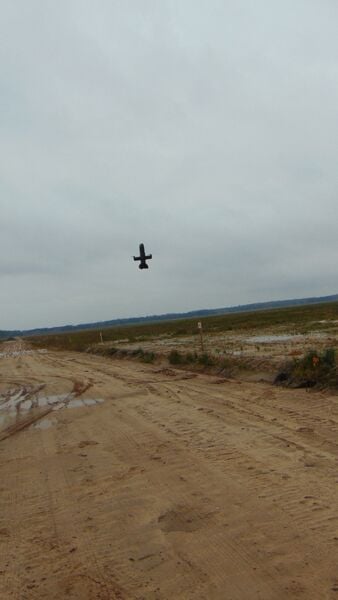

A Blaze interceptor in flight during the Defsecintel-Origin Baltic Drone Wall demonstration held at Latvia’s Selonia training range on 5 November. (Janes/Nicholas Fiorenza)
Origin of Latvia and Defsecintel of Estonia held a Baltic Drone Wall demonstration attended by journalists including
Janes
at Latvia’s Selonia training range on 5 November. Participating in the demonstration were Defsecintel’s Eirshield counter-unmanned aircraft system (C-UAS) and Origin’s Blaze autonomous unmanned aerial vehicle (UAV) interceptor and Beak strike UAV.
Defsecintel provided data from a radar integrated into an Eirshield van, enabling early detection of the target and radar information about both the target and Blaze’s position so it could be navigated and positioned behind the target without using global navigation satellite services (GNSS). Introducing the demonstration, Origin CEO Agris Kipurs said that Blaze finds targets detected by the jam-resistant radar, with artificial intelligence offering its operator the choice of which one to intercept. Defsecintel CEO Jaanus Tamm added that the radar and camera determine whether a threat is a hostile UAV. The target drone was one-fifth smaller than an actual target, making it more difficult to detect, according to Kipurs.
The demonstration involved four near-miss intercepts in which Blaze did not destroy the target drone to demonstrate that the intercept can be aborted at a distance of 20 m from the target drone and that the UAV can come back to its launch location intact.
After Blaze, a Beak was launched with four 1 kg practice bombs that were successfully dropped on a target on a 2 m² sheet from a height of 60 m. Origin lead flight operator Martins, using only his first name, said that with a 3 m radius, the hit would have been deadly, including for a main battle tank.
Gain unlimited access to Janes news and more…