
Listen to the article
3 min
Holding a conversation with a robot assistant used to be just a scene from an Iron Man movie but it’s already available in many modern cars provided by voice services specialist Cerence.
The company claims to supply its AI-powered conversational voice assistant to more than 80 automakers and Tier 1 suppliers worldwide with some 525 million cars on the road.
The latest iteration of its technology, Cerence xUI, will be integrated into Microsoft 365 Copilot, enabling a true mobile office with hands-free work tasks completed on the go.
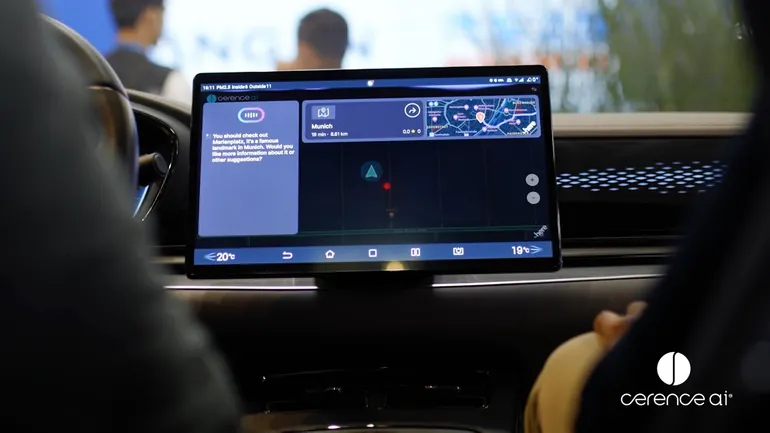
WardsAuto was given a demonstration of Cerence’s latest tech at the IAA Mobility 2025. With barely a hiccup, the voice assistant rattled out instructions quickly, even when interrupted in mid-command and redirected its attention to a new instruction.
The tech is aimed at the commuter catching up with an unfinished workload while in the car and lowering the danger of driver distraction while using mobile devices.
“We’ve all been there – you’re driving, and your phone is dinging as new emails and chats come in. You very quickly start to feel like you’re falling behind,” said Cerence AI’s chief revenue officer, Christian Mentz.
At the Munich show he told WardsAuto that Europe remains one of Cerence’s biggest global markets and there is a drive by many of its automotive clients to make AI-powered large language models (LLMs) available to their customers as soon as possible.
“Every carmaker has a desire to bring LLM-based experiences, more conversational experiences, to customers really quickly,” he said.
His company’s existing footprint in the market is being used to update current voice assistants with over-the-air updates to full LLM capabilities via the cloud.
“Several customers are already implementing this and will now officially launch this year and next,” Mentz added.
Consumers are demanding new in-cabin experiences that LLM-based technology can provide and the company is already working on its next generation of AI assistants to provide better conversational interaction and meet those expectations, explained Mentz.
“You don’t need to touch the hardware. It’s a pure cloud update that works really well with our existing stack on the embedded side, because no one wants to change hardware after it’s already launched or specified,” he said.
The software is completely agnostic and automakers can choose their own operating systems rather than use those of Cerence’s partner companies, Mentz said.
That said, he added that adoption of the technology is in its fledgling stage and no one in the industry knows just how it will develop and be monetized until the consumer begins using it.