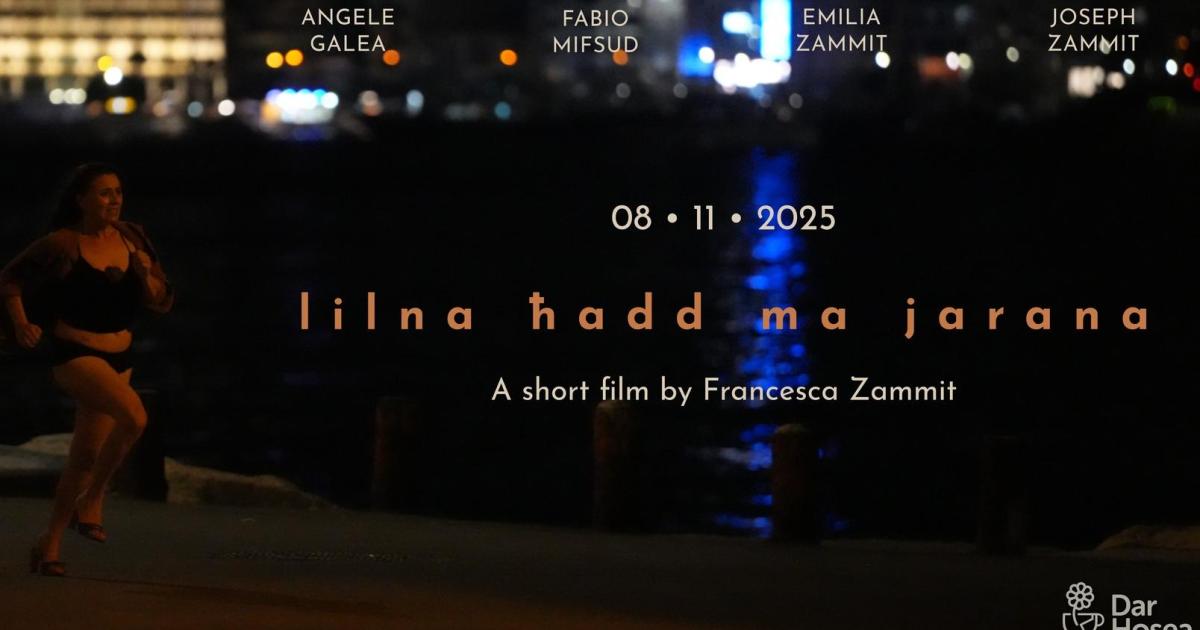
A new short film, Lilna ħadd ma jarana, explores the hidden realities of grooming and shines a spotlight on the resilience of women who endure it.
Written, produced and directed by Francesca Zammit, the short film will premiere on Saturday, November 8 at 7 pm at the University of Malta’s Valletta campus. Commissioned by Dar Hosea, the film centres on the grooming of young girls and how prostitution manifests in Malta.
Dar Hosea is a drop-in centre that provides a safe and welcoming space for women at risk of, or affected by, prostitution and sexual exploitation.
“We hear about prostitution as if it is just human trafficking and are under the false impression that it affects foreigners, but it is embedded in our society, and there are generations of local women who have been stuck in this cycle,� Zammit said.
The film follows a young girl, Emma, who was groomed into prostitution and depicts the loss of her childhood.
“I knew these sorts of families growing up,� Zammit said. “These women are all around us, and we just don’t notice them.�
In preparation for the film, Zammit volunteered at Dar Hosea to meet the women.
“What struck me was that they were very childlike,� she explained. “It was heartbreaking, knowing that people they trusted systematically took childhood away.�
Zammit acknowledged the difficulty in breaking free from this cycle but hoped the film would highlight the strength of the women.
Maria Borg Pellicano, who leads the service at Dar Hosea, said women in prostitution were often groomed into that reality.
“Sometimes it was a parent or relative who pushed them into it. It was normalised. For many, this is their reality. One woman told me, ‘I never expected to do anything else. Even when I went to school, I didn’t imagine a different life.’�
She explained that many women grow up seeing their mothers or grandmothers in similar situations, making it seem inevitable.
Dar Hosea received €5,000 from the Academy of Givers to produce the film and raise awareness of the challenges faced by women in prostitution.
“The resilience of women is the focus of the film; we want to ensure that policies truly respond to their needs and that people really listen to them,� Borg Pellicano said.
In 2024, Dar Hosea reached 149 individuals, 128 women and 21 children. However, the figures do not reflect the full picture, as the service also works with homeless women and rape survivors.Â
Saturday’s screening will be followed by a panel discussion with the filmmaker, a clinical psychologist, a legal expert, an academic researcher and a front-line social worker.