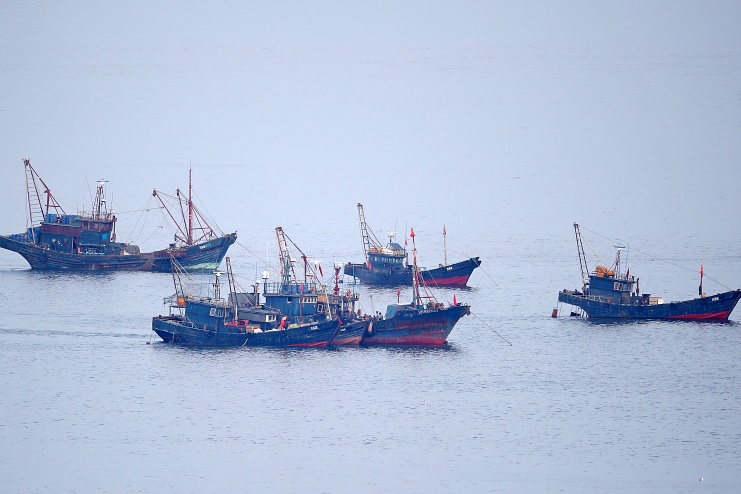
 Chinese fishing boats operating in North Korean waters off of Daeyonpyong Island. (Yonhap News)
North Korea bolstered punishment provisions in its fisheries law to emphasize “criminal accountability” in amendments made in May, with those caught illegally exporting fishery products now subject to fines equal to 10 times the value of the exported goods.
Daily NK recently obtained the text of North Korea’s amended fisheries law. According to the text, North Korea amended the law in 2024 as well, but confirming the nature of that amendment is impossible at present, so the law was compared with the 2022 revision.
The most noteworthy change was the complete revision of the law’s legal accountability system — its punishment provisions — which have been reorganized as a separate chapter.
Chapter 5 of the 2022 law was titled “Guidance and Control of Fishery Sector Activities,” but under the May revision, the title was changed to “Legal Accountability,” and the content on punishments was expanded. The amended Chapter 5 is filled solely with articles on punishments, while administrative articles previously found in Chapter 5 were moved to Chapters 1, 3 and 4.
Emphasis on accountability
Yoon Injoo, a researcher at South Korea’s Korea Maritime Institute, said the amended law goes beyond guidance and control, with added emphasis on legal accountability. Considering North Korea’s usual rhetoric, one could interpret this as meaning authorities are exercising guidance and control poorly, leading to many situations where legal accountability must be pursued, Yoon said.
The amended Chapter 5 significantly increased fines, raising penalties by at least 150% to 10-fold.
For example, the previous law set fines of 100,000 to 500,000 North Korean won for agencies, enterprises and groups and 10,000 won for individuals for catching certain fish species during their protected season. The amended law increased fines to 1 million to 1.5 million won for agencies, enterprises and groups, and to 50,000 to 100,000 won for individuals.
In cases of catching undersized fishery resources, the previous law set fines of 100,000 to 500,000 won for agencies, enterprises and groups, and 10,000 won for individuals, but the amended law raised these to 500,000 to 1.5 million won for agencies, enterprises and groups, and 30,000 to 100,000 won for individuals.
The amended law added several new fines, including penalties for producing fishery goods without documenting when the fish were caught or when the goods were produced, going to sea without having fishing gear inspected, and falling short of quotas, with fines of 1 million won or 1 million to 1.5 million won imposed on agencies, enterprises and groups.
Smuggling penalties intensified
The previous law imposed fixed fines on agencies, enterprises, groups and individuals who were caught illegally exporting fishery items, but the amended law intensified the punitive nature of the fines, imposing penalties equal to 10 times the value of the exported items. As the fine grows alongside the scale of the smuggled items, authorities appear intent on stopping large-scale fishery smuggling at the source.
North Korea also added an article — Article 50 — that bans fishing boats from going to sea.
A total of eight infractions — operation of illegal fish farms, using banned fishing gear or fishing methods, exceeding the deadline for registering catch results, hindering the adoption of fishery information management systems, omitting or refusing to respond to fish farm surveys, refusing to release baby fish, going to sea without permission, and refusing lawful crackdowns or surveys by supervisory officials — are now punished with temporary bans on fish farm operations or going to sea, and with permanent bans in severe cases.
Authorities have essentially warned that they will strictly manage fisheries by including not only illegal activity but also hindering administration and uncooperative behavior in their list of infractions subject to sailing suspensions, Yoon said.
The amended law rearranged the entire fishery management, production and processing processes to manage and supervise them in a centralized way by prioritizing administrative control, unifying procedures, bolstering the protection of scientific and environmental infrastructure, strengthening the planning system and intensifying and subdividing penalties, Yoon said.