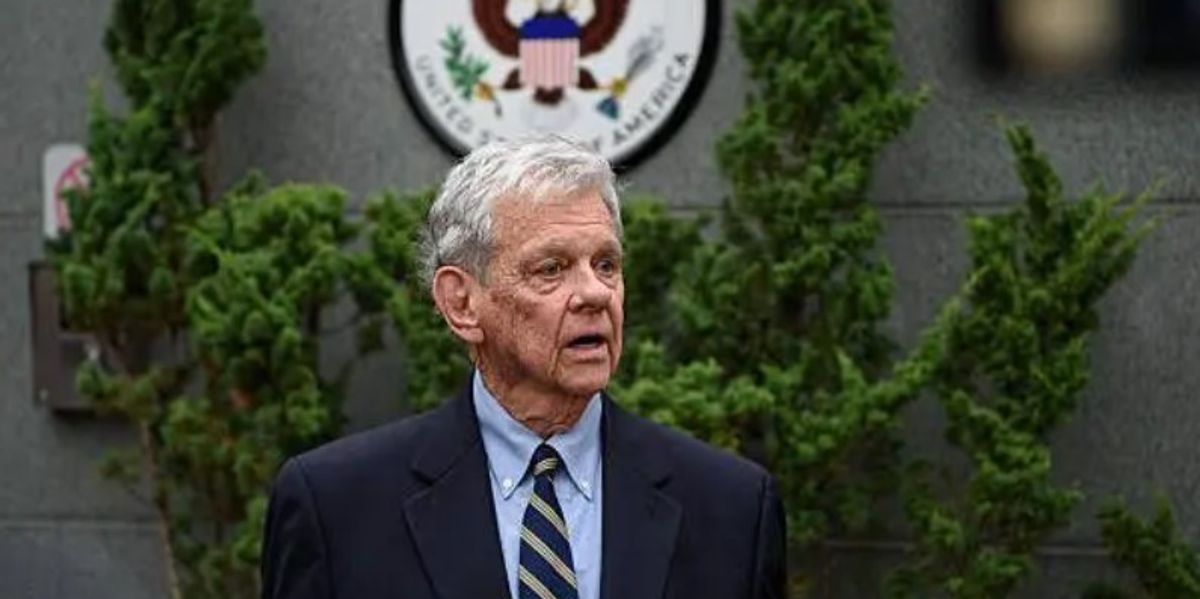
US President Donald Trump announced that he had appointed John Coale as US special envoy for Belarus, with the aim of securing the release of other political prisoners held by the regime of dictator Alexander Lukashenko.
“He has already successfully negotiated the release of 100 hostages and is targeting 50 more,” Trump wrote on his Truth Social account, the Telegraph reports.
The announcement follows US efforts in September to free dozens of political prisoners, who include opposition figures, journalists, protesters and foreign citizens.
John Coale, who currently serves as deputy special envoy to Ukraine and is a former personal lawyer to Trump, helped negotiate the release of the prisoners during his September visit to Minsk.
Following the release, Washington lifted sanctions on Belavia, the state-owned airline of Belarus, which had been under restrictions since August 2023.
For its part, Minsk has increased efforts to break away from the diplomatic isolation imposed by Western countries for its role in Russia’s full-scale invasion of Ukraine and for its support for it.
Minsk has faced severe Western political and economic sanctions due to its support for Moscow, as well as the massive electoral fraud that saw Lukashenko retain power in the 2020 presidential election, which was widely contested.
Trump envoy Keith Kellogg revealed in late September that the goal of the renewed dialogue with Belarus is to “secure lines of communication” with Russian President Vladimir Putin, as part of a broader push to end the war in Ukraine.
Lukashenko also expressed his willingness to strengthen ties if it meant benefits for Minsk.
“I would like to thank in advance the Honorable President of Belarus, Alexander Lukashenko, for his consideration of the release of these additional individuals,” Trump concluded in his post.
Lukashenko, who has ruled Belarus since 1994, is widely seen as a close ally of Putin.
In September, Belarus and Russia held large-scale joint military exercises Zapad-2025. The Kremlin claimed that around 100,000 troops took part – a show of force that increased tensions along NATO’s eastern flank. /Telegraph/