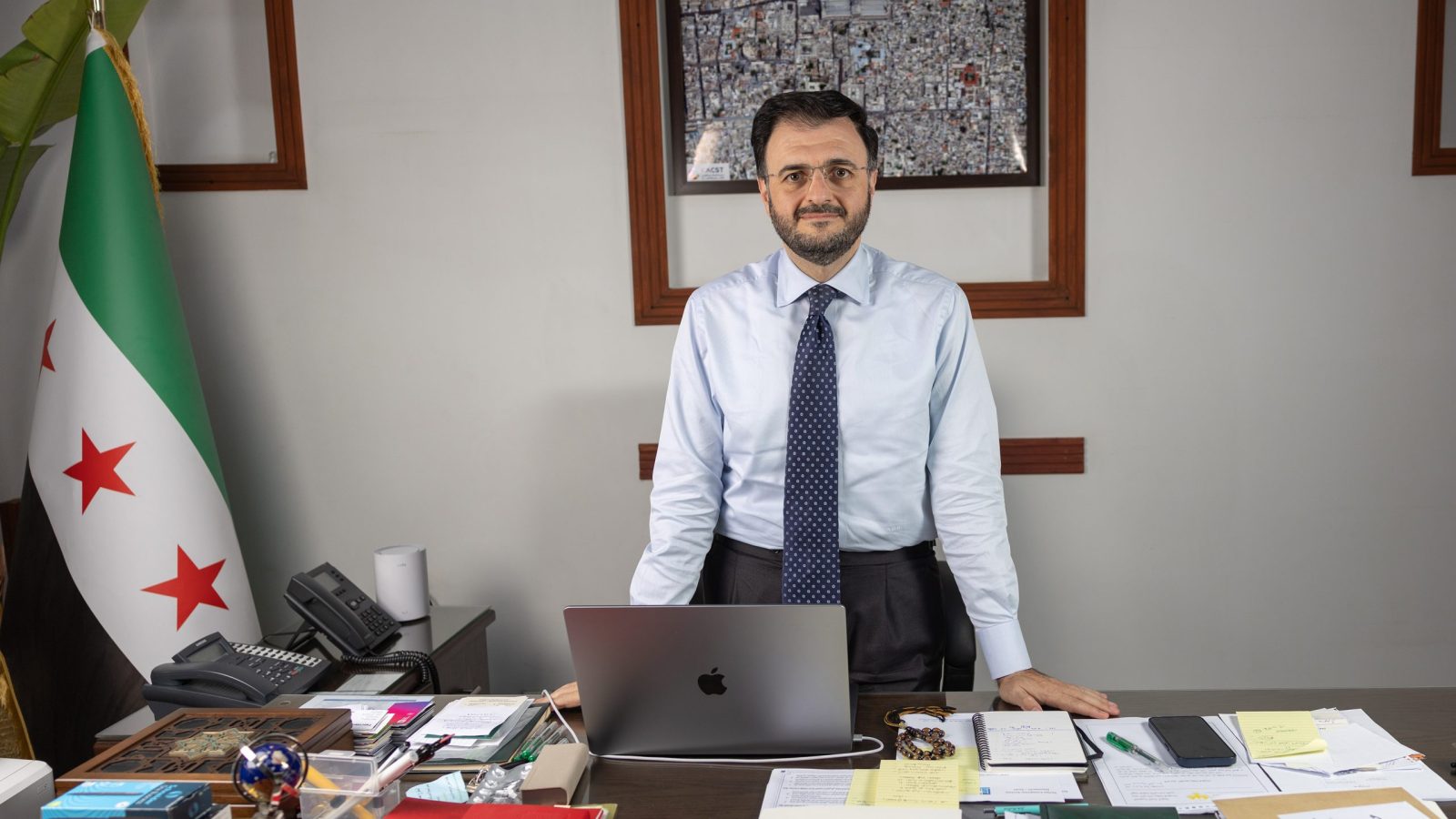
Abdulsalam Haykal faces a practically impossible task: to bring Syria back online after 14 years of civil war and decades of Western sanctions. In his first interview as Syria’s minister of communications and information technology, Haykal said he’d thought hard about whether he should even accept the post. “It was something that took me time to really consider,” he told Rest of World, as autumn sunlight flickered through the stained-glass windows of his Damascus office.
After rebels overthrew former President Bashar al-Assad last December, many observers questioned the intentions of the country’s new leader, Ahmed al-Sharaa, whom the U.S. had designated as a terrorist. Haykal was in exile and unsure if it was safe to return. But while he debated joining the new government, he recalled, he felt “the anticipation that every Syrian had over the years for this moment, when everyone can participate, everyone can feel this sense of ownership.” He added, “But I knew it was going to be very tough.”
Born in 1978 in Damascus, Haykal got his master’s degree from SOAS University in London, then took over his family’s shipping and logistics business. He left Syria in 2012 after the outbreak of war. He was placed, he said, on a regime arrest list: “I was compelled to leave the country due to my stance against the regime’s crimes.”
From his new base in Abu Dhabi, as CEO of Haykal Group, he founded several portfolio companies focused on media, digital innovation, and artificial intelligence. He is leaning into that startup mindset now. His first days on the job were “overwhelming,” he admitted. “But, you know, I’m an entrepreneur, so I’m used to it. You have a vision and you work towards it.”
Haykal is clear-eyed, but determinedly optimistic. A new World Bank report estimates that Syria’s reconstruction will cost at least $216 billion — finances the country doesn’t have. The state still suffers daily power outages. Internet speeds remain among the world’s slowest. Yet Haykal sees potential in a country finally free from the brutal rule of the Assad dynasty.
Thousands of fellow exiles — many of them successful tech professionals — are returning. U.S. President Donald Trump has ordered the removal of most sanctions, opening the way for foreign finance. While the Assad regime was infamous for seizing revenue from businesses, Haykal has traveled the region courting investors. He announced an ambitious slate of public-private projects to deliver high-speed internet and overhaul the country’s decrepit telecom infrastructure. One initiative, which Haykal has deemed Syria’s “digital Silk Road,” would be a 4,500-kilometer (2,800 miles) network of fiber-optic lines and submarine cables designed to turn the country into a data corridor.
Haykal opened up about Syria’s efforts to draw international investment, the hard truth about the country’s current tech infrastructure, and his reasons to be hopeful.
This interview has been edited for length and clarity.
In your first days in office, what were the biggest challenges you saw?
Syria was disconnected from the world for 15 years. And in that time, the world made a leap of 50 years. So, they weren’t a normal 15 years.
Unfortunately, Syria today ranks very low both in broadband connectivity and mobile connectivity — in both, we are in the bottom 10%. So the idea of bridging this gap of 50 years was definitely something that I found daunting. But it didn’t really deter me.
Does the job ever feel impossible?
Yes, often it feels impossible, but the only way is forward. Some people have the luxury of just walking away. But this is really an historic chance that won’t come again for Syrians, to come together around this moment and this transition. The entire team works long hours, and of course, you deal with a lot of complexities as we are a ministry that’s responsible for a service that people use all the time. So whether they have internet or not, a good quality connection or not, that kind of connectivity that they’re aspiring to means something to them about whether this time is different from before.
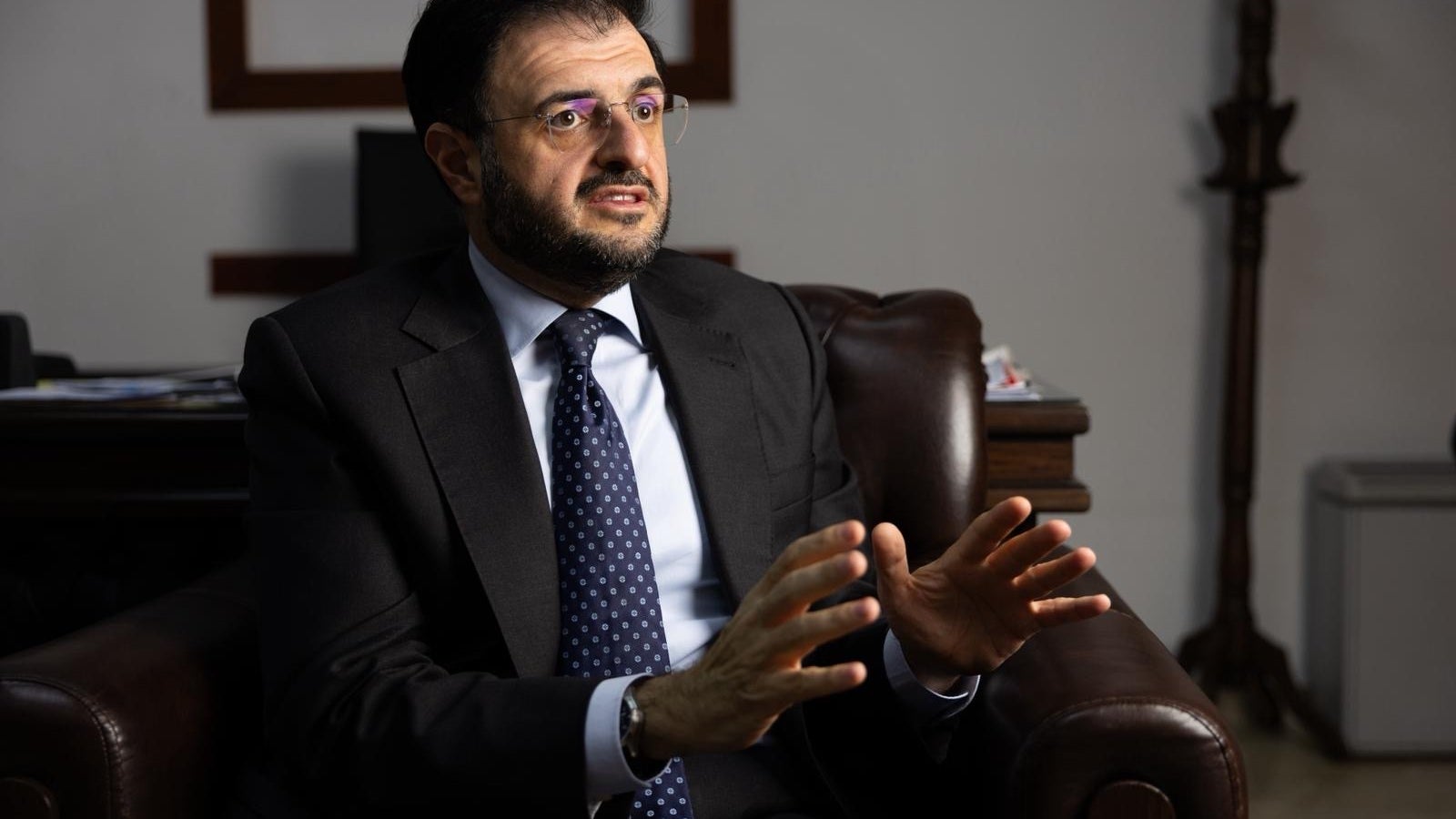
Haykal in his Damascus office in October.
Ali Haj Suleiman for Rest of World
You’ve promised a digital transformation. But for most people living here, internet speeds are still slow, there are constant power cuts, and relatively few people are online. How do you bridge the gap between vision and daily reality?
The number one priority is infrastructure. What we have today is designed probably at best, in terms of capacity, for 2011 — that’s at best. When 5G was introduced, Syria was disconnected. When fiber became the name of the game, Syria was also disconnected. We need to bridge these two areas.
First, we’re rolling out fiber across Syria to be able to carry the traffic that we need. We need the major connecting lines between cities, the internet exchange points, and the data centers to be there. So we need that national backbone. It’s a huge investment that costs between $400 million and $500 million. In terms of what the government needs to spend on first, probably this will not be number one, so that’s why we offered it as an investment.
As an investor, you come and invest in the backbone, and against this you get international traffic through Syria. Submarine cables carry traffic through the Red Sea to Asia, and this route carries 17% of global internet traffic, and 90% of the Europe-Asia traffic. This is a choke point for the world. Syria, through our Mediterranean coastline, can provide another route.
So if you build cable landing stations on the Syrian coast, and then you build terrestrial routes through Jordan, Saudi Arabia, out to the international cable systems in the Arab Gulf, and then the Indian Ocean, this first provides route diversity. So from a geopolitical point of view, this is something that countries are seeking, hyperscalers [companies that operate large cloud and data centers] need, and so on. But also, the Syrian route would be shorter by around 6,000 kilometers (3,700 miles) for a round trip.
Sectarian violence and Israeli airstrikes this year have underscored how fragile the country remains. How do you convince the outside world that Syria is a safe place to set up businesses and invest?
Syria historically has not been a safe country for investors from a cash repatriation point of view, investment policies, and so on. So first, we’re giving investors the security of protecting their investments.
The other thing is, from a security point of view, whether the country is safe for people to operate in, to live in, to thrive in? Probably Damascus today is safer than New York or Chicago. Are there concerns? Of course. Not every part of Syria is Damascus. But that’s a work in progress. I do not really anticipate anything that could derail us from a security point of view, unless something dramatic happens, which I do not see on the horizon. We are on track to increase the level of safety and security in the country.
It might seem to an outsider as Mission Impossible. That’s why you need the will, because it is a complex situation. So we have the intent and we have the will. What we need more of are the tools. Technology is a tool. Money is a tool. Experience is a tool. Expertise is a tool. And we’re building that tool kit.
For decades, the Syrian state controlled all major sectors. Is this government ready to loosen control and let the private sector take the lead in rebuilding the digital economy?
Yes. It is a government that is confident: confident in its vision for the country, confident in its legitimacy, confident in the support that it has from people, and confident that it’s really restoring Syria’s mercantile character and nature. This is a dimension of Syria that has given the country strength over the years. What you’ll find in Syria is deep technical expertise across the board, but specifically in technology. With that, you find business acumen. So that combination is what made Syrians succeed in Europe, the U.S., and anywhere they went in those difficult 15 years. There is a lot of value in that to unlock for Syria. When you do that, you need to do it with a long-term vision, but also with confidence.
It might seem to an outsider as Mission Impossible. That’s why you need the will.”
Now, what happened before in Syria was that governments did not have the confidence to open up, because when you open up to the private sector, you are ceding part of your control. And when Syria offered these big, ambitious projects [under the new government], it sent a message that I’m not talking only about survival. I’m talking about strategy and vision. And when you have something that is bigger than survival, many countries would like to pitch in and be part of it, because it’s an opportunity. In the past, we had a government that wanted to only survive.
How are investors responding to the lifting of sanctions? Are there any lingering concerns about the new government? The U.S.’ terrorist designation of Sharaa was lifted only recently.
The context during which these designations happened is a very different context from today. Syria has been a problematic country for the world. It is a country that has built its foreign policy on being a regional bully, on noncooperation with the world. Now you find a foreign policy that’s saying, “I extend my hand in confidence for partnership, and I’m going to provide an economic opportunity that comes once in a generation or two.”
Number two: All this transformation is happening in a really troubled region, in a region that needs a positive story. And the world is listening.
What’s this government’s level of savvy when it comes to tech?
We’re starting from a very low base here, so it’s still a long way ahead for digital transformation in the country. We need to work on e-government services, government apps — things that have become a given in other parts of the world are still big things to grapple with here. The intention of the government is to deliver an efficient, corruption-free — to the extent that any country can limit corruption — and dignified experience for citizens in government services, and this cannot be delivered without technology.
We also need to work on entrepreneurship and startups. Why? Because the rest of the services are provided by the private sector. So you do your paperwork online, you get a birth certificate online, you open a bank account online, and at the end of the day, who does the last-mile delivery? These are all private-sector companies, and most of the time they’re new companies — startups — so we need to encourage them. Syrians have a storied history of entrepreneurship in Syria and around the world, so we need to actually build the environment in which these startups thrive, in which there is innovation.
How has your entrepreneurial experience shaped your approach and priorities in government?
I combine a few personalities there. One is that I am the third generation in a family business. You are always reminded of the legacy, the preservation.
An entrepreneur is about new things — so you have this mindset of legacy and preservation and belonging to something that is bigger than yourself, and then you have the idea of disruption, thinking of new things and moving fast. Syria is at a stage where both dimensions are part of our story.
There is an amazing legacy in the country that is mostly the ability of the people. It’s extraordinarily moving for me everywhere I go. I meet Syrians, and I speak to the governments they work for, the companies they work for, and they tell me how incredible having them has been. Their contribution, their open-mindedness, their unique combination of technical skill plus business acumen — and really, this is our national asset.
In Syria now, it is a startup nation. So we are rebuilding the nation. It’s about our past, our legacy, and the nation that we’ve been hoping to build for many years. And now it is our chance to contribute.