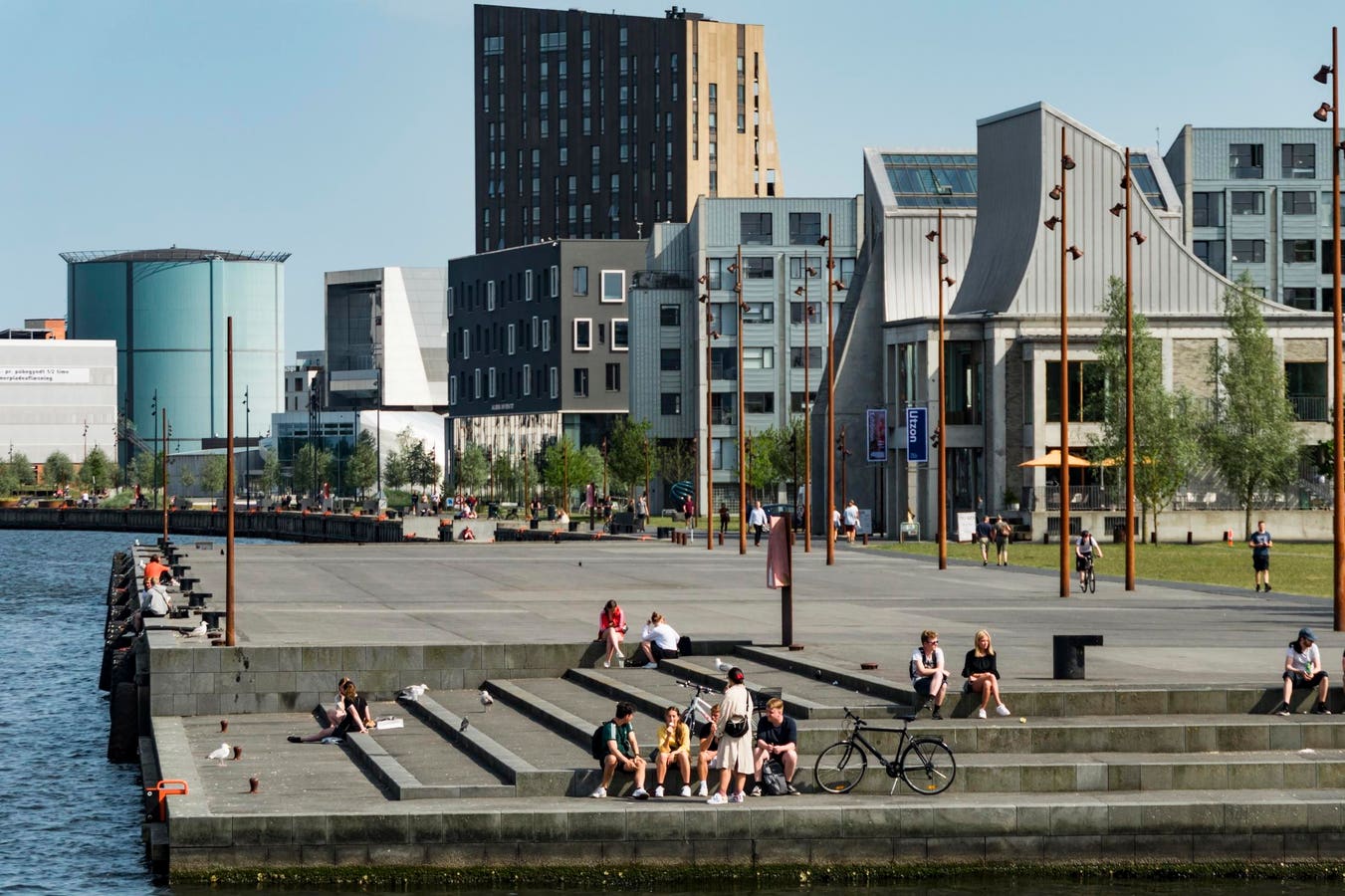
Aalborg’s redeveloped waterfront has become a gathering point for locals and visitors alike.
getty
Sitting on the Limfjord in northern Jutland, Aalborg was known more for cement factories, shipyards and industrial smoke than for art, architecture or waterfront strolls.
But the heavy industry that once dominated the shoreline has gradually given way to open boardwalks, cultural centers, public art installations and outdoor gathering spaces that feel distinctly Scandinavian in their design-forward simplicity.
Aalborg’s Quiet Reinvention Put People First
Stand on the waterfront today and it is difficult to picture the Aalborg of the past. Locals sit with coffee at outdoor tables. Cyclists move along the water’s edge. Children clamber on play sculptures. The atmosphere is calm, open and social, a place that encourages lingering rather than rushing through.
Aalborg has not reinvented itself with spectacle or grand statements. Instead, it has quietly reshaped the way people interact with the city itself.
This shift did not happen overnight. Aalborg’s regeneration began in the early 2000s with a long-term planning vision focused on public space and cultural identity. Industrial facilities were moved away from the central waterfront and large tracts of land were cleared for redevelopment.
Instead of filling the area with high-rise apartments or corporate offices, the city took a different route, prioritizing architecture, community and culture as catalysts for renewal.
The result is a waterfront that feels open and human-scaled, where cultural institutions sit side by side with wide public spaces that are deliberately free to enter, enjoy and use.
Aalborg’s Cultural Gateway
One of the most symbolic landmarks of this transformation is the Utzon Center, a low, sculptural complex that sits directly on the water.
The Utzon Center in Aalborg, Denmark, was the last building to be designed by Jørn Utzon, the architect behind the Sydney Opera House.
getty
Designed by Kim Utzon as a tribute to his father, Jørn Utzon, the architect of the Sydney Opera House, the center functions as a museum, workshop space and cultural hub.
Jørn Utzon was born in Aalborg, and the building connects the city’s industrial history to its creative future. Inside, exhibitions often explore the intersection of architecture, design and society, while the building’s form invites natural light and fluid movement.
Just a short walk away is another cultural anchor: Musikkens Hus, Aalborg’s striking concert hall. Its glass and steel façade reflects the water and sky, while its interior hosts classical performances, contemporary concerts and educational programs.
Together, the Utzon Center and Musikkens Hus form a cultural gateway along the fjord, signaling the city’s shift from production to creativity.
Further inland sits Kunsten modern art museum, designed by Alvar Aalto along with Elissa Aalto and Jean-Jacques Baruel. The building is a masterclass in Nordic modernism.
Surfaces in pale stone and wood create a quiet, meditative atmosphere that suits the museum’s rotating exhibitions and permanent collection. The museum’s light-filled café opens onto a sculpture garden, echoing the city’s emphasis on blending indoor and outdoor spaces.
Modern Aalborg Beyond Buildings
Aalborg’s transformation is not limited to institutions. It is visible at the street level too. Large-scale murals and street art installations have appeared throughout the city, many created during an ongoing program that brings international artists to Aalborg each year.
The pieces are bold in scale but sensitive in tone, offering visual surprises in side streets and residential districts.
This artistic presence adds color and texture to daily life and reflects the influence of the city’s university and growing student population, which contribute to a youthful, creative energy.
Aalborg’s public spaces are thoughtfully designed with a people-first concept.
getty
The city center remains compact and walkable. Outdoor dining comes alive during the warmer months, particularly near the waterfront, where restaurants and cafés spill onto pedestrian walkways.
In the evenings, Jomfru Ane Gade becomes one of Denmark’s liveliest nightlife streets. Its bars and venues draw both residents and visitors, although the atmosphere varies throughout the week. On warm summer nights, the street becomes a social corridor, while quieter nights offer a more relaxed pace.
How To Visit Aalborg And Beyond
Getting to Aalborg is relatively straightforward. Flights connect the city with Copenhagen and several European hubs, while overland travel by train or car brings travelers through the scenic northern Jutland countryside. Once there, most of the city is navigable on foot or rented bicycle.
For a deeper sense of Aalborg’s history, travelers can cross the fjord to Lindholm Høje, an ancient burial site on a hillside overlooking the city. The remains of stone ship settings and grave markers date back to the Iron Age and Viking Age, offering a connection to a far older chapter of northern Denmark’s story.
Aalborg is historically linked with aquavit production, and the spirit remains part of its cultural DNA, though production itself has shifted elsewhere in Denmark.
An appreciation for flavor and craftsmanship lives on in local dining culture, where modern Danish cooking tends to emphasize seasonal ingredients, simple presentation and comfortable hospitality.
As European cities continue to rethink the role of public space, Aalborg stands as an example of what can happen when a city chooses to reshape itself gradually, thoughtfully and with a focus on how people experience the urban environment.
MORE FROM FORBESForbesCopenhagen Tours Beyond The Sightseeing BusBy David NikelForbesWhy Denmark Is The Scandinavian American Travel Destination For 2025By David NikelForbesHow The Øresund Bridge Transformed Travel In ScandinaviaBy David Nikel