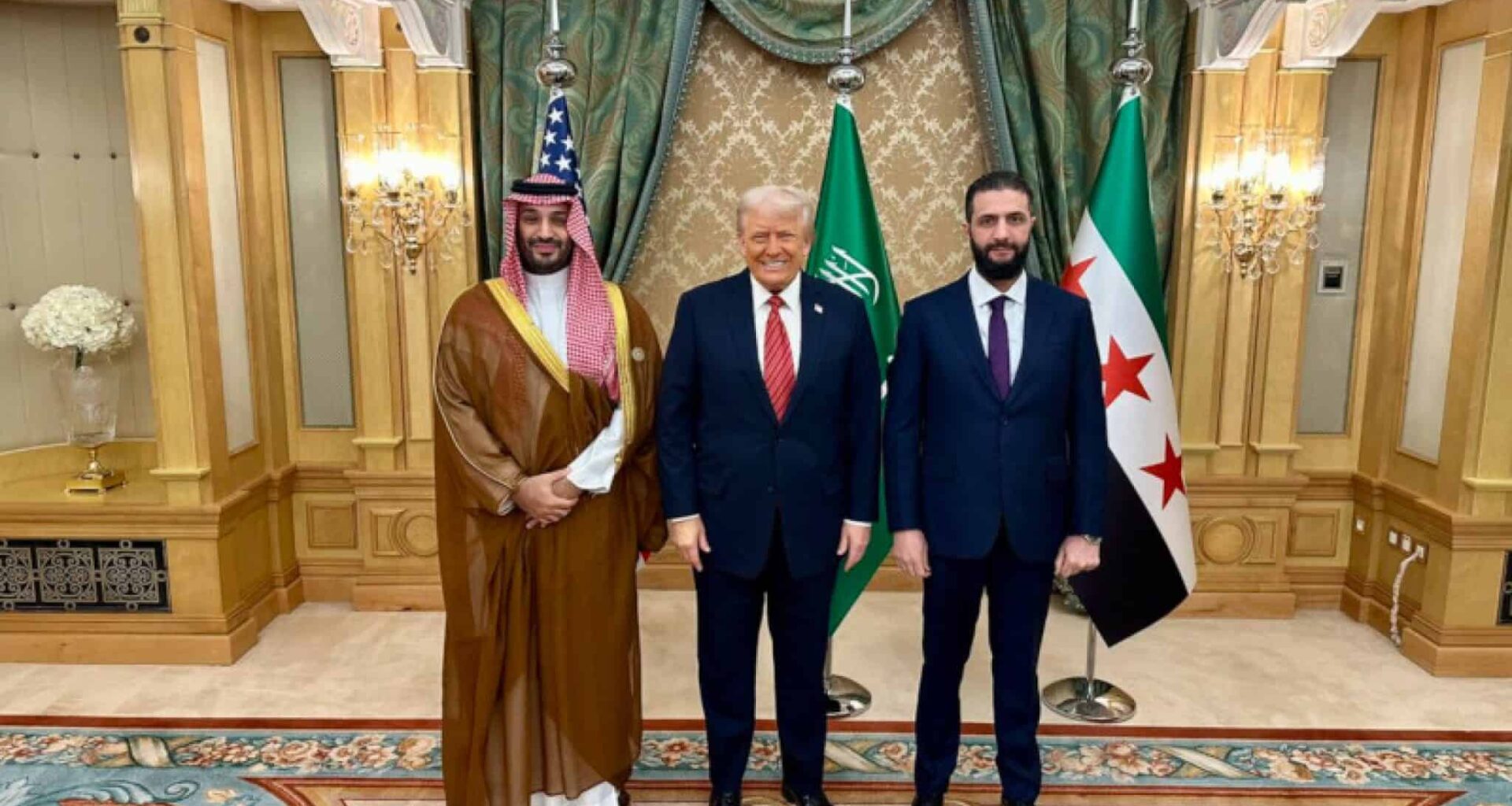
As we approach one year since the overthrow of Syrian dictator Bashar al-Assad, the possibility of a US-aligned Syria seems ever more likely. Former militant and now-President of Syria, Ahmad al-Sharaa, has positioned himself as a non-ideological pragmatist seeking to rebuild Syria by partnering with the West and the Gulf Arab monarchies, a sharp contrast with Assad’s close ties to Russia and Iran. Even so, many have been critical over the Trump administration’s rehabilitation of al-Sharaa given his past membership in al-Qaeda. While these concerns are completely understandable, they also miss al-Sharaa’s recent record, his incentives, and the substantial opening for American foreign policy in the Middle East. A realist foreign policy would acknowledge that, while al-Sharaa’s past crimes are detestable, the possibility of adding Syria to a Western-aligned coalition of Middle Eastern states is too strategically significant to discount.
Beginning with the elephant in the room, the current President of Syria, Ahmad al-Sharaa, was a wanted terrorist who fought for al-Qaeda in Iraq and later served as the al-Nusra Front’s Emir in Syria. In 2017, he parted ways with al-Nusra and helped to create Hayat Tahrir al-Sham (HTS), a Sunni Islamist group that governed the Idlib region of Syria from 2017 to 2025. Al-Sharaa’s choices in ruling Idlib during that time betray his ideological departure from al-Qaeda and al-Nusra. Instead of prioritizing the implementation of a strict Salafi-Jihadist interpretation of Islam, his rule focused on institution-building, economic development, and expanding educational opportunities. That his Idlib-based government was engaged in intense fighting against al-Qaeda and ISIS attests to the fact that, at the very least, those groups long ago ceased to perceive him as an ideologically committed Salafi-Jihadi militant.
To the surprise of many Western analysts, instead of ruling as an authoritarian, al-Sharaa began his rule as a moderate. He explicitly instructed his forces to respect minority places of worship, especially churches. He met with delegations of different religious groups, including Christians, Druze, and Shia. Beginning in January of this year, his government began cracking down on Islamic State, thwarting an attack on the Shia Sayyida Zainab Shrine in Damascus and retaliating against the terror group after the Mar Elias Church attack in June. Following al-Sharaa’s November 10th meeting with President Trump in Washington, DC, it was announced that Syria would officially join the United States’ anti-ISIS coalition.
Furthermore, he has declined to implement compulsory hijab for women, has trimmed his beard to appear more Western, has begun wearing Western-style suits, and has appeared in public with his wife to display a more moderate and friendly image. While some critics believe al-Sharaa’s performance is purely for the sake of PR, it’s important to note that truly committed Islamist militants generally don’t abandon their entire ideology once power is attained. We saw that with the Taliban takeover of Afghanistan, where strict restrictions were placed on women and minority groups as soon as Kabul was conquered.
Al-Sharaa has proven to be a complex and contradictory figure whose past and present don’t necessarily align. During his teenage years, he fell deeply in love with an Alawite girl, but both families rejected the relationship. His later role as a dyed in the wool Sunni Islamist militant has also come into question, having long been viewed as two-faced and untrustworthy by some in Islamic State. Since his split with ISIS in 2017, he’s often been described as a moderate pragmatist. It begs the question of whether al-Sharaa is truly motivated by a desire to create an Islamic emirate or to rebuild Syria into an economically prosperous and internationally connected nation. So far, the latter seems to be the case.
On the international stage, al-Sharaa has worked to establish new relations with the West and Gulf States. The Trump administration has reacted positively to his efforts, recently endorsing a repeal of the Caesar Act, a major sanctions bill levied against Assad’s Syria. Following their November 10th meeting at the White House, Donald Trump has now met with al-Sharaa twice. After their May meeting in Saudi Arabia, Trump described him as “young” and “attractive.” Aside from their warm personal relationship, al-Sharaa’s Syria plays a crucial role in the United States’ regional strategy. An allied Syria gives the United States a major advantage: a counterweight against Iran. First, a stable Syria would showcase the positive benefits of transitioning from an Iranian satellite to an America-aligned hub of prosperity. Syria’s neighbors, Iraq and Lebanon, are increasingly penetrated by destabilizing Iran-backed terrorist organizations like Hezbollah and the Popular Mobilization Forces (PMF). These groups serve only to advance Iran’s disruptive imperial agenda and to keep their respective states weak and fragmented. Instead of seeking to emulate the wreckage seen in Lebanon and Iraq, under al-Sharaa Syria looks to emulate the wealthy Gulf Arab states in their approach to development and alignment with the United States.
Second, Syrian economic development and institution-building would be the first step in fulfilling the Trump administration’s vision of a peaceful Middle East. In his October speech to the Israeli Knesset on the proposed peace plan in Gaza, President Trump optimistically said, “This is the historic dawn of a new Middle East.” Syria would set the precedent for technocratic development of war-torn areas like Gaza and Iraq, reorienting much of the Middle East towards economic development and prosperity rather than continued bloodshed over centuries-old religious and tribal feuds.
But al-Sharaa’s rule has certainly not been without its problems. More radical elements of his army and allied militias have perpetrated horrific war crimes and massacres against Alawite, Christian, and Druze minorities, the latter of which prompted an extended Israeli air campaign against al-Sharaa’s army. However, these crimes have been falsely attributed to al-Sharaa and his central government, rather than the lack of institutional unity that plagues his new Syria. Currently, the Syrian military is composed of various militias, many of which are not on board with al-Sharaa’s pragmatism. While the disunity currently endemic to al-Sharaa’s regime is certainly a cause for concern, the wrong approach would be to label al-Sharaa’s Syria as an enemy state, which would serve only to prolong the suffering and isolation of the Syrian people. Instead, the US should leverage its influence over Syria in order to prevent future persecution while simultaneously supporting economic development and international integration.
Washington’s new man in Damascus not only serves to provide a counterweight against a destabilizing Iran and establish a new ally in the region, but also brings hope to the Syrian people who have yearned for the light of freedom and prosperity.