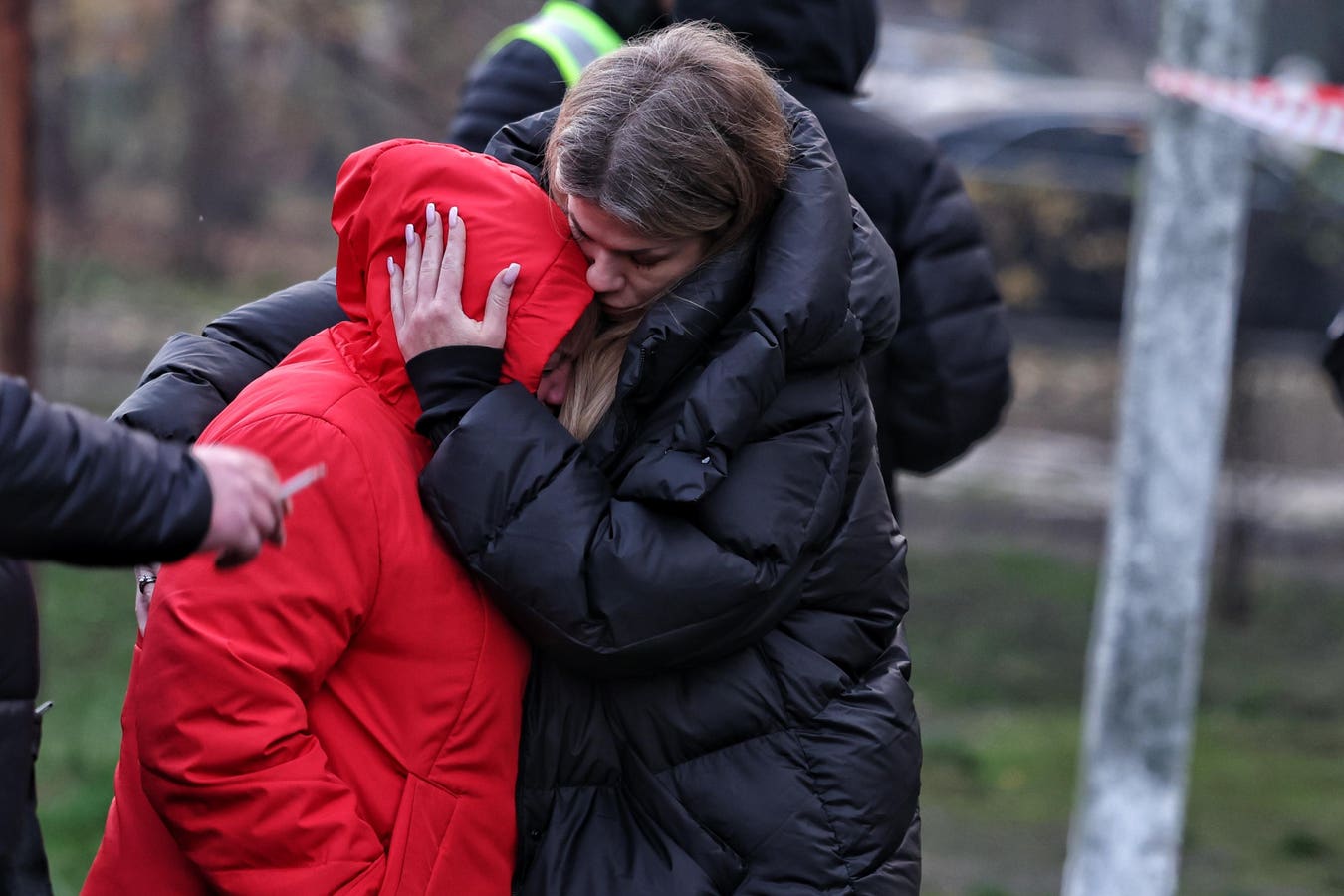
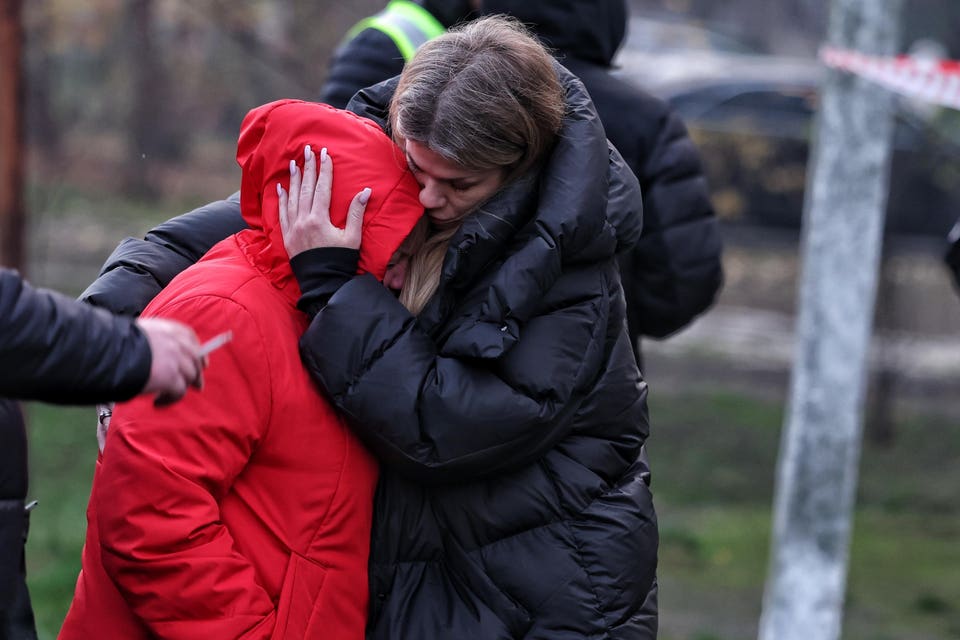
KYIV, UKRAINE – NOVEMBER 14: Russian Massive Drone And Missile Attack Hit Several Residential Districts Of Kyiv (Photo by Yan Dobronosov/Global Images Ukraine via Getty Images)
Global Images Ukraine via Getty Images
Dispatches from Ukraine. Day 1,360.
Russian Attacks on Ukraine
Kyiv. On November 14th, Russia launched a heavy drone and missile attack early on Friday, killing six people in Ukraine’s capital. According to Ukrainian officials, Russian forces used 430 drones and 18 missiles, and Kyiv was responding with long-range strikes. It was one of the biggest attacks on the capital so far.
At the same time, Ukrainian forces struck an oil terminal at Russia’s Novorossiysk seaport on the Black Sea overnight, causing infrastructure damage and leading to a suspension of oil exports from the terminal. The depot is one of Russia’s largest oil export facilities.
Between November 11 and 13, Russian strikes killed seven civilians and wounded a total of 33 others in the eastern Kharkiv region, the western border province of Donetsk and the Zaporizhzhia and Dnipropetrovsk regions.
KYIV, UKRAINE – NOVEMBER 14: Rescuers clean up rubble and debris from damaged residential building after Russian drone-and-missile attack on November 14, 2025 in Kyiv, Ukraine. (Photo by Dan Bashakov/Global Images Ukraine via Getty Images)
Global Images Ukraine via Getty Images
Corruption Scandal
Since Monday, Ukraine has been rocked by a corruption scandal involving the laundering of some $100 million by senior officials. The most high-profile exposé of the wartime era, and possibly in President Volodymyr Zelenskyy’s administration, has already drawn attention from Western allies and forced two ministers of Prime Minister Yuliia Svyrydenko’s cabinet to step down. A political scandal that was unforeseeable just a week ago is now escalating into a political crisis. The scandal stems from the concentration of power in Zelenskyy’s hands, aggravated by his appointments of hyper-loyalists and close supporters to key government positions.
Following a joint, 15-month investigation, the nation’s anti-corruption bodies (National Anti-Corruption Bureau, or NABU, and Specialized Anti-Corruption Prosecutor’s Office, known as SAPO) exposed a scheme inside the state monopoly, Energoatom, which oversees all of Ukraine’s nuclear plants. Through a well-established system of coerced kickbacks, contractors supplying Energoatom were allegedly required to hand over 10-15% of each contract’s value in bribes.
The officials implicated in the case hail from the upper echelons of Ukraine’s government. Among them are Justice Minister Herman Halushchenko, who served as Energy Minister from 2021 until July, and Svitlana Hrynevych, who succeeded him in that post. They offered their resignations almost simultaneously under public pressure from Prime Minister Svyrydenko and Zelenskyy calling for their dismissal on November 12. “I believe that the Minister of Justice and the Minister of Energy cannot remain in office,” Zelenskyy wrote on his official Telegram channel.
A day earlier, however, Zelenskyy offered no comment on the corruption probe when he traveled to Kherson to mark the third anniversary of the city’s liberation from Russian occupation.
He also did not make his evening address to the nation on November 11, breaking a long-standing tradition for only the third time since taking office: the first occurred after a fierce Oval Office clash with U.S. President Donald Trump and Vice President J.D. Vance in February; the second on July 22, when Zelenskyy tried to curb the powers of NABU and SAPO, triggering street protests. Even then, the address eventually appeared shortly after midnight on July 23.
NABU has continued to release new recordings of conversations among the suspects; so far, only a fraction of the more than 1,000 hours of conversations has been made public. The newly revealed excerpts have implicated Oleksiy Chernyshov, a former deputy prime minister and close friend of Zelenskyy. Meanwhile, another longtime friend and business associate, Timur Mindich, often described by Ukrainian media as the president’s “wallet,” is accused of guiding the scheme. Mindich reportedly fled the country hours before searches began.
Ukraine’s State Border Service has issued a statement reporting that Mindich crossed the border legally, suggesting that he was informed in advance of the Monday searches. It marked yet another instance in which high-profile suspects have slipped out of Ukraine just before arrest.
Zelenskyy, who has built his presidency on promises to dismantle Ukraine’s old oligarchic networks, has struggled to manage the scandal. He signed a decree imposing sanctions on Mindich and his associate, businessman Oleksandr Zuckerman, both of whom are implicated in the ongoing probe and hold Israeli citizenship. The decree, published on the president’s official website, imposes asset freezes, halts commercial transactions and bans their transit through Ukrainian territory for a period of three years.
Still, despite Zelenskyy’s decision to impose sanctions on close associates, the opposition criticizes the measures as insufficient. Opposition lawmaker Yaroslav Zheleznyak has stated that the government had initially proposed a 10-year ban on Mindich, but that the term was shortened contrary to the intent of the restrictions.
In addition, Zelenskyy’s attempt to draw a clear line between himself and the accused officials has done little to quiet speculation. Mindich is not a distant acquaintance; he was one of the business partners who helped finance Zelenskyy’s entertainment ventures long before his 2019 political rise. Many Ukrainians find it hard to believe that such an intricate corruption network could have operated without his tacit approval.
European officials have offered cautious approval of Ukraine’s anti-corruption efforts, emphasizing that independent agencies are essential for maintaining confidence in Kyiv. “We are closely monitoring the situation and are glad to see that anti-corruption agencies are actively fighting corruption,” said a European Commission official in a comment to Forbes Ukraine, speaking anonymously due to a lack of authority to make official statements.
Predictably, Moscow views the corruption scandal as an opportunity to discredit Kyiv. As Russian President Vladimir Putin’s press secretary Dmitry Peskov noted, countries in the EU and the U.S., “which are donors to the ‘Kyiv regime,’” are increasingly realizing that “some of the money they collect from taxpayers is being embezzled.” Russian state media quickly framed the story as proof that Ukraine’s leadership is irredeemably corrupt, fitting it into Moscow’s allegations portraying Ukraine’s government as corrupt to the core.
By Danylo Nosov, Alan Sacks