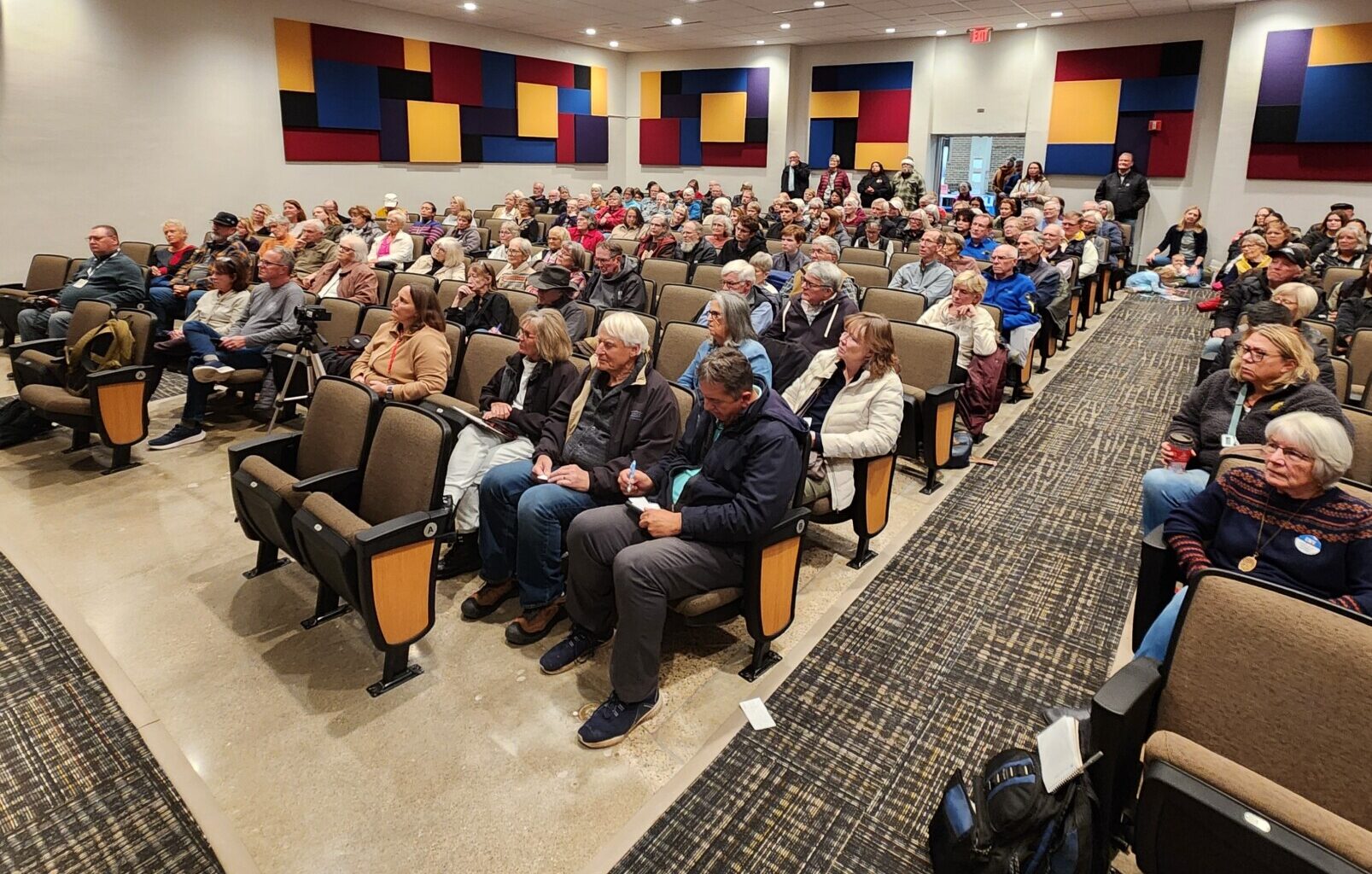
— Drastic changes in immigration policies under the current presidential administration are being felt locally.
Speakers at a panel discussion Monday in Willmar noted the policies are targeting immigrants who are here legally.
“Are we against illegal immigration, or are we against immigration? And I know it’s just one word, but the difference is huge,” said
Deputy Director Yasin Alsaidi, one of four panelists. “As someone who practices to help people find their legal status, I’m finding that the answer to that every day is we are against immigration.”
The Willmar community gathered Monday at the Kennedy Elementary School Little Theater to learn more about new
policies, how they are affecting the community and what they can do to address the issues.
More than 160 people were in attendance at the event, which also featured
American Civil Liberties Union of Minnesota
director of advocacy Julio Zalaya,
program manager for the Willmar area Jenny Groen, and Asha DuMonthier, an organizing strategist with the ACLU from California.
One of the catalysts for this community conversation is the
Kandiyohi County Sheriff’s Office
entering into a
287(g) memorandum of agreement with Immigration and Customs Enforcement,
which allows correctional officers in the jail to serve and execute federal administrative warrants on immigrant inmates whom
wants to detain after release from local custody — called the “warrant service officer” model under the 287(g) program.
In an interview with the West Central Tribune earlier this year, Sheriff Eric Tollefson explained that the warrant service program would be only for correctional officers within the walls of Kandiyohi County Jail.
The Trump administration expanded the use of the 287(g) agreements when he came into office. The Department of Homeland Security in
said there were more than 1,000
agreements with state and local law enforcement agencies.
The speakers on Monday discussed various administration policies that make it more difficult for immigrants to obtain and keep legal status.
According to Alsaidi, it now costs $100,000 for “people with special talents” to get an H-1B visa to work in the United States.
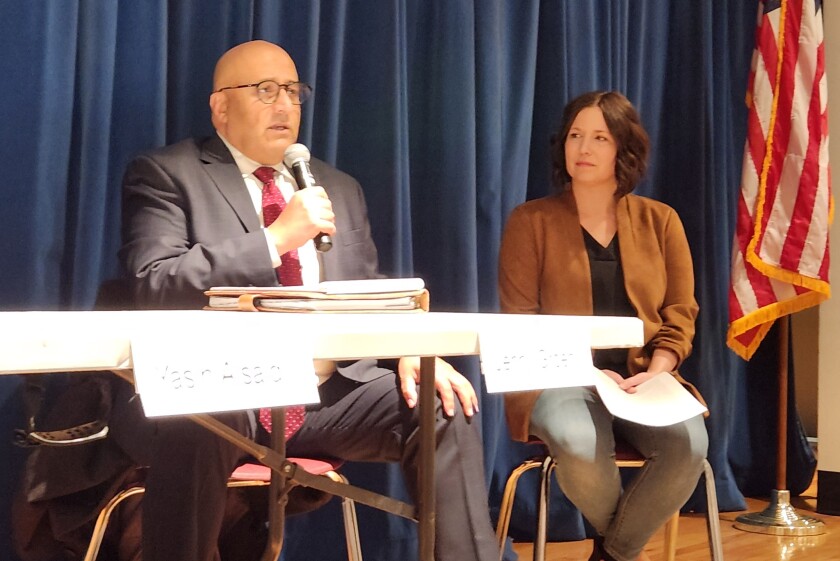
Mid-Minnesota Legal Aid Deputy Director Yasin Alsaidi, left, on Monday, Nov. 10, 2025, in Willmar speaks about how the Trump administration’s immigration policies are affecting immigrants who are in the United States with legal status and what he does to try to assist them. Immigration forum co-panelist Jenny Groen, Willmar area program manager for Arrive Ministries, listens.
Jennifer Kotila / West Central Tribune
Green card holders are having their interviews for citizenship canceled and instead a “neighborhood investigation” takes place during which immigration officers will be contacting neighbors, coworkers and other community members “claiming they’re from the fraud investigation department,” Alsaidi said.
Asylum seekers are being charged $540 for employment authorization documents, which were previously free.
A final example he shared is that student visas are being canceled for minor infractions, such as speeding tickets or writing an opinion piece in a local newspaper.
Zalaya of the ACLU shared that there is currently a bottleneck in the immigration court system, which used to have around 2,000 judges and now has only 400, making people susceptible to the “deportation machine.”
He pointed out that the budget for ICE has ballooned to $170 billion, making it the third-largest armed enforcement agency in the world. It rivals some of the world’s biggest militaries.
According to Zalaya, that federal investment into ICE will not only go to the border wall but also into immigration detention and surveillance — not only of immigrants, but of U.S. citizens.
“More and more local police agencies, sheriff agencies, are being asked to cooperate with ICE,” he said.
He said that courts have already ruled that states have no role in immigration enforcement, but more and more local law enforcement agencies will be invited to assist ICE.
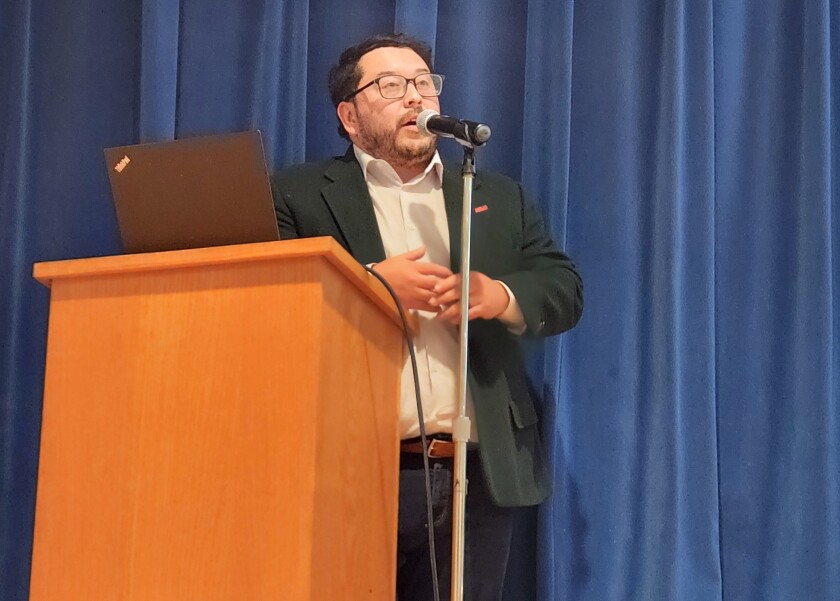
ACLU of Minnesota Director of Advocacy Julio Zalaya during an immigration forum on Monday, Nov. 10, 2025, speaks about how the current administration is expanding its efforts to create a “deportation machine” and how it is affecting immigrants with no criminal backgrounds and immigrants who have legal status to reside in the United States.
Jennifer Kotila / West Central Tribune
“You heard about a nursing mother who was held in Kandiyohi (County). These are individual cases of people being held in this county, right, who don’t otherwise have the criminality that ICE has been saying that they’re looking for,” Zalaya said. “ … This is super concerning, because I think for our law enforcement, they’re really concerned with criminality, right? And criminal conduct, and that just isn’t the case for a lot of these cases.”
Alsaidi said that under the current administration, immigration laws change by the day, making it difficult for him as an immigration attorney to advise his clients properly.
“As an immigration attorney, talking to people who are desperate, and saying, ‘We’re advising you this, but my advice lasts just today, I don’t know what’s going to happen tomorrow,’” Alsaidi said. “Whatever you think, wherever you stand on the issue, I think you would agree with me that this is not a proper way to do business.”
He noted he tries to be dispassionate about the issue, because he is trying to use the law to help immigrants and a heartbreaking story does not always help.
The only advice he has to offer undocumented immigrants with children who were born in the U.S. and are citizens, parents who are afraid they may be picked up by ICE and separated from their children, is to sign a
designation of parental authority
that allows somebody else to parent their children for a year while they are gone.
“That gives them peace,” Alsaidi said. “That’s the heart-wrenching part. But then again, you have to understand that the undocumented people that are here are here for a reason, because even under these conditions, it’s better for them.”
Alsaidi also shared that he worked with a woman who applied for asylum, but her children were still in her home country and she had not seen them for two years. She was trying to figure out how to bring them to the U.S. to be with her.
“I finally said, ‘Are you sure you want to immigrate here?’ And you can see a light bulb go off. All of that to say, I think we’re moving into the idea of, we are against immigration, not against illegal immigration, and that’s just something that we need to be cognizant about,” Alsaidi added.
The first question from the audience affirmed Alaidi’s theory that some are now against all immigration, not just illegal immigration. “I am appalled by ICE’s heavy-handed tactics, breaking up families. However, I am against immigration, because the U.S. population has more than doubled since I was born. Daily life and the state of the environment was better in the ‘50s. We don’t need all these people. Am I wrong? I don’t think so.”
Alsaidi responded by asking the audience if they wanted to see their stock portfolios rise, see economic growth and see services grow.
“The population of the U.S. is declining without immigrants,” he said. “I lived in New Hampshire. Their towns are being abandoned. You can look at the news. There are little towns in Ohio that are being abandoned and now being populated by immigrants. We, unfortunately or fortunately, need growth to sustain economic prosperity.”
He told the audience to think about their own well-being regarding immigration, their investments, who is going to take care of them, and how much they will be paying for produce if the immigrants now working the fields are replaced by union workers being paid five, six, or seven times what immigrants are paid.
“It’s just a one-sided argument that doesn’t factor in all the variables, and some of the variables, I would argue, would benefit you directly,” Alsaidi said.
Another audience member stated that it seems like many of the changes to immigration laws are happening with little to no due process.
Alsaidi responded that the U.S. Constitution covers every American citizen here and abroad, as well as everybody within the United States — not just U.S. citizens.
“So if we’re going to detain you, deport you, arrest you, we need to have a warrant. You need to identify yourself as a police officer. You need to let somebody know what they’re being arrested for. You need to allow them legal representation. That’s the due process that sometimes is not happening,” Alsaidi said.
He explained a change to the
whereby an immigrant who cannot prove they have been in the U.S. for more than two years will not even see a judge before being removed.
“Those things that are happening right now haven’t happened before in the history of the U.S. We’ve never seen a force that’s masked, that’s not identifiable. Sometimes they’re in rented cars, sometimes they’re in (rented moving trucks),” Alsaidi said. “Coming and getting people off the street with nary a word, without anything. … Smashing windows to gain access to somebody in a car. Those are all things that everybody in the U.S. is protected from.”
Another question from the audience was how to make sure local law enforcement protects local residents when ICE officers are masked, not identifying themselves or not providing warrants. “Who protects the people who are being attacked by ICE?”
Alsaidi said he has seen some local departments get involved and others not wanting to interfere with a federal agency.
“Honestly, it’s going to be up to the police department and how they want to be involved,” he said. “ … The byproduct of this is people who are afraid of ICE have become afraid of every law enforcement agency, which means crimes go unreported sometimes, which means a mistrust of everything, and that’s a terrible situation to be in.”
Zalaya told the audience that conversations are taking place about what local law enforcement will do when ICE blatantly commits crimes and civil rights violations.
“We haven’t been in this position where there’s been this much of a ramp-up, especially as new recruits come in who are undertrained … (who do not have) the level of professionalism, the level of training that our peace officers have,” he said. “ … There’s going to come a point where a local officer is going to see a violation in front of their face and they’re going to have to make a decision. And you’ve seen this happening across the country, and I think that the jury’s still out on how local law enforcement is going to respond, but it is a topic that needs to be answered.”
DuMonthier encouraged those who are concerned to get involved and learn as much as they can about the changes in immigration policy and the agreements that local law enforcement have with ICE.
She also encouraged people to communicate their concerns with their elected officials once they feel informed about what is taking place.
“It’s important that your elected officials understand and know where you’re coming from,” DuMonthier said.
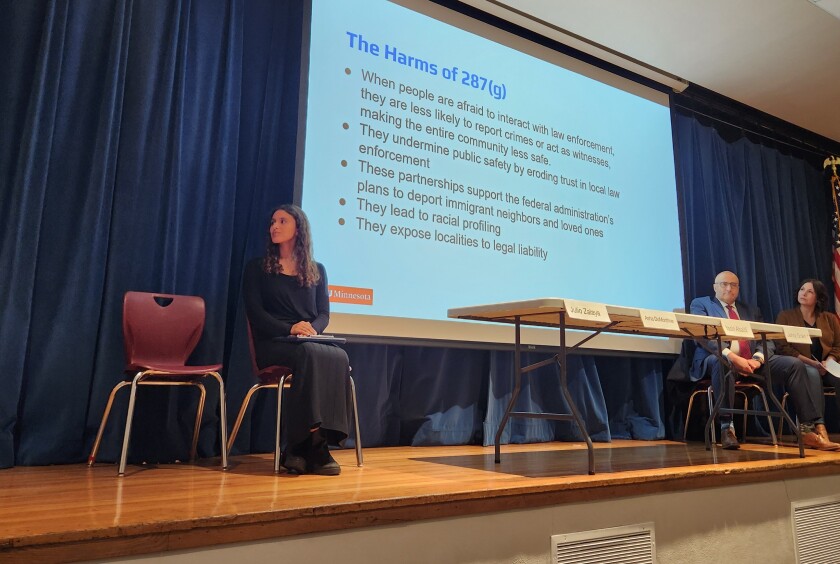
Asha DuMonthier, an organizing strategist with the ACLU from California, from left, Yasini Asaidi and Jenny Groen listen as Julio Zalaya speaks Monday, Nov. 10, 2025, about the harms of 287(g) agreements between U.S. Immigration and Customs Enforcement and local county sheriff’s offices.
Jennifer Kotila / West Central Tribune
Noting the divisiveness that has spread across the U.S., impeding the ability of people to engage in conversations with those they disagree with, she also encouraged those in attendance to be open to discussing the issue.
“We need to try to understand each other, to try to come and, you know, find a common ground in order to make progress together,” DuMonthier said.
Zalaya told the audience that Willmar has been known to be a city that welcomes immigrants and diversity, and the conversation regarding what is happening at the federal level falls on its residents and elected officials in a unique way.
Documented immigrants and even U.S. citizens are sheltering, nervous to leave their homes, because they are unsure whether or not local law enforcement is working with ICE.
“It really ends with us in this room, the question of what community you want to be, what community we want to see in the future, who is the community,” Zalaya said.