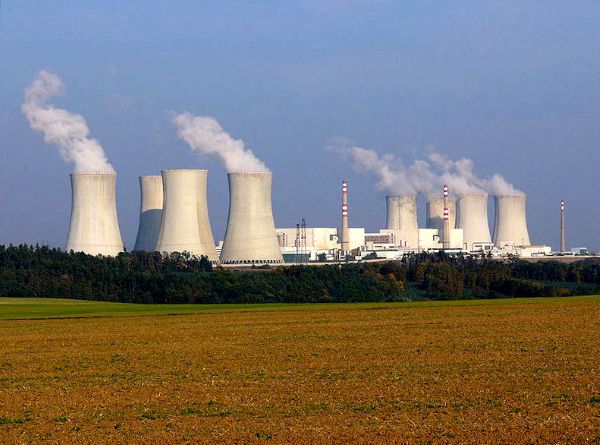
The Czech Republic is advancing its nuclear energy initiatives by planning two new reactors at the Dukovany power plant. Mobile drilling rigs are conducting geological surveys to extract samples from depths of 140 meters, ensuring the site is suitable for a $19 billion investment. This expansion is expected to double the country’s nuclear output, strengthening its status as a leading nuclear-reliant nation in Europe.
In a competitive process, South Korea’s Korea Hydro and Nuclear Power (KHNP) will construct a new facility featuring two reactors, each exceeding 1,000 megawatts. These reactors are projected to start operations in the late 2030s, alongside the existing four reactors at Dukovany, which have a combined capacity of 2,048 megawatts.
The agreement with KHNP also allows the Czech Republic to develop two additional units at the Temelín nuclear plant, which currently has two 1,000-megawatt reactors. Plans include exploring small modular nuclear reactors.
“Nuclear will generate between 50% and 60% around 2050 in the Czech Republic, or maybe slightly more,” Petr Závodský, chief executive of the Dukovany project, told The Associated Press in an interview.
The expansion of nuclear energy is crucial for the country to transition away from fossil fuels, ensuring a steady and reliable energy supply at competitive prices. It is also essential for meeting stringent emission reduction targets and addressing the anticipated surge in electricity demand driven by data centres and electric vehicles, as noted by Závodský.
This expansion in the Czech Republic occurs during a period marked by increasing energy demand and approaching deadlines for significant reductions in carbon emissions, which have collectively renewed interest in nuclear technology. While nuclear power does produce waste, it does not emit greenhouse gases such as carbon dioxide, a key contributor to climate change.
The European Union has incorporated nuclear energy into its classification system for environmentally sustainable economic activities, thereby facilitating financing opportunities. This development is advantageous for countries such as the Czech Republic, Slovakia, Hungary, and France, which have extensive reliance on nuclear power.
Recently, Belgium and Sweden have opted to maintain their nuclear energy capabilities, while Denmark and Italy are reconsidering their positions. Furthermore, Poland is poised to join a cohort of 12 nuclear-friendly nations within the European Union, having secured an agreement with the U.S.-based Westinghouse to construct three nuclear units.
EU and nuclear electricity
In September, the United Kingdom signed a cooperation agreement with the United States, which Energy Secretary Ed Miliband described as the start of “a golden age of nuclear energy.” The deal includes a £14.2 billion investment for the Sizewell C nuclear power plant, the first in the U.K. since 1995.
Additionally, CEZ, the leading power company in the Czech Republic, has partnered with Rolls-Royce SMR to develop small modular nuclear reactors. The estimated cost of the Dukovany project exceeds $19 billion, with the Czech government planning to take an 80% stake and provide a 30-year loan for construction. The government will also ensure a stable income from electricity production for CEZ over the next 40 years, pending EU approval as part of its climate neutrality goals by 2050.
“We’re in a good position to argue that we won’t be able to do without new nuclear units,” Závodský said. “Today, we get some 40% electricity from nuclear, but we also currently get another 40% from coal. It’s clear we have to replace the coal.”
Uncertainty regarding financing has led to significant delays in the Czech Republic’s nuclear expansion efforts. In 2014, CEZ cancelled a tender for two new reactors at the Temelin nuclear plant after the government declined to provide financial guarantees. Following Russia’s invasion of Ukraine, Rosatom and China’s CNG were excluded from the Dukovany tender due to security concerns.
To reduce reliance on Russian energy, CEZ has signed agreements with Westinghouse and France’s Framatome for a ten-year supply of nuclear fuel.
While public support for nuclear energy exists, some scepticism remains. The organisation Friends of the Earth argues that nuclear energy is costly and advocates for alternative investments in the industry. Additionally, the Czech Republic lacks permanent storage for spent nuclear fuel.
The proximity of the Dukovany and Temelín plants to the Austrian border adds complexity, as Austria abandoned nuclear energy after the Chernobyl disaster and continues to express strong scepticism, recently rejecting the Czech proposal for small modular reactors.
This article used information from The Associated Press.