The Austrian national team has had chances repeatedly, and the last one, reaching the 60th minute, was very clear, but the Bosnian goalkeeper came out well and managed to clear the ball. Player M. Gregoritsch entered, and Laimer, who was on a yellow card, left. Some modifications are also expected for the visiting team.
Yellow card for Bosnia’s number 3 player, Dennis Hadžikadunić, following a foul in midfield. Austria is gaining confidence and constantly attacking the Bosnian box. However, the score remains in favor of Bosnia.
The Austrian national team has made it clear they are looking for the equalizer from minute 46. The Bosnian team is defending during these first minutes of the second half while players from both teams are warming up. Tabaković had a chance on a counter-attack for Bosnia.
The teams are back on the pitch. The second 45 minutes will be decisive for Austria, who is currently heading to the play-offs, while Bosnia and Herzegovina would qualify directly for the 2026 World Cup. It will be a second half full of excitement!
Due to the VAR review, extra minutes were played. The Austrians are still reeling from the shock and the anger of having the goal disallowed, which would have put them back in the match. Both teams are heading to the locker room, awaiting instructions from their respective head coaches. Yellow card for Laimer
The Austrian team managed to equalize just minutes before halftime. The player Konrad Laimer struck the ball low and close to the post; although the goalkeeper touched it, he failed to keep it out. There is a VAR review because the goal-scoring play seemed to begin with a foul. We await the referee’s decision to find out if it is a goal or if a foul was committed.
We are reaching the final minutes of this first half. Neither team is giving space to the other, and the match is heavily contested in midfield, with a few attacking hints from both sides. We will see how much time the referee adds; it shouldn’t be much due to the few fouls and stoppages in play.
The match continues to be very even. The Austrian defense is staunch and gives no space to the Bosnian attackers. On the counter-attacks, Bosnia manages to retreat, and their defense is also solid. Sewald had a chance in the 35th minute.
Bosnia almost got it! On a counter-attack, they nearly scored the second goal. Players are warming up next to the benches, while the smoke from the flares fills the pitch with fog. Bosnia is failing to be clinical, but they maintain the lead in this UEFA qualifying match.
While tense moments are being experienced in the match, the fans are setting off flares in the south side of the stadium. The Austrian national team is pushing forward, gaining confidence as the minutes tick by. Bosnia manages a few counter-attacks, but as the half-hour mark is reached, the home team is dominating.
The match reaches the 23-minute mark. Bosnia is approaching the Austrian box with more players. The fans in the stands are complaining, and whistles can be heard when the home team gets the ball. The visiting team is defending solidly.
The early goal gives Bosnia the possibility to control the game. The first few minutes were dominated by Austria, who had possession of the ball, but failed to reach the Bosnian box with conviction. Austria maintains possession of the ball but cannot get past the attacking third of the field.
Haris Tabaković scores. The play started with a corner kick for the visiting team; two rebounds left Tabaković in front of the goal, and he only had to subtly head the ball in to score the goal that currently puts them ahead.
We are past the first 10 minutes, and the teams are failing to create attacking plays. Austria already surprised once, but failed to put the goal away. The coaches won’t stop giving instructions, and the crowd keeps cheering; the chants are booming tonight.
We reach the first six minutes of the game. The teams move onto the attack with great caution; any mistake could mean a goal against them, which is why they are playing to advance safely on the pitch.
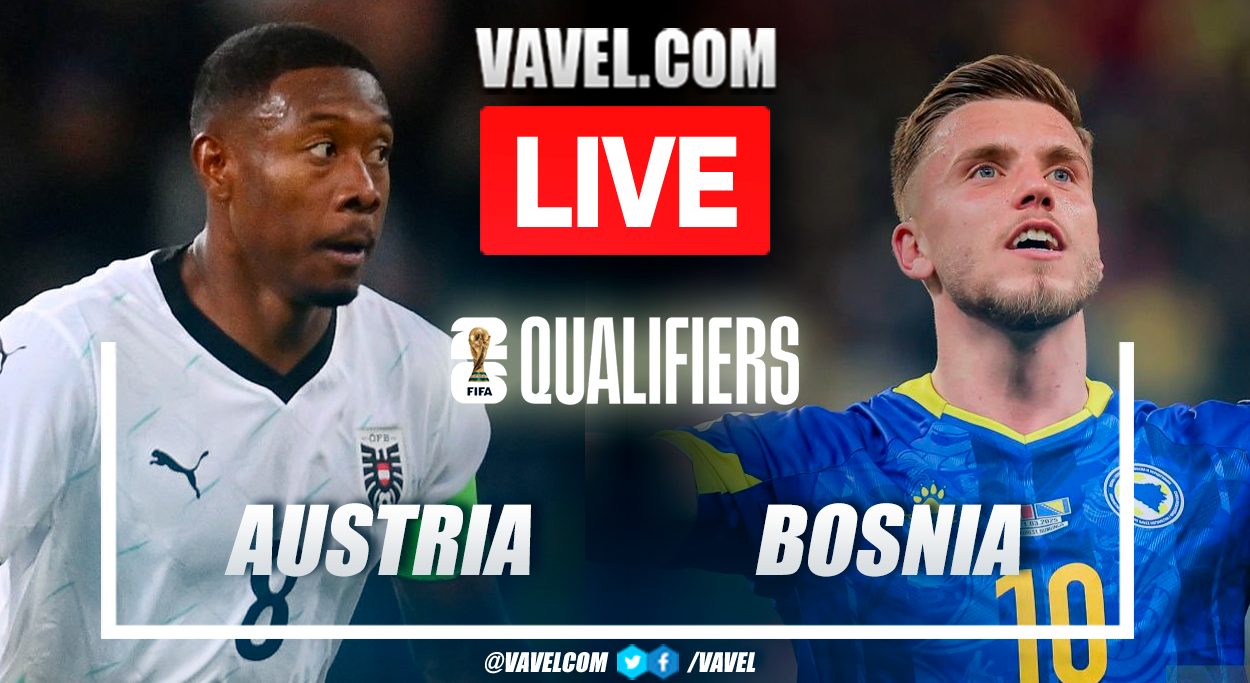
Austria vs Bosnia
The referee blows the whistle to start the match, and Austria kicks off, immediately launching a coordinated attack. The crowd continues to cheer from the opening minutes, creating an electric atmosphere at the Ernst-Happel Stadium as both teams aim to assert themselves in this crucial UEFA qualifying match.
The atmosphere at the Ernst-Happel Stadium is truly electrifying. Austrian fans are filling the stands, with red colors standing out on this crucial qualifying night. Chants, flags, and banners set the scene for the match about to kick off, creating a vibrant and passionate environment that promises an intense game from start to finish.
The Austria national team is led by Ralf Rangnick, a German coach who has been in charge since 2022. Under his guidance, Austria aims to establish a strong and competitive playing style in qualifiers and international tournaments.
Austrian football also features other notable coaches, such as Jürgen Säumel (SK Sturm Graz) and Christian Ilzer (1899 Hoffenheim), who contribute their experience and expertise to the country’s football development.
The Bosnia and Herzegovina national team is currently led by Sergej Barbarez, who took charge in 2024. A former professional footballer, Barbarez now guides the national team, aiming to bring stability and strong performances in international competitions.
The coaching staff also includes experienced assistant coaches such as Ninoslav Milenkovic and Zlatan Bajramovic, who support the team in tactical and physical preparation.
The head coaches of Austria and Bosnia and Herzegovina have confirmed the lineups for the match. Coaches Ralf Rangnick and Sergej Barbarez have chosen their starting squads, focusing on strategy, midfield balance, and attacking efficiency.
A tactical and intense duel is expected, with both teams aiming to assert dominance from the start of the game.
The Austria national team has shown strong recent performances, particularly in the Euro 2024, where they finished top of their group and reached the round of 16. The team is known for its possession-based style (59.58%), high passing accuracy (86%), and an effective attack, averaging 3 goals per game. While their results in larger tournaments have been mixed, Austria’s football history remains notable for its achievements in past decades, establishing the team as a respected competitor on the international stage.
The Bosnia and Herzegovina national team is currently in a transitional phase, working to achieve consistency and stability in its performances. Their results have been uneven in both UEFA qualifiers and friendly matches, reflecting a period of adjustment. Despite this, the team has demonstrated strong attacking potential, showing an ability to create chances and score goals, keeping their hopes alive for qualification to the 2026 World Cup.
We will soon share with you the starting lineups for the Austria vs Bosnia and Herzegovina live match, as well as the latest information from the Ernst-Happel Stadium.
Don’t miss any detail of the live match updates and commentary from VAVEL’s coverage.
Edin Džeko is regarded as a true legend in Bosnian football and one of the most prominent strikers in recent European history. His life story includes a challenging childhood shaped by the Bosnian war, an experience that strengthened his resilience. Known for his powerful physique, exceptional aerial ability, clinical finishing, and high-level technique, Džeko continues to be the most influential figure in his national team.
David Alaba stands out as Austria’s most influential player, serving as both captain and central defender. His contribution is crucial due to his leadership, experience, and technical quality. Despite suffering a major knee injury that sidelined him during Euro 2024, he has returned to action and remains a fundamental part of Austria’s push to qualify for the 2026 World Cup.
These two teams are currently evenly matched based on their recent head-to-head record. They have faced each other four times, with one victory for each side and two draws. For this reason, we can expect a very balanced match, likely to be played with caution. It is also possible that we won’t see a large goal difference, as both teams have historically scored few goals against each other and their wins have been decided by just one goal.
Bosnia and Herzegovina comes into this match as the second-place team in Group H of the UEFA qualifiers, with 16 points from five victories and one draw. In their last five matches, they have won three, drawn one, and lost one. They have had a solid qualifying campaign and still dream of securing a spot in the 2026 World Cup.
Austria comes into this match as the leader of Group H in the UEFA qualifiers, with 18 points from six victories. In their last five matches, they have won four and lost one. They have had a very strong qualifying campaign and dream of securing a spot in the 2026 World Cup.
The Austria vs Bosnia Herzegovina match will be played at the Ernst-Happel-Stadion, located in the city of Vienna, in Austria. This stadium, inaugurated in 1931, has a capacity for 50,865 spectators.
Known for hosting historic European nights, the venue stands out for its giant open-ring roof and its acoustics, which make the atmosphere particularly intense during international matches.
Welcome to the live broadcast of Austria vs Bosnia Herzegovina, Matchday of the UEFA Qualifiers. The match will take place at the Ernst-Happel-Stadion, at 2:45 PM ET.
My name is Daniel Medina and I will be your host for this match. We will bring you pre-match analysis, score updates and live news here on VAVEL.