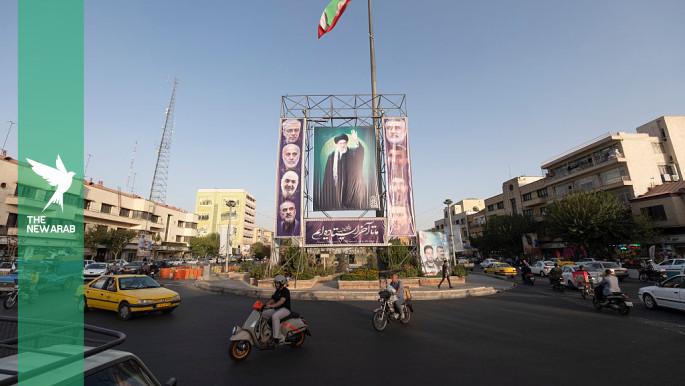
Since the end of the 12-day war that Israel and the United States waged against Iran in June, arrests, summonings and convictions of activists and dissidents have sharply increased. [Getty]
The pressure on political activists, journalists, dissidents, academics and even non-political inmates in Iran reached unprecedented levels, even by the standards of the country’s theocratic regime.
Since the end of the 12-day war that Israel and the United States waged against Iran in June, arrests, summonings and convictions of activists and dissidents have sharply increased. At the same time, in a more alarming trend, the number of executions has reached a new high.
Mahmood Amiry-Moghaddam, head of the Oslo-based Iran Human Rights organisation, claimed to The New Arab that officials, on average, hanged one person every three hours in October. He noted that the real number could be even higher because Iran’s judiciary does not report all executions.
Amiry-Moghaddam, who has spent nearly two decades documenting executions—from trial conditions to the carrying out of death sentences—points to a recent protest inside Iranian prisons as proof of how serious the situation has become. In Qezel Hesar Prison, non-political inmates went on a hunger strike and even sewed their lips shut to protest the sharp rise in executions.
While opposition media had long covered the executions of political and ideological prisoners, this protest reached a far wider audience because of its extreme and painful form.
Speaking about the protest, Amiry-Moghaddam said prisoners are now driven by pure desperation. “A hunger strike is already a sign of helplessness,” he said. “But sewing your lips shut goes even further.”
He added that prisoners take such extreme steps because they feel powerless, knowing they could be executed at any moment. Their only hope is to make their voices heard outside the prison as the current wave of executions rises far beyond “what used to be normal.”
Iran Human Rights has repeatedly warned about the sharp rise in executions, and recently, international rights groups have also raised alarms about what Iranians have faced since the end of the 12-day war.
Journalists under attack
On 30 October, at the UN General Assembly, the Independent International Fact-Finding Mission on the Islamic Republic expressed “deep concern over the impact of Israeli airstrikes” on the rise in arrests, espionage accusations and executions in Iran.
The mission also highlighted that the repression has crossed Iran’s borders. Based on information it received, “more than 45 journalists in seven countries have faced credible threats” as a result of reporting on events in Iran.
Inside the country, the pressure on journalists has also intensified. Reporters who criticised the authorities in their work or on social media were summoned and threatened.
An Iranian journalist who spoke with TNA on condition of anonymity described the lengthy interrogations they faced in recent weeks. They were summoned by phone and warned not to disclose it to anyone.
“I still don’t know which intelligence organisation interrogated me, since it happened in a residential building,” they said. “But from the way they acted and the questions they asked, I assume they were linked to the Ministry of Intelligence.”
Iran has several parallel intelligence bodies, but the two main ones are the Ministry of Intelligence and the Intelligence Organisation of the Islamic Revolutionary Guard Corps (IRGC), the latter being the most feared.
The journalist said they were never told why they were being interrogated or what would happen next, a pattern also reported by other journalists.
“They asked about my opinion on the 12-day war and then questioned many of my social media posts, including the ones in which I criticised the war,” they explained. “I don’t think they really cared about what we wrote. They want to intimidate everyone and silence even the softest critical voices.”
‘Crimes against humanity’
Amiry-Moghaddam said the rise in executions, arrests and pressure on civil society after the war is directly linked to the regime’s fear of another social uprising. In his view, the government’s failures during the war also showed that it could not even defend itself.
“A government drowning in crisis and lacking legitimacy feels the need to show off its power and create fear more than ever,” he said. “The Islamic Republic sees itself in danger, and what threatens it is not a foreign attack, but the people inside Iran.”
He said international pressure is the only way to slow the executions. But he added that there is little hope for European governments that claim to support human rights.
“When one person is executed every three hours, people expect these [Western] governments to at least say something,” he stressed. “We have seen in the past that even a simple statement can affect Iran’s actions.”
For now, he added, there is no sign of such action. Western governments appear focused only on Iran’s nuclear program, not on executions or repression.
Still, he noted that the UN Fact-Finding Commission’s recent use of the term “crimes against humanity”—the first time this language has been used about the executions—could raise pressure on Iran’s leaders and increase the political cost of carrying out executions.