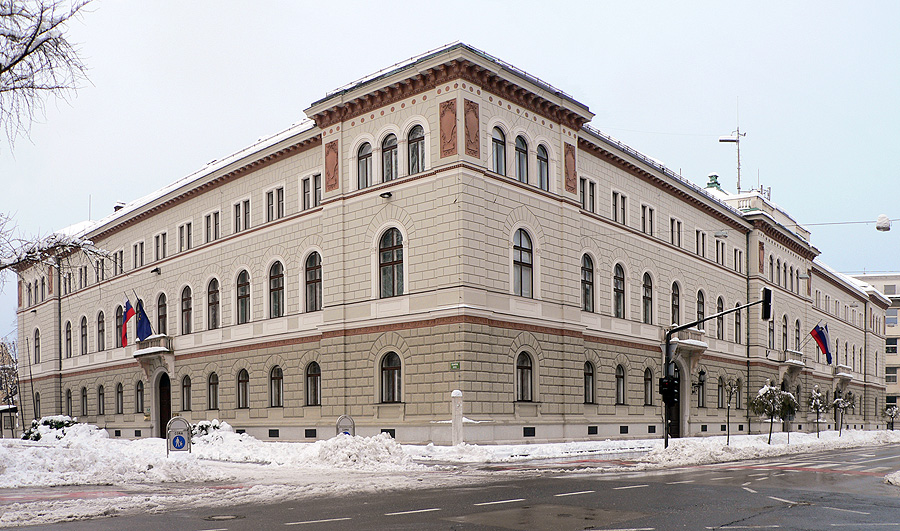
The Slovenian parliament on Monday passed a security law that expands police powers and restricts welfare rights amid criticism that the law targets the Roma community.
Slovenian Prime Minister Robert Golob said the bill “is not designed to punish, its principal aim is prevention. We want to give police concrete powers to confiscate weapons quickly.” The legislation grants the police powers to enter homes without a warrant and video surveillance in “high security risk areas.” Additional powers also permit the police to remove an individual from an area for breaching public order and issue an exclusion order preventing their return. The police are further empowered to close premises and disperse gatherings where criminal activity is occurring.
The Measures to Ensure Public Safety bill is also known as the “Šutar Law” due to its introduction two weeks after the murder of Aleš Šutar in Novo Mesto. The primary suspect is a 21-year-old individual of the Romani community, and the incident evoked mass protests, many of which were anti-Roma. A subsequent “defense act” has since been employed, causing a mass presence of police in Romani neighbourhoods.
Stipulations of the new law have been criticized by members of the Romani community and the general press as arbitrary and empowering of the police to overstep judicial protections. Rights groups also criticize the law for indirectly targeting the Roma community and blaming an entire group for singular incidents. Amnesty International on Friday urged the Slovenian Parliament to reject the “draconian security bill.”
Esther Major, Amnesty International’s deputy director for research in Europe, stated:
While not explicitly aimed at the Roma population, the vitriolic rhetoric used by the government to justify these measures raises serious fears that they would be deployed arbitrarily and discriminatorily against the Roma population. Coupled with the security crackdown, punitive restrictions on social benefits could further penalize the most marginalized families.
The Šutar Law potentially contravenes protections detailed in the Slovenian Constitution. For example, Article 35 safeguards privacy and dignity, Article 36 prohibits entry without a judicial order, and Articles 37 and 38 provide protections concerning communication and data protection.
Vice President at the Roma Foundation for Europe Mensur Haliti commented, “If the government conflates fighting crime with policing the Roma, it is not protecting public safety—it is punishing an entire group for the actions of individuals. Crime and violence must be addressed, but proportionality is what separates the rule of law from collective blame.”