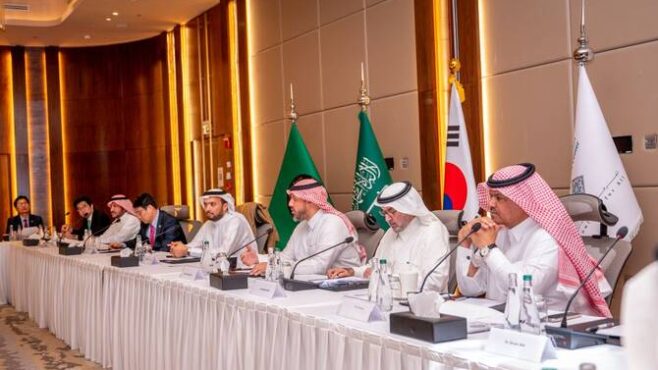
Seminar explored ways to enhance cooperation in advanced technology and energy
Ambassador Moon Byung-jun said that the seminar came at a timely moment considering the active high-level exchanges between Korea and the GCC
RIYADH: The South Korean Embassy in cooperation with the Gulf Research Center jointly held the second Korea-GCC Cooperation Seminar in Riyadh on Wednesday.
The seminar explored ways to enhance cooperation in advanced technology and energy, including opportunities to cooperate in circular carbon economy, transportation, artificial intelligence, data, defense, space, energy transition, renewable and hydrogen energy.
Acting Korean Ambassador Moon Byung-jun said that the seminar came at a timely moment considering the active high-level exchanges between Korea and the GCC countries, which reflect the strength of relations and strong will to further expand cooperation between the two sides.
Experts from both sides explored opportunities in artificial intelligence, smart manufacturing, renewable energy technologies, and digital transformation, and reviewed global trends in these sectors for driving economic growth.
Speaking to Arab News on the sideline of the seminar, the ambassador said: “This is our annual seminar organized jointly by the embassy and the GRC rotating the theme. This year we focus on energy and technology. There are a lot of changes going on globally, we have to discuss it for better cooperation.
“There’s a lot going on here in renewable energy. So we have to discuss how we can work together. Creativity is important and to discuss in detail will help us all,” he added.
Saudi Arabia is positioning itself as a leader in the hydrogen economy, with significant investments in green and blue versions of the fuel with the aim to generate half the Kingdom’s electricity from renewable sources by 2030.
With its commitment to achieving net-zero emissions by 2060, strategic partnerships, and projects like Neom’s hydrogen initiative, Saudi Arabia is paving the way for a sustainable, hydrogen-powered future.
South Korea has decided to close all coal-fired power plants by 2040. Renewable energy capacity in the East Asian country has increased sixfold from 2013 to 2023.
“Our president is currently visiting the UAE where he has discussed cooperation in renewable energy, AI and defence with his counterpart, so we are looking for better coordination in the GCC in all these areas,” the envoy said.
South Korea has agreed to work with the UAE on the US-backed Stargate project to build a huge new artificial intelligence data campus in the Gulf country.
South Korea said it will help build computing power and energy infrastructure for the world’s largest set of AI data centres outside the US, after South Korean President Lee Jae-myung held a summit with UAE President Sheikh Mohamed bin Zayed Al-Nahyan.
South Korea, home to chipmakers Samsung Electronics, and SK Hynix, aims to become a regional AI hub after the president, who took office on June 4, prioritised AI investment to spur growth.
On Saudi Arabia, ther ambassador said: “The Kingdom is a key ally, the biggest oil supplier to our government and the largest economic partner in the region. We have a very strong relationship in the area of oil and gas. But we have to expand that beyond the energy cooperation and work together in AI and data.
“So we are discussing the way of, how we can work together for the mutual benefit, and focus on technological advancements so that the two sides can mutually benefit from it,” he said.
The annual seminar is a platform for policymakers, business leaders, and researchers to exchange insights, identify opportunities for joint projects, and strengthen the strategic partnership between Korea and the GCC to address current and future challenges.
It aims to provide a dynamic platform for dialogue, and create a space for academic experts, policymakers, industry leaders, and key stakeholders from Korea and GCC countries to exchange perspectives, share experiences, and discuss emerging global trends.
The seminar aims to deepen mutual understanding of the opportunities and challenges faced by both regions in the rapidly evolving technological and energy landscapes.
The goal is to generate a roadmap for joint initiatives, policy recommendations, and future cooperation mechanisms that can contribute to long-term economic resilience and sustainable growth for both sides.
The relationship between Korea and the GCC has long been anchored in a foundation of mutual interests, particularly in the areas of energy security, trade, and investment.
In past decades, both sides have built strong ties through the exchange of energy resources, technology, and expertise, which has played a pivotal role in supporting the economic growth of both regions. A significant milestone in this partnership is the Korea-GCC Free Trade Agreement.