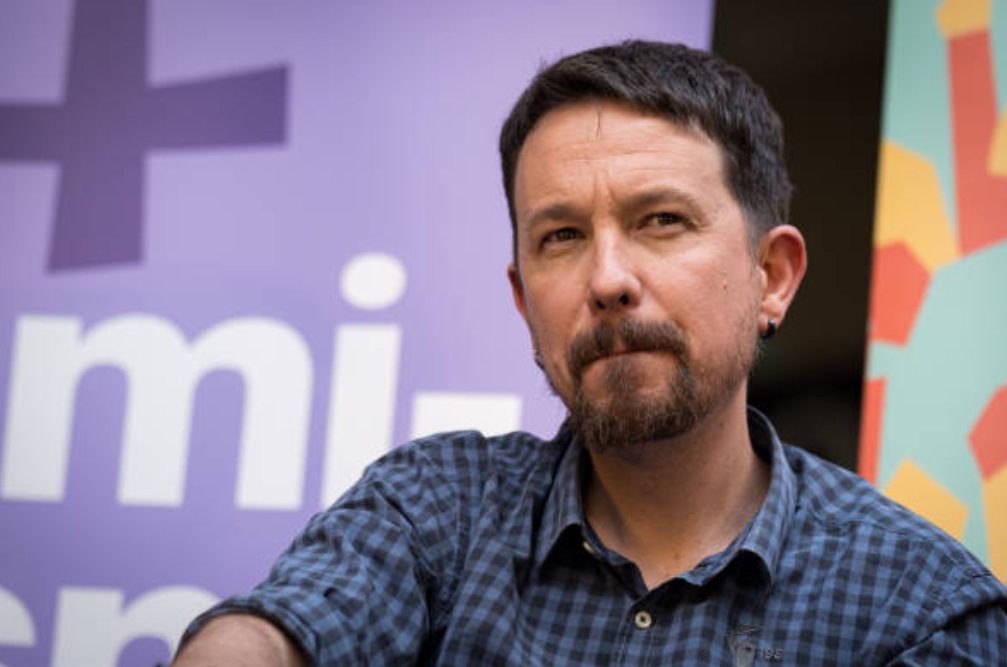
Rabat — Pablo Iglesias Turrión, co-founder of Spain’s far-left Podemos party and web TV show host, has called for armed conflict against Morocco, with comments following a political journey that reads like a tale of ambition, controversy, and spectacular downfall.
Iglesias burst onto Spain’s political scene in 2014, riding the wave of the Indignados movement.
He positioned himself as a clean alternative to Spain’s corrupt political establishment. His party, Podemos, promised to sweep away “the caste.” But behind the revolutionary rhetoric, a different story emerged.
From the start, Iglesias championed the Polisario Front with unusual fervor; his party’s electoral program called for establishing high-level diplomatic relations with the self-proclaimed Sahrawi Arab Democratic Republic (SADR).
The politician transformed himself into the Polisario’s loudest Spanish advocate, organizing rallies where Polisario flags flew, accusing Morocco of colonialism, and calling Spain’s government treasonous.
His rise peaked in 2020 when Prime Minister Pedro Sánchez appointed him deputy prime minister. He immediately tried to arrange an official meeting between a Spanish state secretary and a Polisario representative. Sánchez quickly shut down the initiative, forcing Iglesias to publicly disavow his misstep, and avoiding his use of his government position to legitimize the separatist movement.
A financial scandal led to Iglesias’s downfall — not political disagreements. The investigation revealed a web of alleged illegal financing, money laundering, and personal enrichment, following a Podemos lawyer who filed a complaint regarding alleged accounting irregularities in summer 2020.
The Civil Guard’s report uncovered what Spanish media called Podemos’s “caja B” — a black fund that diverted money meant for solidarity projects to benefit Iglesias’s associates. One mysterious communications association received party funds with little oversight.
The “Neurona affair” dealt the heaviest blow. Podemos paid a Mexican consulting firm €363,000 for communication services during the April 2019 campaign. Investigators discovered that the company had connections to Venezuelan dictator Nicolás Maduro, another Polisario ally. The money left Spain through shell companies, raising suspicions about a scheme to funnel electoral funds to friendly Latin American networks.
Several Podemos officials fell, including Iglesias’s communications director, the party treasurer, and the party itself as a legal entity. Iglesias escaped prosecution due to insufficient evidence, but the damage was done.
The May 2021 Madrid regional elections delivered the final blow, as Podemos won only 7% of votes. Iglesias admitted failure and announced his immediate withdrawal from politics. His brief, chaotic political career ended in humiliation.
Most recently, Iglesias has been hosting “La Base” on his internet channel, Canal Red. His favorite topic remains the Polisario and its war against Morocco’s sovereignty over the southern Moroccan region of Western. Earlier this month, just days after the UN Security Council adopted Resolution 2797 on October 31, he devoted an entire show to calling for armed struggle against Morocco.
“The Polisario Front has no other choice but armed struggle to defend the right of Sahrawis to form a nation,” he stated.
Many viewers saw his remarks as inciting terrorism. Such shocking comments would not have been out of bounds had they come from some fringe political activist or radical agitator. But Iglesias’s apparent call for a necessary war on Morocco’s territorial integrity matters – and is particularly troubling – given his past role as Spain’s Deputy Prime Minister.
As such, with relations between Madrid and Rabat having spectacularly improved over the past three years, it remains to be seen how the Spanish government responds to such beyond-the-pale comments.
Still, it bears reminding that Iglesias is no stranger to such inflammatory remarks. Throughout his career, the radical leftist politician has consistently attacked Morocco with incendiary rhetoric. He regularly denounces what he calls “Moroccan colonialism” and brands the Kingdom as a dictatorship.
And he long accused the Spanish government of “historical betrayal” toward the Sahrawi cause. He also organizes rallies urging Spaniards to rise against their own government for befriending Morocco. Despite never visiting the Western Sahara region to witness its situation firsthand, he has been one of the separatist Polisario Front’s most vocal advocates in Spain.
The “indignant one” who claimed to fight corruption now stands accused of the same crimes he denounced.
His calls for war against Morocco reveal a desperate attempt to stay relevant through extreme provocation.