Unlock the Editor’s Digest for free
Roula Khalaf, Editor of the FT, selects her favourite stories in this weekly newsletter.
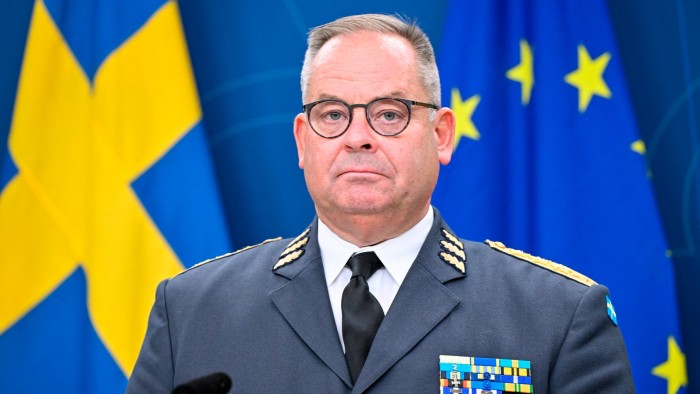
Political polarisation in the west is a “candy shop� for hybrid warfare as Russia seeks to sow division among Nato members through attacks on infrastructure and by hijacking elections, Sweden’s top military official has warned.
Michael Claesson, Sweden’s chief of defence staff, told the Financial Times that Russia was combining “sabotage, special operations, even attacks against individuals� with attacks on critical infrastructure and “exploiting vulnerabilities in the information environment� in order to “split us up� and “break up cohesion in our societies�.
“The fact that we have a certain political polarisation in many countries in the west is, of course, a candy shop for a hybrid-warfare warrior to exploit,� said Claesson.
The general’s comments come days after Poland blamed operatives linked to Russian intelligence for acts of sabotage on its railways this month. Russia has also recently been blamed for multiple drone incursions into European airspace and for spreading disinformation during EU elections.
Claesson warned that Nato should also be more alive to Russia’s activities in northern Africa, where he said it was controlling trafficking routes for migrants and drugs as well as other criminal activities. “This transports very quickly . . . to the whole of Europe and Nato territory,� he said.
 Migrants are rescued off the Libyan coast: Claesson claims Russia controls migration routes across north Africa as part of their efforts to destabilise Europe © Mahmud Turkia/AFP/Getty Images
As the war in Ukraine drags towards its fifth year, Europe has been racing to shore up its ailing infrastructure and defences should Russia launch any more direct attacks, particularly on Nato’s eastern flank.
The European Commission set out a defence industry “road map� this week that aims to upgrade defence procurement rules and includes plans to cut cross-border bureaucracy and improve infrastructure to allow an army to pass rapidly across the bloc.
Recommended

In May the EU started a €150bn loan scheme to support defence investments in member states. It stipulates that no more than 35 per cent of the components in assets bought using the loans should be made outside the European Economic Area or Ukraine.
Despite Sweden not applying for the scheme, Claesson said it was a necessary tool to help member states in “a dire financial situation� to upgrade their military capabilities.
However, he warned that less emphasis should be afforded to prioritising goods made in Europe, given that national defence industries were active worldwide.
“There is not enough [domestic] production capacity to fill all the needs and requirements currently . . . to narrow down or to limit oneself in this phase. It’s a no-go,� Claesson said.
Most important was to cut the bureaucracy associated with defence production. Claesson described it as “extremely hampering�.
He also commented on the risks associated with the melting Arctic, saying this had implications for Russia’s second-strike capability. However, Moscow would need “immense investments� to maintain its upper hand in the Arctic since much of its military infrastructure there had been built on the thawing permafrost, he added.