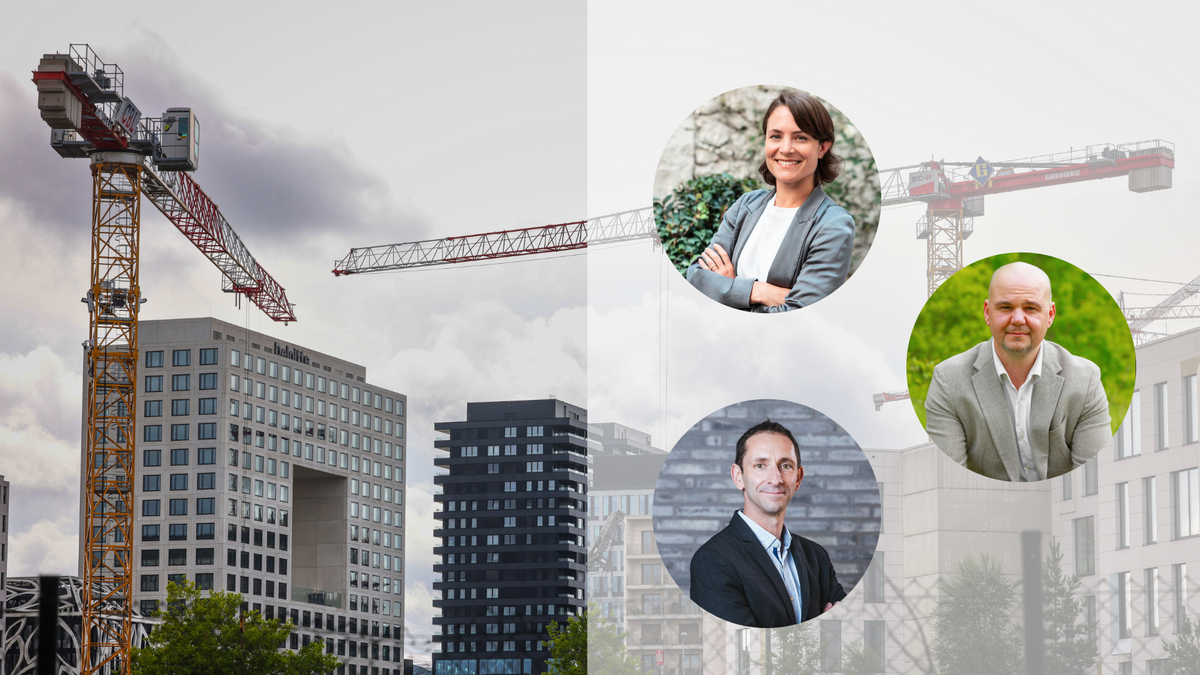
As Europe’s construction sector grapples with rising energy costs, climate risks and an ageing building stock, what will construction look like in Luxembourg by 2030?
In a country where developable land is limited and every plot counts, every design decision – from façade glazing to retrofitting 1960s apartment blocks – has consequences not just for emissions, but for everyday comfort, wellbeing and urban resilience. Three experts, each in their respective field of expertise, shared their vision of the future of construction with the Luxembourg Times.
Buildings are responsible for around 40% of Europe’s emissions, according to the European Commission and the World Green Building Council, making them a key focus for climate action.
Luxembourg in its National Energy and Climate Plan (PNEC) aims to cut emissions from construction, together with industry and manufacturing, by nearly half by 2030. This includes improving energy efficiency in existing buildings, implementing low-carbon construction methods and better integrating renewable energy.
With this year’s COP30 climate summit focusing on implementation rather than new pledges, the focus in construction, too, is on practical ways to cut carbon while making homes and offices resilient to climate shocks, reminding Europe that its 2030 climate goals are not so far away.
Also read:Brazilians in Luxembourg reflect on Amazon climate summit
“It’s late, but at least it’s here now,” said Cécile Dap, director of the Local Carbon Building Initiative (LCBI), a European certification that since 2022 has the goal of bringing consistency to carbon measurement and reduction in real estate. “Buildings are finally recognized as major emitters and as assets at risk from climate impacts. Heatwaves, floods and extreme weather are no longer theoretical, they are happening now,” she said.
Harmonisation across Europe of how carbon emissions are calculated remains a challenge, said Dap.
The LCBI is pushing for whole-life carbon accounting, a method used to measure all the carbon emissions a building is responsible for during its entire existence, which will become mandatory under the revised Energy Performance of Buildings Directive (EPBD) between 2028 and 2030.
Unlike the energy passport, which only measures a building’s energy use once it is operating, whole-life carbon accounting captures the far larger share of emissions linked to materials, construction and end-of-life, the parts of the footprint that policymakers can no longer afford to ignore.
“Buildings can no longer stay in the background of climate policy. The time for measurable change is now. […] Investors, insurers, regulators, they’re all starting to treat buildings as long-term carbon assets,” she said, adding that standardisation is “critical”.
Cécile Dap, director of the Local carbon building initiative (LCBI) said that the “time is now” to treat buildings as long-term carbon assets. © Photo credit: Pauline de Courreges/LCBI
“If we talk about mitigation and trying to lower the carbon footprint of buildings, it’s still a question of training and having something standardised to account for and compare at European and international level,” she explained.
Financial players “don’t have time to calculate the carbon footprint of every building they invest in. They need a simple, trustworthy tool to benchmark it. Tools like LCBI or standard certification schemes bridge training on the ground and give finance a clear, comparable vision.”
A recent LCBI-certified building in Luxembourg is the Roots development, a project in Belval that has become a laboratory for emerging European sustainability standards, developed by BPI Luxembourg.
Construction began in October on the multi-use Roots complex, part of a two-decade transformation plan for the Belval area © Photo credit: BPI
BPI Luxembourg uses design as a climate calculator
Part of the Belgian group BPI Real Estate, BPI Luxembourgs’ shift towards sustainable and digital planning started at the drawing board, it said in an interview with the Luxembourg Times. Over the past five years, the company has reimagined design processes, moving from material optimisation to a more holistic approach where every architectural layer is assessed for carbon impact.
“All our design models are fully digital. Why? Because if you work with standard, repetitive models, not much changes and that’s fine. But when you’re dealing with highly complex systems and optimising every component, it becomes extremely complicated,” said Frédéric Vingtans, BPI’s design director. “You need digital tools that let you identify constraints and coordinate everything. Otherwise, it’s impossible to find the optimal solutions.”
“But today, the essential reflection is to save material. And you can only do that if you integrate it at the very start, when the project is still flexible and you can question every layer of the design,” he said.
Designing sustainable building doesn’t mean sacrificing beauty, said Frédéric Vingtans in an interview with the Luxembourg Times. © Photo credit: BPI
For the Roots development, this meant scrutinising every component.
Redesigning the foundation piles – using fewer but deeper pillars with optimized diameters and lower-carbon concrete – cut the foundation’s carbon footprint by nearly 30% without altering the architectural intent, said Vingtans. Simulations showed that limiting façade glazing to around 60-65% improved indoor temperatures, reduced cooling loads, and enhanced comfort, pushing back against the glass-heavy aesthetic of modern offices.
“It’s not about sacrificing beauty,” Vingtans explained. “Oversized structures, unnecessary layers, or too much glass add carbon that no ‘green’ material can compensate for.”
Innovation also extends to existing buildings, where most carbon is already embedded. A 40-year-old office block in Strassen, recently converted into housing, kept its original structural frame and still achieved carbon savings comparable to Roots.
Also read:Luxembourg highlights climate finance expertise at COP30 in Brazil
“The structure carries most of the carbon. If it is sound, you can save enormous amounts simply by keeping it,” he said. “That meant we were able to use good-quality materials with a bit more freedom. We didn’t have to go hunting for ultra low-carbon materials pushed by lobbying or anything like that. We used materials that were respectful, efficient – but standard – and we still achieved nearly 25–30% reductions,” he said.
The Mimosa building in Strassen now has triple A rating, electricity production via photovoltaic panels and underfloor heating with a heat pump, all of which consumed far less carbon than demolishing, and starting again from scratch.
Ensuring buildings can withstand future climate impacts – from heatwaves to flooding – is now as important as cutting carbon, Vingtan said. “We need enough forward-planning to guarantee that in the coming decades the building will not become unusable,” he explained, adding that regulations still lag behind.
The Mimosa building in Strassen was an old office building that is been transformed in co-living housing using its original skeleton. © Photo credit: BPI Luxembourg
For now, progress in Europe and in Luxembourg often depends on individual companies and forward-looking investors rather than binding regulations, he added. “Up to now, decarbonisation was seen as a positive effort, something nice to improve. But with energy prices surging, Europe absolutely needs a decarbonisation plan for its industries. It’s essential in the long term.”
“Europe may only account for 5% of global CO2 emissions, but we’re losing some of our leadership. Given our carbon debt, it’s important that we remain leaders in this field and continue advancing,” the BPI director said.
Also read:Construction sector sees trend towards sustainability
Delivering science to policymakers
At the Luxembourg Institute of Science and Technology (List), 80 researchers and engineers work on the national dimension of the transition in order to advise policymakers.
“Climate adaptation is no longer abstract,” said Sylvain Kubicki, group leader of List’s sustainable urban and built environment group. “Our buildings must remain usable in twenty or thirty years.”
However, the fragmentation in Luxembourg’s construction sector also makes this endeavour difficult. Hundreds of micro-firms, family businesses and one-person ateliers operate independently, meaning that information about buildings, their materials and their energy performance is scattered.
“Data is produced, but there’s a lack of sharing culture, even with big players,” noted List’s group leader. “This is crucial for renovation of existing buildings. We don’t always know how many buildings there are, their condition, or which measures are most efficient economically and environmentally.”
List’s working group, headed by Sylvain Kubicki, is developing environmental, social and economic assessment methods, supporting policymakers and public owners with urban planning. © Photo credit: List
List is developing environmental, social and economic assessment methods, supporting policymakers and public owners. It is also working on resilient district planning tools, such as the ‘Regen’ project – aligned with EU-level research – integrating circular design, climate adaptation and social considerations into the early stages of urban planning.
The project creates detailed virtual models of districts, simulates energy use, heat, and carbon impacts, and allows residents and planners to see how different design choices affect outcomes.
According to Kubicki, Luxembourg’s potential lies in becoming a pilot country for resilient districts where climate adaptation, circularity and digital workflows are embedded from the very beginning. The country could also use its compact size to harmonise data-sharing standards, overcoming the fragmentation that slows down renovation and end-of-life planning.
Luxembourg is far from that maturity, but it has a different advantage: scale
Sylvain Kubicki
As climate resilience, carbon performance of buildings and their valuation by investors is becoming more interlinked, “Luxembourg could move faster than larger markets in integrating these expectations into investment and insurance decisions”, he proposed.
And as the construction market shifts toward deconstruction, circular construction and robotics, Luxembourg’s training ecosystem could accelerate to meet these emerging skills.
Technology can help foresee how districts can be shaped to be fit for the future, said Sylvain Kubicki © Photo credit: List
Europe’s reference point for digitalised construction is currently the Nordic countries. “At the European level… Nordic countries are greater. A lot of processes are digitalised, even their building permit procedures, and this seems to be really providing efficiency and improvements,” he explained.
“Luxembourg is far from that maturity, but it has a different advantage: scale. While it cannot rival Nordic digitalisation yet, it can experiment faster and integrate research directly into new urban districts.” said Kubicki.
Looking toward 2030
By 2030, Luxembourg’s construction sector will need to balance carbon reduction, resilience and liveability. Early-stage carbon thinking, circular retrofits, digital modelling and climate adaptation will shape both new developments and the vast existing building stock.
Residents can expect more comfortable indoor temperatures year-round, better-managed humidity and greener, cooler surroundings thanks to vegetated roofs, water features and natural ventilation, while investors and insurers will increasingly judge assets by carbon performance and resilience.
“Regulations, digital tools and assessment methods are pushing the sector forward,” said Kubicki. “COP30 is not abstract, it’s a push. Now Luxembourg must turn ambition into measurable change.”
“We need more resilient districts and buildings, which requires new digital approaches. Digital transition should be over quickly, that’s the bet,” said the List researcher.
Also read:Group moves toward Luxembourg’s first housing cooperative in Belval