Near potential growth rate level\n “expanding fiscal pace needs to be adjusted”
![International Monetary Fund (IMF) building in Washington, DC, U.S. [EPA = Yonhap News]](https://www.europesays.com/wp-content/uploads/2025/11/news-p.v1.20250602.f40dfb810ff147d2bf69f4d29de556af_P1.jpg) 사진 확대
사진 확대 International Monetary Fund (IMF) building in Washington, DC, U.S. [EPA = Yonhap News]
The International Monetary Fund (IMF) advised the Lee Jae-myung government, which has set up a “super budget” worth 728 trillion won, that it needs to change its fiscal policy stance.
According to the Ministry of Strategy and Finance on the 24th, the IMF released the “2025 Korea Annual Consultation Report” containing these details. The report released this time was based on interviews with major government ministries and related organizations such as the Ministry of Strategy and Finance and the Bank of Korea from September 11 to 24 this year.
First of all, the IMF forecast Korea’s economic growth rate for this year and next year to be 0.9% and 1.8%, respectively. In particular, the IMF predicted that the Korean economy has entered a recovery phase since the second half of 2025, and that it will show a clear recovery in 2026. The economic growth rate predicted by the IMF next year means that the Korean economy has entered a stage of recovery in the potential growth rate.
At the same time, the IMF predicted that Korea’s inflation rate will stabilize to 2.0% in 2025 and 1.8% in 2026. However, the IMF stressed, “After the recovery of the potential growth rate, it is necessary to adjust the fiscal policy stance in consideration of inflationary pressure.” If the potential growth rate recovers next year, it means that we should be wary of expansionary finances from next year. Specifically, the IMF added, “We need to continue our efforts to expand revenue and streamline spending while strengthening the reliable mid-term fiscal system, including the fiscal anchor, to ensure fiscal sustainability.”
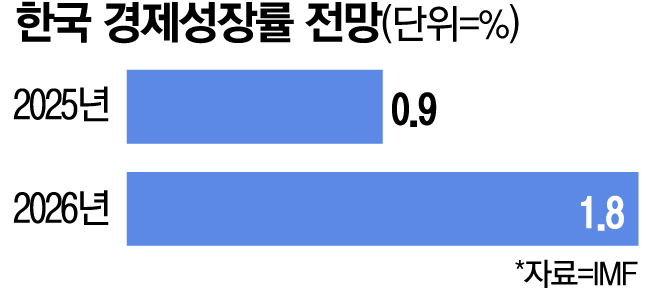 사진 확대
사진 확대 The fiscal reference point is a similar concept to the ‘fiscal rule’ that manages national debt below a predetermined ratio. The message is for the government to expand revenue, including expanding the tax base, maintaining tax exemptions and reductions, and improving the income of funds in the nature of quasi-taxation.
Currently, the government has virtually abolished fiscal rules. The government submitted a “Korean-style fiscal rule” to the National Assembly in 2020 to manage the ratio of national debt to GDP within 60% and the ratio of fiscal deficit within -3%, but it is still pending at the standing committee. An official from the Ministry of Economy and Finance said, “The government and the ruling party are not talking about fiscal rules at all,” adding, “The philosophy of fiscal rules to manage national debt has been pushed to the lower ranks.”
Korea’s national debt is expected to increase rapidly. Korea’s national debt-to-GDP ratio is expected to reach 58 percent in 2029. This is an increase of about 10 percentage points compared to 2025 (48.2%; IMF forecast).