Drones violate the airspace of Moldova, Romania during Russia’s attack on Ukraine. Ukraine strikes a laser testbed aircraft, landing ship, oil refinery inside Russia. Russian officials, ultranationalist voices reject all drafts of the U.S. peace plan, ISW says.
Drones violate airspace of Moldova, Romania during Russia’s attack on Ukraine
Russia launched a major missile and drone attack on Ukraine overnight, killing at least seven people in Kyiv and injuring 20 others. Ukraine’s Air Force said Russia used 22 missiles and 464 drones to deliver the strike.
The missiles included four Kh-47M2 Kinzhal air-launched ballistic missiles, seven Iskander-K cruise missiles, eight Kalibr sea-launched cruise missiles and three Iskander-M ballistic missiles. Around 250 of the drones were Shaheds.
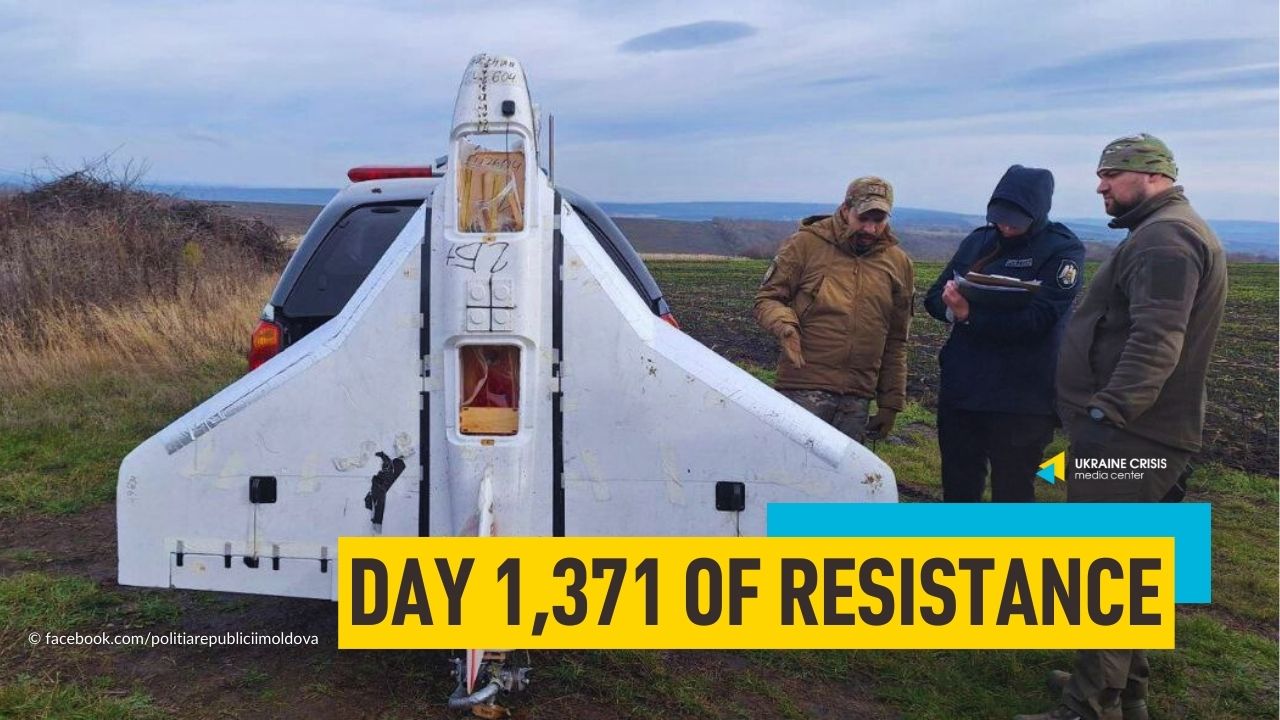
Four drones entered the airspace of neighboring Moldova and Romania, Ukrainian President Volodymyr Zelenskyi said in a post to X on Tuesday. The exact time of their flights was recorded, he added.
The Moldovan army’s surveillance system detected six drones that had violated the country’s airspace during Russia’s major attack on Ukraine overnight on Tuesday, the Moldovan Defense Ministry said, as cited by Ukrainian news site European Pravda.
One of the drones was spotted near Ukraine’s Vynohradivka and Moldova’s Vulcănești. Its flight altitude was around 1,500 meters when it breached the Moldovan airspace. It then started to move toward the Romanian border, the statement read.
The Moldovan military said it later spotted five more drones flying over Donduşeni, Orhei, Bender, Vadul lui Vodă and Floreşti. One of the drones fell on the roof of a house in the village of Cuhureştii de Sus.
Russia primarily targeted Kyiv and the surrounding region in the attack, damaging residential buildings and civilian infrastructure. Rescue works were underway on the affected sites in the Ukrainian capital on Tuesday morning, Zelenskyi said. At least eight people were injured in Kyiv region.
A Russian attack on the southern part of Odesa region overnight on Tuesday hit the port’s civilian infrastructure, damaging equipment, head of the regional military administration, Oleh Kiper said.
Russia also struck the regions of Dnipro, Kharkiv, Chernihiv and Cherkasy, targeting energy sector and “everything that keeps normal life going,” Zelenskyi said.
“This is precisely why all partners must remember that lives need to be saved every single day. Weapons and air defense systems are important, as is the sanctions pressure on the aggressor. There can be no pauses in assistance,” he said.
“What matters most now is that all partners move toward diplomacy together, through joint efforts. Pressure on Russia must deliver results,” he added.
Ukraine strikes laser testbed aircraft, landing ship, oil refinery inside Russia
The Ukrainian military carried out a number of successful strikes on Russian “strategic sites” overnight, using Bars jet-powered drones and Neptune cruise missiles, the General Staff of the Ukrainian Armed Forces said Tuesday.
Ukraine struck an aircraft repair facility of the Beriev avaiation complex and the Atlant Aero plant manufacturing Molniya drones in the city of Taganrog in Rostov region. The strike likely knocked out an A-60 laser testbed aircraft. The Beriev facility repairs and modernizes A-50 early warning and control planes and Tu-95MS strategic bombers, the Ukrainian General Staff said. Numerous explosions were heard and spot fires erupted on the site, it added.
In the Krasnodar region, Ukraine’s defense forces struck the Sheskharis oil terminal in Novorossiysk and the Tuapse oil refinery. According to preliminary reports, the devices for loading and unloading oil onto tankers and a launcher of an S-400 air defense system were hit, the General Staff said. The damage is being assessed, it added.
Ukraine’s Security Service in cooperation with other branches of the Ukrainian military struck Novorossiysk with drones overnight on Tuesday, an unnamed source in the agency told Ukrainian media. The strike reportedly damaged a Project 1171 landing ship moored near the pier of a naval base, an oil terminal and S-300/S-400 air defense systems.
Russian officials, ultranationalist voices reject all drafts of U.S. peace plan, ISW says
Russian officials and ultranationalist voices are rejecting the U.S. peace plan and its revised version. They are also trying to blame Europe for Moscow’s unwillingness to compromise, the Institute for the Study of War (ISW) said in an update on Monday. The paragraphs below are quoted from the report.
Russian officials and ultranationalist voices have been rejecting the 28-point US peace plan since it was first reported in mid-November 2025 because the proposed plan did not concede to all of Russia’s absolutist war demands.
Russian officials and ultranationalist voices are simultaneously misrepresenting revisions to the original plan and European involvement as undermining the peace process, likely in an effort to deflect from Russia’s own rejection of the deal.
Kremlin Presidential Aide Yuriy Ushakov stated on November 24 that the European version of the peace proposal is unacceptable for Russia, and Russian State Duma International Affairs Committee Chairperson Leonid Slutsky claimed that the European proposal would only continue the war. Duma International Affairs Committee Deputy Chairperson Svetlana Zhurova claimed that continued US changes to the peace plan will “drag on” the negotiations “endlessly.” Zhurova claimed that the only two relevant negotiating parties are Russia and the United States, implying that any peace plans must exclude Ukrainian and European inputs.
Russian ultranationalist milbloggers, a key pro-war constituency for Russian President Vladimir Putin, continued to reject the modified peace proposal, criticize the United States for moving away from Russian demands, and claim that Europe only wants to continue the war in Ukraine. The milbloggers called for Russia to achieve its war aims by force instead.
The Kremlin has refused to meaningfully negotiate in response to all US-led peace initiatives thus far in 2025, and has shown no willingness to make the significant compromises required of a negotiation process.[18] The Kremlin very likely aims to prolong negotiations to end the war to allow Russian forces to continue advancing on the battlefield. The Kremlin likely plans to use Russian advances to further intensify information operations aimed at convincing the West and Ukraine that a Russian military victory is inevitable and that Ukraine should capitulate to Russia’s demands.
The Kremlin continues to show no willingness to compromise for good-faith peace negotiations and has not set conditions for Russians to accept anything less than a full Russian victory in Ukraine.