The government’s Autumn Budget has signalled even more of a push to leverage nuclear energy in the UK while also ending oil production in the North Sea.
Chancellor of the exchequer Rachel Reeves made her Budget announcements today, Wednesday, 26 November, detailing the government’s plans to go “further to make nuclear power cheaper and to accelerate its deployment”.
These plans include setting out pathways for investment in the nuclear sector where updates to the Green Financing Framework will add nuclear energy for power generation to the list of policies eligible to be funded by green gilts and retail Green Savings Bonds.
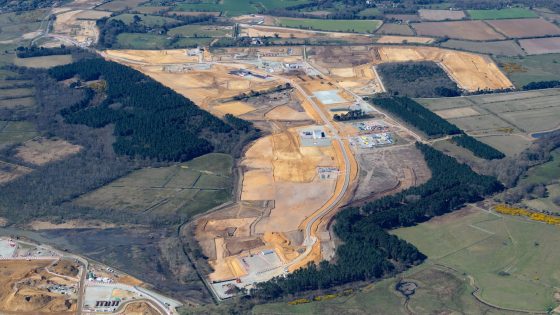
Earlier this month, the government announced that Wylfa in Anglesey, North Wales, will host the UK’s first small modular reactor project. Off-the-back of this, the Budget makes clear that the government plans to continue identifying potential sites for large-scale nuclear power.
The government believes this will build on its recently released modern Industrial Strategy and significant funding commitments for Sizewell C, which reached financial close earlier this month.
Prime minister Kier Starmer set up a Nuclear Regulatory Taskforce led by John Fingleton in February to propose radical reforms to an industry which is suffering from complex regulation that has seen the UK become “the most expensive” nation to build new nuclear projects. The resultant report was released this week and concluded there is a “systemic problem” within the UK’s nuclear industry causing huge cost overruns and delays to construction projects. Included in the report was also 46 recommendations for how the UK’s nuclear industry should be reformed.
Documents released as part of the Budget state: “The government warmly welcomes [the Taskforce report] and endorses its approach and accepts the principle of all the recommendations it has set out.
“These recommendations will radically move the dial on the regulatory regime for civil and defence nuclear in this country.
“The government will present a full implementation plan within three months, taking account of our international obligations, national security considerations and planning, environmental and court processes.
“The taskforce will be engaged in the implementation phase to review progress and support delivery.
“The government will complete implementation within two years, subject to legislative timelines on elements requiring primary legislation.”
One of the recommendations the government has specifically announced it will look to implement intends to take steps to align regulatory structures and incentives, including the exploration of consolidating defence and civil nuclear regulatory functions. Starmer will also legislate to give the Office of Nuclear Regulation (ONR) the ability to consider “overall strategic factors such as energy and national security imperatives in the delivery of its statutory purposes”.
The government also stated it will monitor implementation of the recommendations and will seek any opportunities to apply these to other sectors. An example given in the Budget documents concerns “AI-related infrastructure”.
Further developing the UK’s nuclear industry, Starmer has today also issued a “Strategic Steer” to set expectations for the civil, defence and decommissioning nuclear sectors. He believes this will “accelerate safe and efficient delivery through proportionate regulation and stronger collaboration”.
Nuclear Industry Association (NIA) chief executive Tom Greatrex said: “We welcome the chancellor’s support for the Nuclear Regulatory Review 2025 and her commitment to publish a plan within the next three months.
“It’s now crucial that the government sticks to this timeline and adopts the taskforce’s recommendations with urgency, so we can maintain momentum and turn these proposals into reality – strengthening our energy security and ensuring reliable, clean power for decades to come.
“We also strongly welcome the announcement that nuclear will be included within the UK’s Green Financing Framework. This is a vital step that will help reduce the cost of financing, unlock investment at scale and put nuclear on a level footing with other clean energy technologies.”
Mott MacDonald development director for energy Clare Rhodes-James said: “The commitment to nuclear and renewables sends a positive message. It was vital for the nuclear sector that the chancellor confirmed a response to the Nuclear Regulatory Taskforce within three months.
“The recommendations have the potential to significantly reduce costs and uncertainty, while maintaining a strong safety focus, that will be critical to delivering clean power to meet net zero targets.”
Grid connections
The Budget announcements further revealed the government’s plans to continue reforming the process of connecting energy projects to the UK’s grid.
At the end of last year the government released its roadmap for achieving a net zero grid by 2030, which detailed the significant overhauls it will take to the way that it is managed. Reforming the way the connections queue is handled is one of the major requirements.
The connections queue has been a major obstacle for infrastructure delivery in the UK years, accelerating recently because of the rush to electrify economic processes as a pathway to decarbonisation and net zero targets.
The grid was built to handle supply coming from a small number of large, centralised generators like coal-fired power station, delivered to homes and businesses.
Now, the shift to decentralised supply from a range of renewables sources, particularly offshore wind farms off Scotland, and increasing demand in the southeast of England, has forced policymakers to work on reforming the grid.
Under the National Energy System Operator’s (Neso’s) reforms, future projects will apply to join the national electricity transmission system during designated windows and will be required to meet key progress milestones. This is a step away from the current “first come, first served” approach to a more strategic “first ready and needed, first connected” system.
Alongside Neso and Ofgem, Reeves outlined a number of further reforms in the Budget which include:
Applying new powers being sought in the Planning and Infrastructure Bill to create mechanisms to reallocate released capacity and reserve future capacity for strategically important demand projects
Working with Ofgem to explore enhanced entry and membership requirements to ensure viable projects progress in the demand queue
Reducing the time to power by exploring self-build for high voltage grid infrastructure and more flexible connections where possible
Removing speculative demand in the grid connection queue. The Department for Science, Innovation and Technology (DSIT) will set out a strategic plan for data centres to ensure only the most strategic and credible projects are taken forward
North Sea
Alongside a push for more nuclear and renewable energy to power the grid, the government has also used the Budget to announce the publication of the North Sea Future Plan.
This plan sets out commitments to cease issuing new oil and gas licences to explore new fields in the North Sea.
Existing fields will continue to be managed for their full lifespan, including by introducing Transitional Energy Certificates.
This constitutes what is being referred to as action from the government to support ongoing investment and opportunities in oil and gas, “ensuring a fair, orderly and prosperous transition in the North Sea”. The plan also establishes a new North Sea Jobs Service offering tailored end‑to‑end support for the current workforce.
The government has also provided confirmed details of a permanent mechanism to respond to oil and gas price shocks when the Energy Profits Levy (EPL) ends.
Also known as the oil and gas windfall tax, the EPL is a temporary UK tax on enormous profits of oil and gas companies operating in the North Sea. It was introduced in part to raise money to help fund support for households struggling with high energy bills by taxing the high profits of oil and gas companies operating in the UK.
A new Oil and Gas Price Mechanism will act as a windfall tax to deliver a fair return to the nation when oil and gas prices are unusually high.
The mechanism will be revenue-based and apply an additional tax rate of 35% above price thresholds of $90 per barrel of oil and 90p per therm for gas.
The Budget documents state: “Current price forecasts suggest that oil and gas prices are expected to be close to triggering the Energy Security Investment Mechanism (ESIM) price floor within the next few years.
“If average oil and gas prices fall under the ESIM thresholds, the Energy Profits Levy (EPL) will end immediately and the new OGPM will come into effect, returning the tax rate to the 40% headline rate in the permanent regime, with the OGPM only applying when prices are unusually high.
“If the ESIM is not triggered, the EPL will end by March 2030 and will be replaced by the OGPM.”
With the plan announced, the government intends to commence engagement immediately on the draft legislation and implementation.
Greenpeace UK co-executive director Areeba Hamid said: “Britain has just made history.
“Closing the door to new exploration marks the beginning of the end of oil and gas in this country.
“By standing firm on its manifesto promise, the government has shown genuine global climate leadership, making the UK the world’s largest economy to call time on new fossil fuel exploration. This is a major milestone.
“Oil and gas production has driven both the climate and energy price crises, leaving us all paying through the nose while fossil fuel giants have pocketed billions. But the winds are changing. The future of Britain’s energy is and needs to be clean, stable, home-grown renewables – not expensive, volatile, climate-wrecking fossil fuels.
“However, the current plan – and the cash – to support North Sea workers doesn’t go far enough.
“It’s vital they are at the heart of Britain’s transition to a clean-energy superpower, not left behind by it – but a £20M jobs package doesn’t cut the mustard. A fair transition will create thousands of new jobs, strengthen communities, and prove that climate leadership and economic security can go hand in hand.”
Like what you’ve read? To receive New Civil Engineer’s daily and weekly newsletters click here.