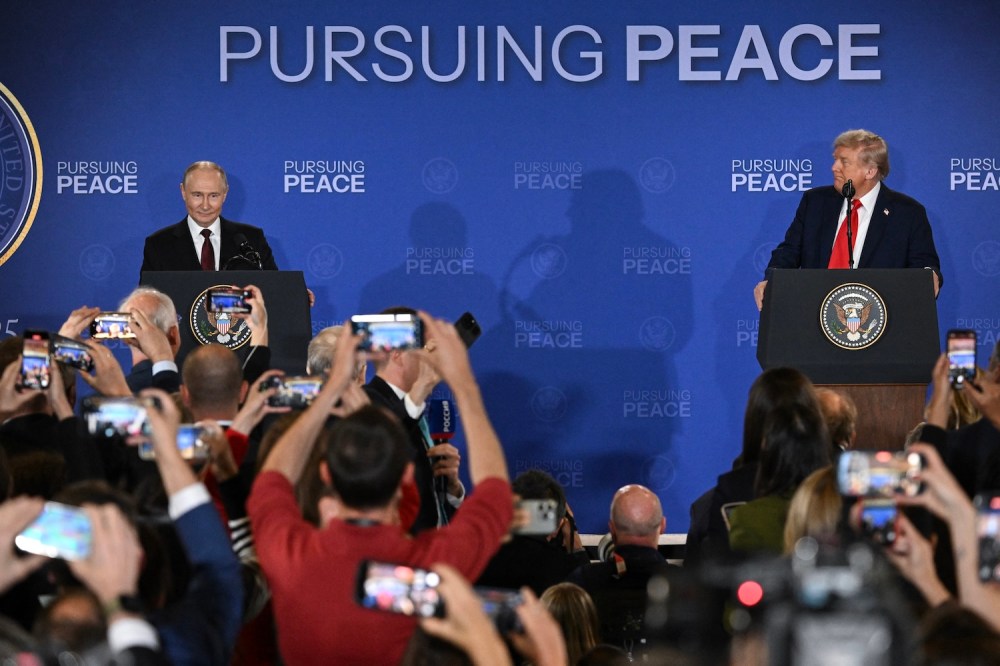
As the flurry of diplomatic activity to achieve peace in Ukraine continues, many observers seem to be losing sight of the objective. A fair and just peace would be desirable, but that ship sailed long ago.
Instead, the goal of diplomacy should be to achieve a sovereign, independent Ukraine, anchored in the West, and capable of defending itself. That will likely require difficult compromises with Russia. In this context, proposed concessions on Ukraine’s NATO membership or military size may be regrettable necessities. But asking Ukraine to compromise its front lines would be a grave and potentially irreversible mistake.
As the flurry of diplomatic activity to achieve peace in Ukraine continues, many observers seem to be losing sight of the objective. A fair and just peace would be desirable, but that ship sailed long ago.
Instead, the goal of diplomacy should be to achieve a sovereign, independent Ukraine, anchored in the West, and capable of defending itself. That will likely require difficult compromises with Russia. In this context, proposed concessions on Ukraine’s NATO membership or military size may be regrettable necessities. But asking Ukraine to compromise its front lines would be a grave and potentially irreversible mistake.
There was a time years ago when a just peace seemed possible. If Ukraine had succeeded in defeating Russian forces and taking back all of its internationally recognized territory, Kyiv and its Western backers may have been in a position to impose conditions on Moscow, including punishing President Vladimir Putin and Russia for its unjustified aggression. Some even dreamed of trying Putin for war crimes.
For at least the past two years, however, it has been clear that Ukraine retaking all of its internationally recognized territory would be impossible and that achieving a cease-fire roughly along the current lines of contact would be the best that Kyiv could hope for. This would mean recognizing Russia’s de facto (but not de jure) control of the territory that it has already conquered.
It has also been clear for some time that Putin is willing to incur enormous costs in his renewed bid to take Ukraine, and he believes that he is winning on the battlefield. Getting him to stop will require changing those assumptions; making some difficult compromises; or, most likely, both.
Strategies often fail because people forget what they are doing. That appears to be the case with some of the negative reactions to the peace plans that have been proposed in recent weeks. Critics, for example, have complained about proposed provisions that essentially reward Russian aggression and place one-sided restrictions on Ukraine.
To be sure, there are objectionable elements in some of the proposed plans, but that may be beside the point. The focus should be on the essential elements of a deal that can drive toward the desired end state.
There are at least two possible scenarios for the future of Ukraine after any peace agreement. In scenario one, Ukraine possesses a strong military and defense industry as well as Western security guarantees that deter future Russian military aggression. Ukraine becomes a consolidated democracy, and its people choose pro-Western leaders. Ukraine joins the European Union and other Western institutions and becomes deeply integrated with the rest of Europe. In this best-case scenario, the future Ukraine of five or 10 years from now resembles its neighbors, such as Poland and Romania. Long-standing hopes of creating a “Europe whole and free” would be closer to reality.
Many of the elements of the various proposed deals can help get to that outcome. Even the widely panned 28-point plan that tilted in Russia’s favor affirms Ukraine’s sovereignty. It allows for Ukraine’s membership in the European Union. While it bars NATO membership for Ukraine, it provides for U.S. security guarantees and threatens a “decisive coordinated military response” if Russia were to reattack. This is a strong foundation on which to build.
The reality is that most of the benefit of NATO membership derives from the U.S. security guarantee that comes with it. Putin does not respect European power, but he fears the United States. Washington’s bilateral defense treaties with its allies in the Indo-Pacific have been sufficient to secure those countries for many decades.
Similarly, a strong security relationship between the United States and Ukraine is nearly as good as NATO membership and should be sufficient to deter future Russian attacks.
Putin has consistently objected to any NATO forces on Ukrainian territory, but are there creative solutions that would allow Korean, Japanese, or Australian forces to secure the peace? These countries have been consistent supporters of Ukraine, and the entire free world has a stake in this outcome.
Many observers have understandably objected to one-sided limits on the size of the Ukrainian military. Should not any limits apply to the aggressor, not the victim? But proposed limits may not be incompatible with the desired end state. A military of 600,000 troops is much more potent than the 250,000-strong military that Ukraine possessed before the war. Moreover, Ukraine is a laboratory for the future of warfare, and what we are seeing is that capabilities provided by emerging technology, such as unmanned systems and artificial intelligence algorithms, are more important than head count.
There is a second, worst-case scenario, one in which concessions compromise Ukraine’s ability to maintain its sovereignty.
Any peace deal will only be a tactical pause in Putin’s mind, and he will never abandon his goal of suborning Ukraine one way or another in his bid to recreate the Russian Empire. He will use the time and space from any peace agreement to plan for a renewed invasion. He will also employ an array of other tools, including malign influence and election interference, to try to turn Ukraine into a Russian puppet state, like Belarus.
A good deal, therefore, should exclude provisions that might ease these outcomes. This is why giving away territory that Russia has not already conquered in Ukraine’s so-called fortress belt should be a bright red line. Russia has fought hard for many months to take this territory without success. If it succeeds in taking this territory, either on the battlefield or at the negotiating table, then Putin will be much better positioned to strike deeper into the heart of Ukraine, as many military analysts have pointed out.
Other elements of proposed deals are objectionable but do not materially affect the West’s ability to achieve its goals. The promise to lift sanctions on Russia, for example, fits into this category. These are the kinds of concessions that likely will need to be made in order to secure Moscow’s agreement.
To be sure, Putin may not be willing to sign on to any deal at this moment. And even if he does sign a deal, it may not hold for long. He has essentially cheated on every peace and arms control agreement that Moscow has ever signed.
Still, diplomacy is worth a shot. Ukraine is suffering mightily in this war, and a just peace is not in the cards. Achieving a stable cease-fire or peace, even if it includes unsavory compromises and Putin agrees in bad faith, can still provide the time and space to stop the killing, secure an independent and democratic Ukraine, and anchor it in the West.
Perhaps paradoxically, unfair compromises with an illiberal leader may actually help to strengthen the liberal international order.