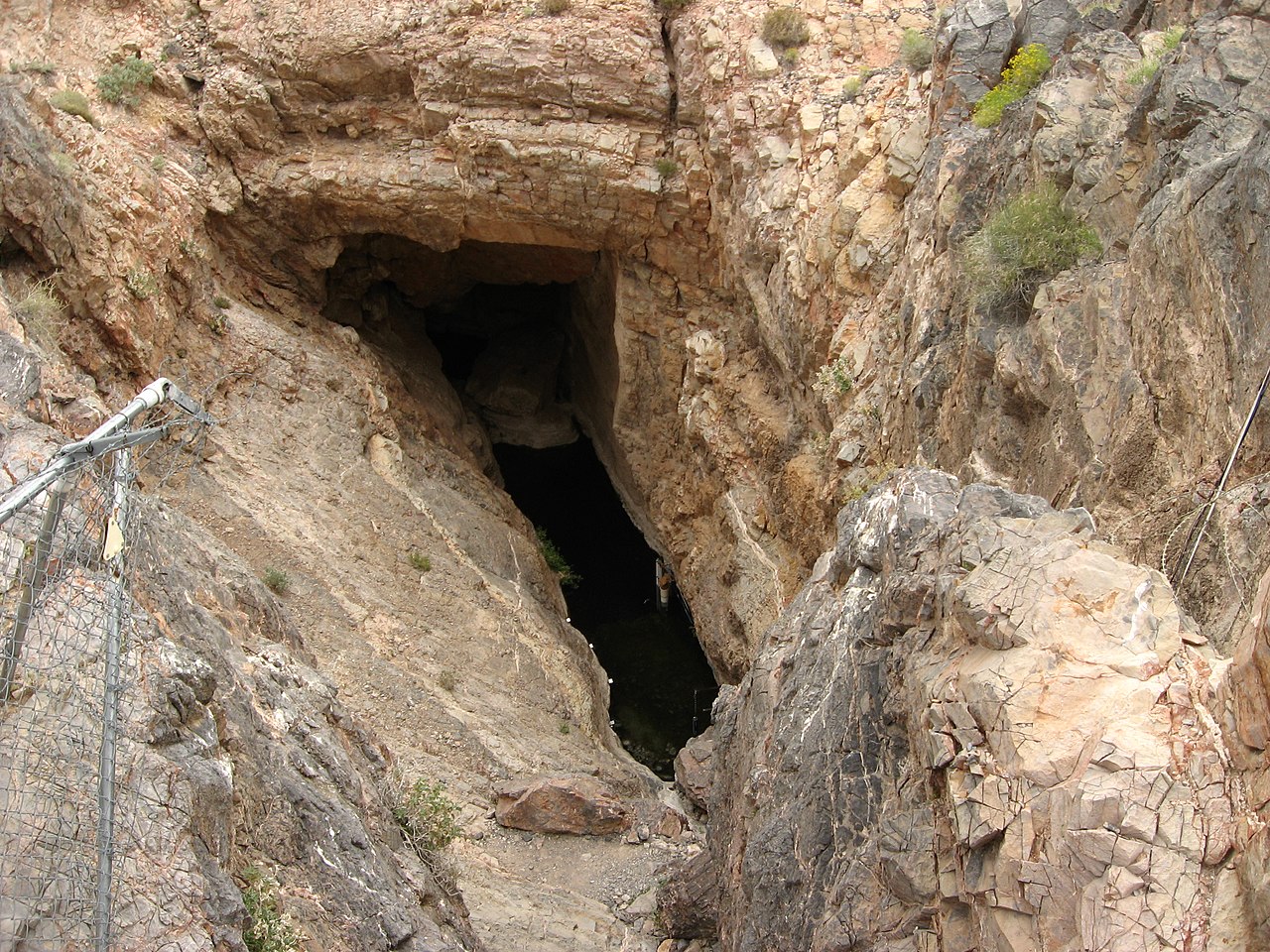
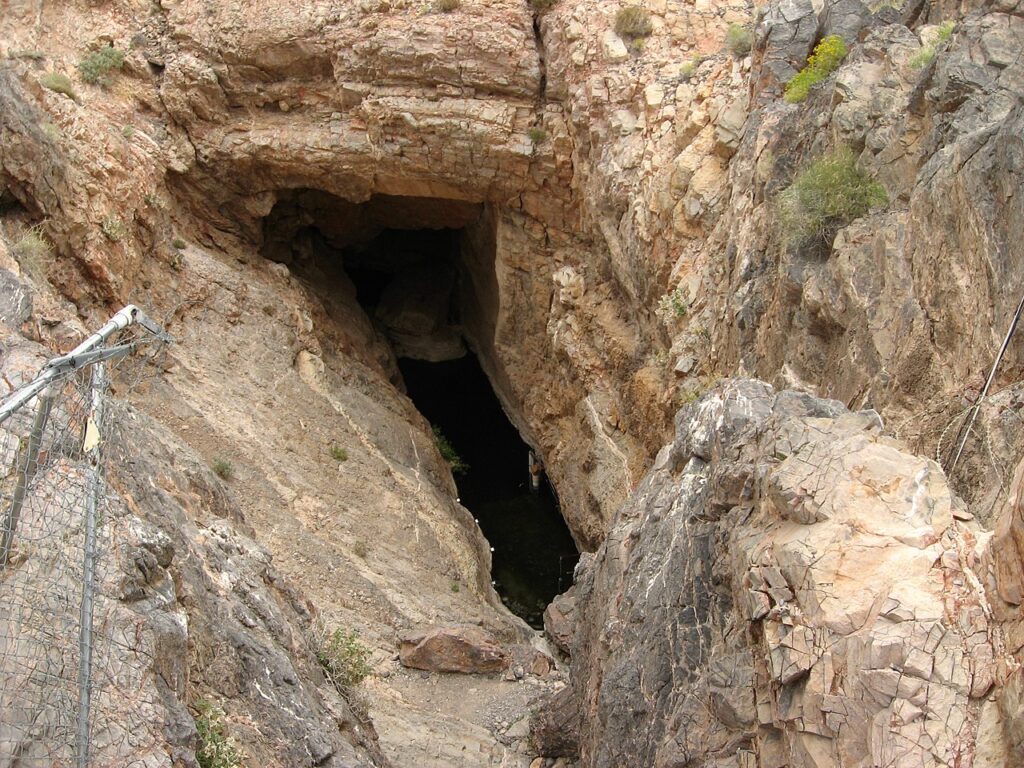
A one-meter core of calcite pulled from a cave of Devils Hole in Nevada has yielded a rare record of roughly 580,000 years of climate change Credit: Ken Lund – CC BY-SA 2.0 via Wikimedia Commons.
A one-meter (roughly 3.3 feet) core of calcite pulled from a cave of Devils Hole in southern Nevada has yielded a rare record of roughly 580,000 years of climate change, spanning the past six ice ages, researchers said.
The team, led by Kathleen Wendt of Oregon State University, abseiled about 20 meters (roughly 65.6 feet) down a narrow shaft and squeezed through a tight opening to reach Devils Hole II, a deep, fissure-like cave where groundwater has plastered cave walls with meter-thick mineral deposits over hundreds of thousands of years. There, the scientists drilled a one-meter (roughly 3.3 feet) core from a calcite deposit and sent it to the surface for laboratory analysis.
The study, published last week in the journal Nature Communications, used oxygen isotope analysis of the calcite to reconstruct long-term changes in the region’s climate. Oxygen isotopes trapped in calcite vary with temperature and rainfall, giving scientists a chemical archive of past conditions.
The findings in the cave show climate change patterns in Nevada
“What we see over this time span are glacial periods, when Nevada was cooler and wetter, followed by interglacial periods, when Nevada was hot and dry, like what we’re experiencing today,” Wendt said in a statement. “But midway through those interglacial periods, the available groundwater dropped sharply and vegetation plummeted.”
The record links those swings to ecological shifts. During the cooler, wetter glacials, southern Nevada supported megafauna such as mammoths, bison, ground sloths, dire wolves, and sabre-toothed cats, the researchers noted. As conditions warmed during interglacials, some cold-adapted species likely retreated northward or to higher, cooler terrain.
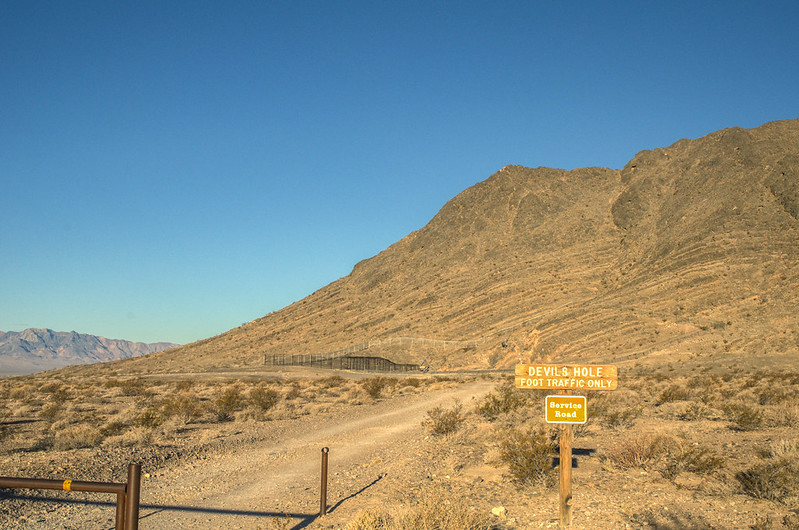
Entrance to Devil’s Hole, Death Valley National Park (Exclave Unit), Amargosa Valley, Nevada. Devils Hole’ is a geothermal (92 °F/33 °C), aquifer-fed pool within a limestone cavern in the Amargosa Desert in the Amargosa Valley of Nevada. Credit: Wayne Hsieh – CC BY-SA 2.0 via Flickr.
Co-author Christo Buizert, also of Oregon State, said the findings illuminate how storm patterns and rainfall belts have shifted over time. “Today, the bulk of the rainstorms coming off the ocean hit the Pacific Northwest, but during ice age periods, that same belt of rainstorms would land a lot further south,” he said. “That tells us these storm systems can move up and down the coast, and they can shift quickly and dramatically. This raises questions about what we might expect in this region in the future as climate continues to change.”
The Devils Hole in Nevada is seen as a physical historical archive by scientists
Devils Hole had long been identified as a promising archive because groundwater has flowed through the system for hundreds of thousands of years, depositing layers of minerals such as calcite on the cave walls. Extracting a core required technical cave work: abseiling into a narrow shaft and navigating the fissure-like chamber to reach intact deposits.
The researchers’ oxygen isotope chronology provides a new terrestrial complement to the more widely used ice-core records from Greenland and Antarctica, which offer long, continuous records but come from polar, high-latitude regions. Finding a similarly long, land-based archive in a hot, arid region of the southwestern United States is uncommon and valuable for understanding how local climate and ecosystems responded to global glacial-interglacial cycles.
The teams’ results underline rapid shifts in rainfall and groundwater availability during past warm intervals, a pattern the authors say could help inform expectations about water resources and vegetation in the region as the climate continues to change.