The Last Address: A Catastrophe in Hospice Care in Latvia
It is good that there are professionals in the country ready to help. But do we always know where to run, whom to turn to in these difficult moments?
## Difficult Numbers
* 51 days – this is the average lifespan of patients in palliative care institutions in our republic.
* 44.65 euros – the average cost per patient per day.
* 9 certified doctors (for all of Riga) – family doctors, internists, who are focused on working with palliative patients.
* 5 million – the total costs for hospice care in the country. This is 420 times less than what is planned to be spent on the defense of Latvia in 2026.
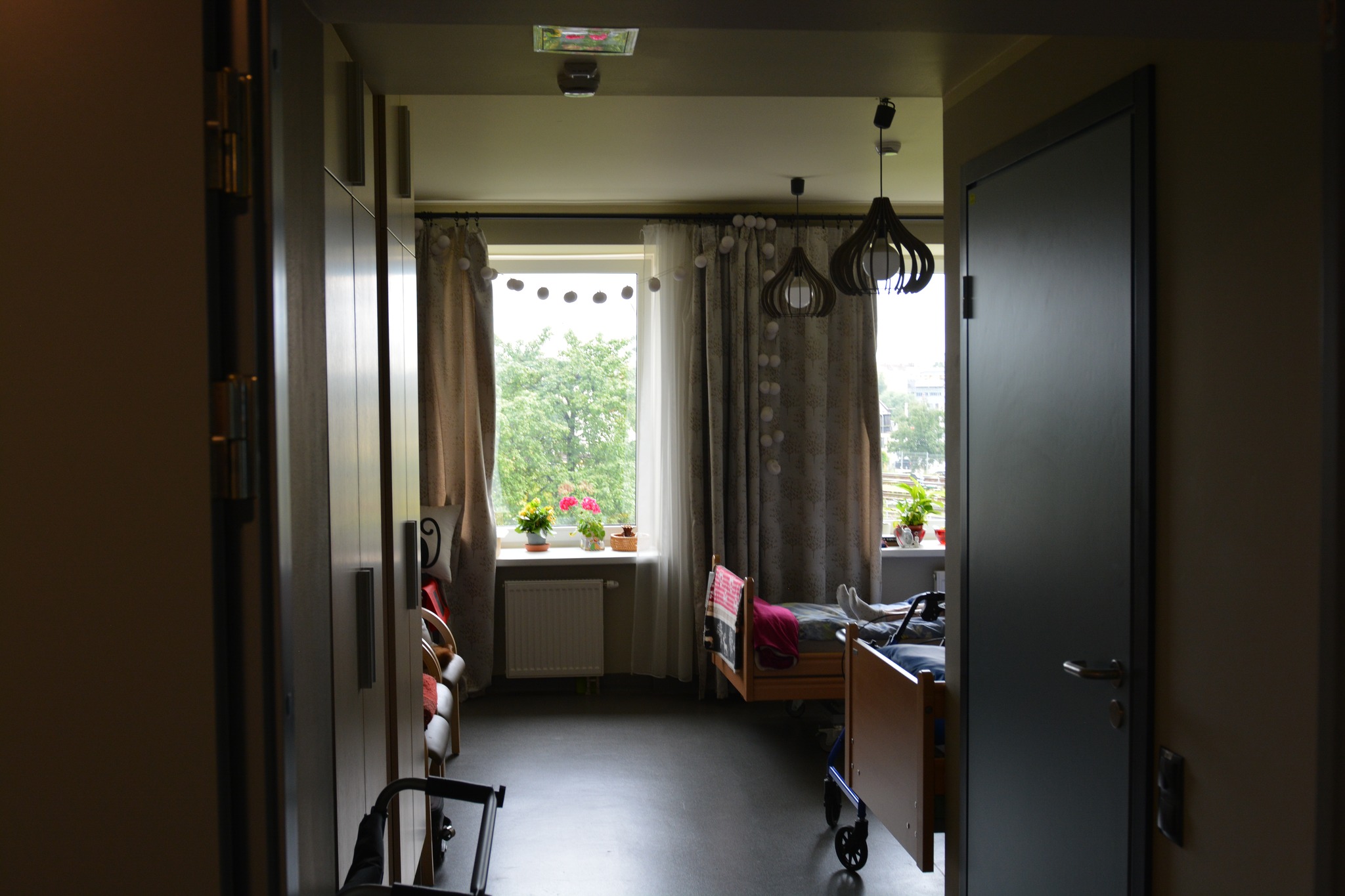
_The long-term care ward of the Samaritans Center on Daugavpils Street. Photo by the author._
## Neither to Treat nor to Support – No One to Turn To
One is forced to learn about previously unknown medical specialties. For example, a geriatrician – unlike a pediatrician, this specialist treats only elderly people.
An algologist – a specialist in overcoming pain. Is the fentanyl patch sufficient, or is intravenous morphine already necessary?
An occupational therapist – a specialist capable of bringing a terminally ill person to a level of minimal self-care (and there is only one for all of Latgale!!!).
But if a cancer patient can “burn out” literally in a week, then for diagnoses like Alzheimer’s disease, six months or a year is not a long time. For example, according to 2024 data, 26 people received therapy for more than 9 months. Although the Ministry of Health and the Ministry of Welfare have started the process of “verifying such patients” (are they taking too long to pass away, perhaps?).
Doctors specializing in therapeutic nutrition – half a doctor (that is, 0.5 positions) for Riga, half a doctor for Latgale. And what is a person in a condition where they cannot swallow anything supposed to do?…
## Dramatic Budget
For one visit to a palliative patient, about 30 tools and materials are needed, costing 7.61 euros: a disposable syringe – less than 4 cents, an absorbent compress – 7.5 cents, a sterile dressing kit – 0.63 cents, a urinary catheter – 1 euro. A type of ointment “Betadine,” used for one standard procedure with a palliative patient – 12 cents, glucose solution – 67 cents, sodium chloride solution – 1.13 euros.
In essence, the cost of palliative services is minimal. Of course, there are high-tech devices, for example, a mobile unit for saturating oxygen and moisture in cases of respiratory failure. To use it, they ask relatives to sign, and it is brought from the hospice service to a private nursing home, as the private institution does not have this equipment. And completely free of charge.
## “Unjustified Medical Assistance”
Surprisingly, this term was mentioned at a meeting of the Saeima’s Social and Labor Affairs Committee. In 2024 and the first half of 2025, in four medical SIA that provided palliative care, 8,581 cases of assistance were recorded, which were actually intended for patients who were simultaneously in hospitals.
Payments for assistance after the death of patients were also recorded – 96 people over a year and a half. The National Health Service notes the possibility of “errors in information circulation.” Although, of course, “checks are ongoing”…
In any case, here is a graph: three curves are decreasing, which represent the intensity of visits by doctors, physician assistants, and other services. And one is increasing – and that is the cost!
## When Help at Home is Needed
In 2026, it is planned to increase the social component of palliative care – mobile teams will more often visit lonely elderly residents at home. Hygiene, cooking, cleaning – all this is currently received by 813 people in Latvia, while last year there were only 356.
Undoubtedly, demand creates supply. But there is also a price to the question. Of course, caregivers will find it easier to work with one spouse of the former president than to visit the homes of 10 restless elderly people.
And one more nuance: placing your relative even in a paid, not cheap, care center does not guarantee that you will see them there in a few days or weeks. Because the staff working with elderly people, for example, on weekends, are simply not trained for crisis situations, and therefore they may be taken from the nursing home to emergency care first to one hospital, then, in the middle of the night, to another…
## Who is Entitled to Palliative Care in Latvia
– with HIV infection,
– encephalitis,
– myelitis,
– multiple sclerosis,
– heart failure,
– diseases of the peripheral nervous system,
– weakened skeletal muscles,
– spinal cord injuries and bedsores…
The palliative care department of the Riga East Clinical University Hospital is currently located in the “Bikernieki” inpatient facility. According to the institution’s statistics, on the page aslimnica.lv, it can be learned that about 60-70% of patients there are cancer patients. A multidisciplinary team is promised – a surgeon, neurologist, radiologist, oncologist, and even a psychotherapist and chaplain.
However, “the time spent in the department is limited to 7 days.” And if at least a hundred million out of two billion for military expenses were allocated to the elderly – it would amount to at least months…