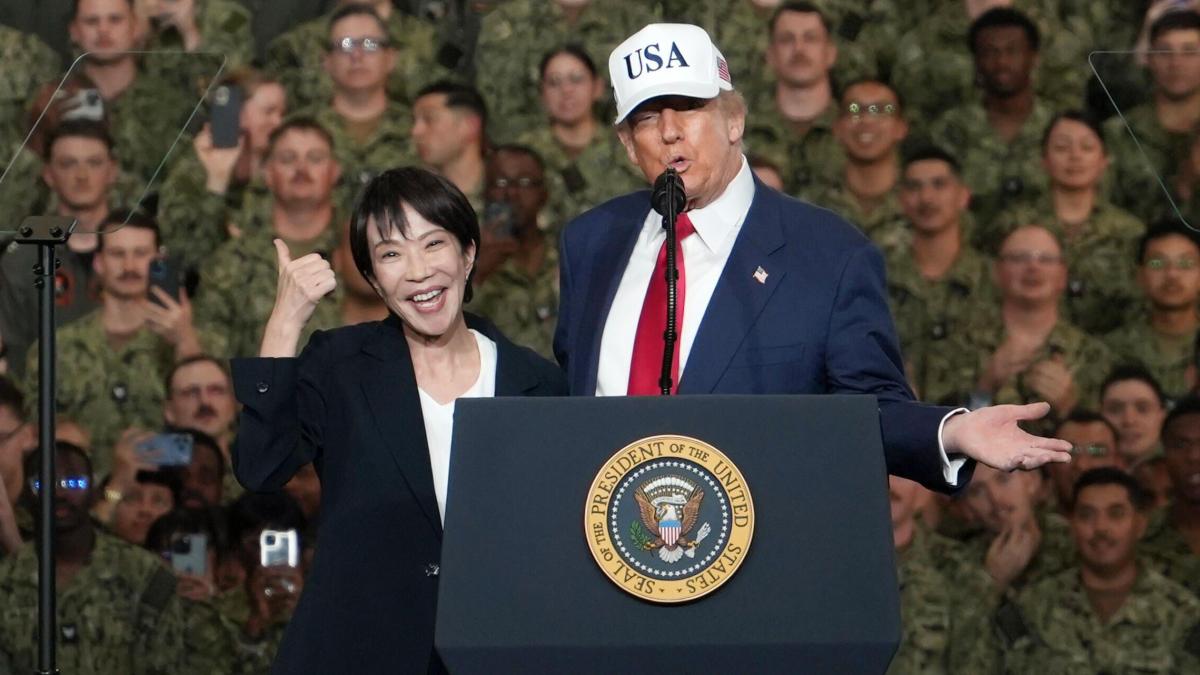
President Trump has urged the new Japanese prime minister, Sanae Takaichi, not to provoke China over the sensitive matter of Taiwan, according to reports.
The intervention will raise concerns in Japan that its ally and military protector is ready to compromise with its increasingly powerful neighbour and leave the country isolated and vulnerable to Chinese aggression.
US and Japanese officials said Trump’s request came in a telephone call on Monday, according to The Wall Street Journal and the newspaper Asahi. Significantly, it followed an hour-long conversation between Trump and President Xi, in which the two men discussed the implementation of a trade deal and the Chinese leader called for the US to recognise his insistent claim to sovereignty over Taiwan.
• Xi’s plan to seize Taiwan without firing a single shot
However, Minoru Kihara, a Japanese government spokesman, denied the Wall Street Journal’s account. “The article has a passage that says, on the question of Taiwan’s sovereignty, [Trump] advised her [Takaichi] not to provoke the Chinese government. There is no such fact,” he told a regular media briefing.
Takaichi said in her reporting of the call with Trump that they had discussed his conversation with Xi, as well as bilateral relations. “President Trump said we are very close friends and he offered that I should feel free to call him anytime,” she said.

Anti-landing spikes at a beach in Kinmen, Taiwan, in May — with the the Chinese city of Xiamen visible in the distance
DANIEL CENG/ANADOLU VIA GETTY IMAGES
Although neither side has said as much, it seems that Trump got the message that Chinese displeasure with Takaichi could endanger the détente between Beijing and Washington.
“China and the United States share a common responsibility to jointly safeguard the post-war international order and oppose any attempts or actions to revive militarism,” said an article in the newspaper of the Chinese Communist Party, a reference to Japanese wartime aggression in China and east Asia.
“[Takaichi has] raised concern and vigilance in the international community regarding Japan’s dangerous strategic moves.”
After less than a month in office, Takaichi infuriated Xi, threatening China’s second-most important bilateral relationship. Three weeks ago she answered a question from an MP by saying that a Chinese invasion of Taiwan would be an “existential threat” to Japan.
The phrase implies that in such a situation Japan would be entitled to dispatch its Self-Defence Forces in an act of collective defence with its allies — in other words go to war with China.
• China bans Japanese seafood as diplomatic row deepens
The idea that Japan would have to become involved in a conflict over Taiwan is common among members of Takaichi’s conservative Liberal Democratic Party but it has never been articulated so clearly by a prime minister.

Takaichi and Xi met in October in South Korea
KYODO NEWS/AP
“Successive administrations have handled this with the utmost caution,” her predecessor, Shigeru Ishiba, said in response to Takaichi’s words. “That is how sensitive the Japan-China relationship is. This is not about being able to say whatever one wants, or simply gaining higher approval ratings.”
However, polls show that most of the Japanese public approve of Takaichi’s directness, and she is unlikely to withdraw her remarks. But Trump’s intervention will make it difficult to repeat them.
“The United States relationship with China is very good, and that’s also very good for Japan, who is our dear and close ally,” Trump said in a statement to The Wall Street Journal. “Getting along with China is a great thing for China and the US. In my opinion, President Xi will be substantially upping his purchase of soybean and other farm products, and anything good for our farmers is good for me.”
Trump, who plans to visit China in April, added: “We signed wonderful trade deals with Japan, China, South Korea, and many other nations, and the world is at peace. Let’s keep it that way!”