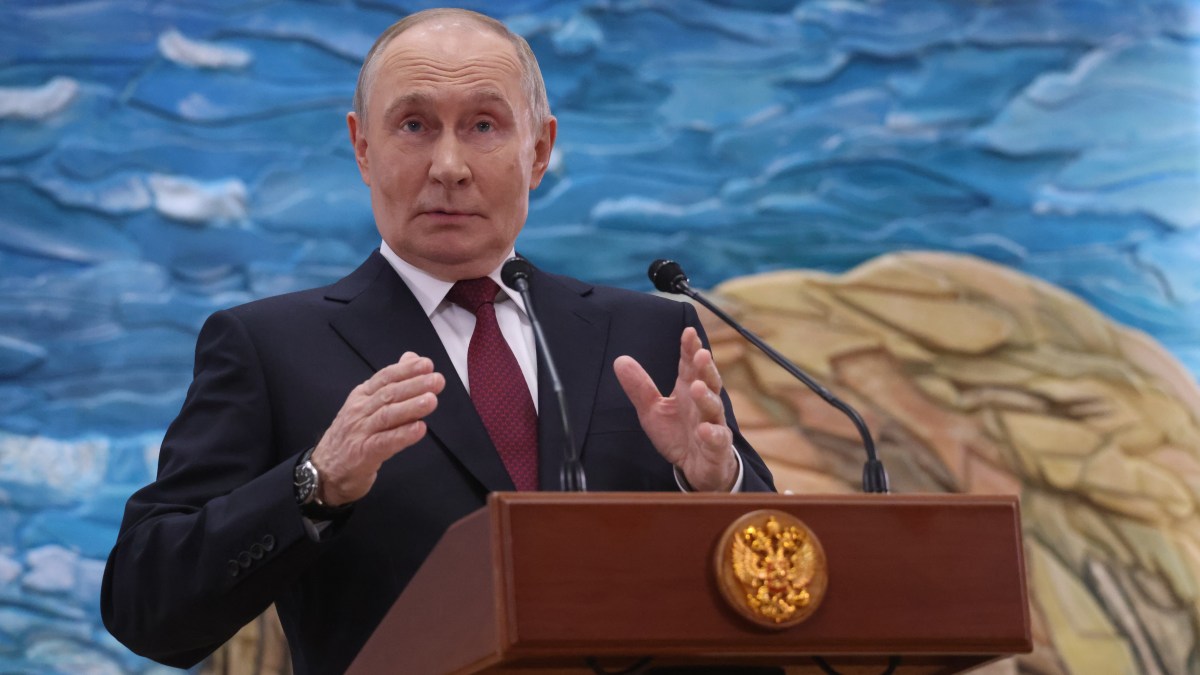
President Putin has promised to keep up his war on Ukraine if Kyiv refuses to retreat from its own territory, casting fresh doubt on the momentum of peace talks to stop the three-year conflict.
“If Ukrainian forces leave the territories they hold then we will stop combat operations,” Putin told reporters during a trip to Kyrgyzstan in Central Asia. “If they don’t then we will achieve it by military means.”
Putin did not specify the areas in question but Moscow has said that it wants Kyiv to relinquish control over four regions in eastern and southern Ukraine, even parts which Russian forces have not occupied since they invaded in 2022.
Putin said it would be “pointless” to sign a peace deal with Ukraine’s current leadership, while taunting Europe for fearing a Russian invasion.
He was bullish about Russian advances at the front, saying his forces had surrounded the Ukrainian city of Pokrovsk, known as the “gateway to Donetsk”, and controlled about 70 per cent of it. Russian troops were closing in on the nearby city of Myrnohrad where they were engaged in the “systematic destruction” of its Ukrainian defenders, he added.
A US-backed plan for peace, leaked last week, suggested annexed Crimea and the Luhansk and Donetsk regions of Ukraine should be recognised as “de facto Russian”, including by the United States.
President Zelensky, however, said that Russia’s demands for territory were the “main problem” and Kyiv’s allies are keen that any peace agreement does not set a dangerous precedent by endorsing a land grab in modern-day Europe.

Volodymyr Zelensky
ALDARA ZARRAOA/GETTY IMAGES
Russia occupies about 20 per cent of Ukrainian territory, including almost all of the Luhansk region and parts of the Donetsk, Kherson and Zaporizhzhia regions.
In an interview on Thursday, Andriy Yermak, Zelensky’s chief of staff, saidthat “as long as Zelensky is president, no one should count on us giving up territory”.
“Not a single sane person today would sign a document to give up territory,” he told the Atlantic magazine. “The constitution prohibits this. Nobody can do that unless they want to go against the Ukrainian constitution and the Ukrainian people.”
“All we can realistically talk about right now is really to define the line of contact,” Yermak said. “And that’s what we need to do.”
Friedrich Merz, the German chancellor, said on Thursday that Ukraine would need strong armed forces and security guarantees after any peace deal with Russia was agreed and Kyiv should not be forced to surrender territory.
In his first full comments on US proposals for a peace deal revealed last week, which Washington had originally lobbied for Kyiv to approve by Thursday, Putin made clear that quick progress was highly unlikely. He said that Moscow was ready for “serious” negotiations with the United States and Europe and that US proposals could be the “basis for future agreements”. But he added that Kyiv could not be a signatory because it had lost legitimacy by failing to hold elections.
Putin discusses the proposed peace deal
“Whoever can or wants to hold negotiations on their behalf, let them do so,” Putin added. “We need for our decisions to be recognised internationally by international players.”
• Marc Bennetts: A week of ‘peace plans’ and whirlwind diplomacy hits a Kremlin wall
Analysts said Putin looked happy to stall on a deal until Ukraine was so weak it had to give in to the Kremlin’s demands, which include ceding territory currently held by Ukrainian forces, recognition of Crimea as Russian, and a promise that Ukraine could not join Nato. If these were not met, Russia would keep on fighting.
Putin indicated that a deal was far from completion and the US had simply drafted a list of issues to address. “It would be impolite on my part to speak now about some kind of final versions,” he added, “because there aren’t any.” Talks should carry on “in diplomatic language”, he added.
He made a sarcastic reference to one of the elements of the 28-point draft US plan, which proposed that Moscow should enshrine in law a non-aggression policy towards Europe.
“It’s one thing to say that Russia is not planning to attack Europe. For us that sounds funny. Of course we never intended such a thing. But if they want to hear that from us, well then, let’s record it, no problem,” said Putin. “There are people there [in Europe], it seems to me, who have slightly lost it, when they, or some rascals who want something for that, say publicly to their populations that Russian is preparing an attack on Europe and we need to immediately strengthen our armed forces.”
• The Times view: It’s time for Europe to step up and help Ukraine survive
US and Ukrainian officials discussed a refined version of the American draft agreement in Geneva on Sunday. Steve Witkoff, President Trump’s envoy, is due to travel to Moscow next week to meet Putin and test Kremlin thinking on the plan.
The US draft agreement has been heavily criticised for leaning towards Russia’s priorities, but Tatiana Stanovaya, a political analyst, said Moscow was still troubled by some points, such as the permitted size of the Ukrainian army and the absence of a total ban on Kyiv possessing long-range weapons. For now, Stanovaya said, Moscow was “simply waiting” for clarification. “I see nothing at the moment that would force Putin to recalculate his goals or abandon his core demands,” she added. “He feels more confident than ever about the battlefield situation and is convinced that he can wait until Kyiv finally accepts that it cannot win and must negotiate on Russia’s well-known terms.”
Putin said that recognition of occupied Crimea and Ukraine’s eastern Donbas area as Russian would be a “key moment” in talks with the United States.

A Ukrainian soldier in Donetsk
REUTERS
The American draft plan had proposed that Crimea and Donbas “will be recognised as de facto Russian, including by the United States”. It is thought that Kyiv might accept de facto (in practice) Russian control rather than de jure (legally binding) as it would not impinge on Ukraine’s constitution, which says its borders are “indivisible and inviolable”.
Russia rejoining the G7 group of wealthy nations to make it the G8 again, a concession to Moscow proposed in the leaked American peace plan, was unlikely, Putin said in Kyrgyzstan. “Can you imagine it yourself?” he asked reporters. “Like we arrive, say ‘Hallo’, and then what, frown and look at one another?” Russia had not asked to rejoin the group, Putin added, although it did not reject co-operation.
In an unusual airing of alleged jockeying behind the scenes in Moscow, Putin batted away a reporter’s suggestion that Sergey Lavrov, his long-serving foreign minister, had fallen out of favour after he clashed with Marco Rubio, the US secretary of state, over Ukraine. “That’s rubbish,” said Putin.