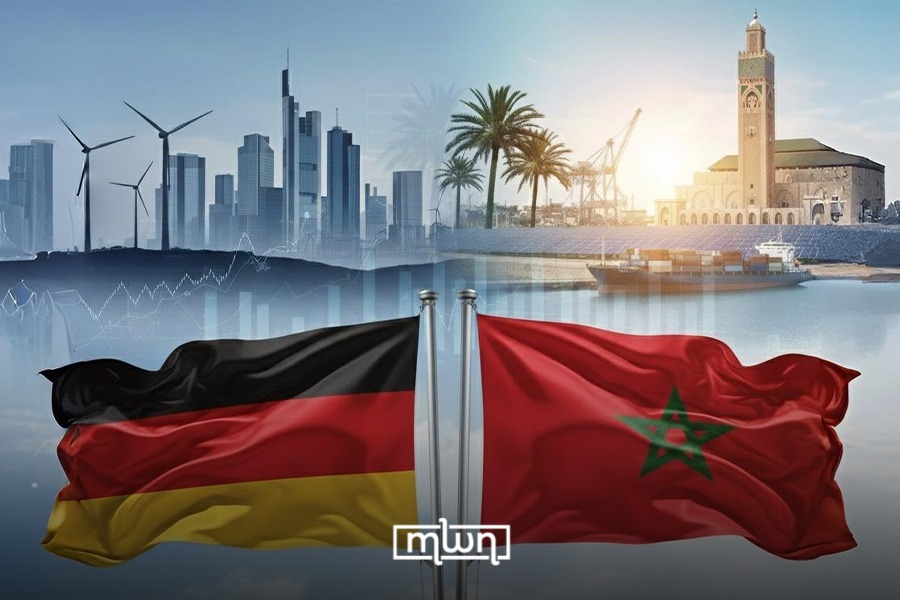
Economic relations between Germany and Morocco are undergoing a phase of recalibration. Developments from the past continue to have an impact, current dynamics are reshaping cooperation, and new potential is emerging. Overall, two past trends, two current developments and two future dynamics can be identified that shape the economic-policy framework of the partnership.
Past Trends
Skilled Labour Migration: Limits of an Existing Model
Skilled labour migration from Morocco to Germany is increasingly hitting structural limits. Programs designed to bring Moroccan trainees into low-wage occupations in Germany are associated with growing risks and visible failures.
At the same time, the massive reduction of jobs in Germany’s industrial sector, as well as the large number of unemployed migrants from Syria and Ukraine, directly affects society’s and politics’ willingness to admit further workers. The domestic political climate is tense; tightened naturalization requirements have reversed earlier, more progressive reforms. Under these conditions, this migration model is losing political and social viability.
For these reasons, the Federal Chancellor referred this week at an economic summit to a provision in the coalition agreement: the quasi-nationalization of skilled labour recruitment. This is to be implemented through the creation of a “Work-and-Stay Agency,� which will bypass private — and in some cases dubious — intermediaries through digital procedures and recruit highly qualified workers in a more targeted manner.
Energy and Hydrogen: Missed Opportunities Due to Diverging Logics
In the energy sector, particularly regarding hydrogen, a clear gap between expectations and actual developments has become visible. For a long time, Morocco relied primarily on state-level agreements and showed reluctance towards market-based mechanisms. In Germany, by contrast, the division of labour is clearly defined: the state provides early regulatory certainty, while private companies invest within this framework.
Moroccan authorities sent contradictory signals to German investors. Instead of presenting their own preliminary studies in a timely manner, considerable effort was directed towards obtaining German public funding for implementation studies — costing valuable momentum. At the same time, the Minister of Energy set a target price of three euros per kilogram of hydrogen, significantly below the current market price for green hydrogen, which stands between eight and thirteen euros. Ambitious aims are legitimate, but they require realistic pathways and partnership-based frameworks. Otherwise, they are more likely to deter serious investment than to attract it.
Current Developments
Strong Presence of German Interests in Morocco: Where Is the Balance?
Germany continues to expand its institutional presence in Morocco. In addition to the German Chamber of Commerce Abroad and Germany Trade & Invest, the Federal Association of Small and Medium-Sized Enterprises recently opened a liaison office in Rabat. Germany is thus broadly represented institutionally and maintains a stable operational infrastructure in the Kingdom.
On the Moroccan side, however, a sustainable and operationally capable long-term representation in Germany is still lacking. Roadshows, trade fair appearances or project-based delegations create only temporary visibility and do not produce continuous impact. A permanent presence in Germany is essential for building trust, representing interests consistently and accompanying complex investment processes transparently. It forms the basis for coordinated economic engagement.
Near-shoring: Morocco in Competition for Production Sites
The global trend towards near-shoring is having a tangible impact on German companies. High energy prices, bureaucracy and structural costs within the Federal Republic are driving companies to search for alternative locations. Morocco offers a combination of logistics capacity, political stability and industry clusters close to European markets.
The Port of Tanger Med functions as a logistical backbone, reliably linking the flow of goods between Europe, Africa and other global markets. This is complemented by competitive tax regimes, modern industrial zones and moderate labour costs.
These locational advantages create an environment in which German companies increasingly relocate or expand production stages. Morocco is positioning itself as an industrial extension of the European economic area and strengthening its role within global supply chains.
Future Dynamics
Defense Industry: Between Economic Sector and National Security Interest
Shifts in Europe’s security landscape and the war in Ukraine have led to a significant expansion of Germany’s military-industrial complex. At the same time, the German defense industry faces well-known structural challenges: heavy bureaucratic burdens, limited availability of industrial space and rising costs.
Here, Morocco can play a strategic role. The German defense sector requires long-term bundled orders to scale production. Establishing production or distribution structures in Morocco would facilitate access to markets in Africa and South America. Examples such as the presence of the supplier Böllhoff in Casablanca demonstrate that industrial structures in security-relevant fields can be implemented in practice.
In a global context where new forms of security cooperation are emerging, this sector could become a central field of German–Moroccan collaboration. Future development will depend largely on whether clear political and economic conditions are established in a timely manner — also in view of Morocco’s own security interests.
Investment in the Moroccan Sahara: New Opportunities Driven by Political Momentum
The Moroccan Sahara is gaining importance as an investment destination. Until now, major German corporations — including Siemens Energy and Heidelberg Cement — have been the primary actors operating there. These projects marked an initial phase of opening the region to specialized German companies.
The most recent decision of the United Nations Security Council, Resolution 2797, provides Morocco with additional political arguments to invite German companies — particularly the broad German Mittelstand — to invest in the Sahara. To expand such activities, various supporting measures would be necessary, including state guarantees, broader political backing for regional projects and the extension of consular services by the German embassy to the Sahara.
In combination with the Royal Atlantic Initiative, which aims to give Sahel states logistical access to the ocean, the Sahara would become more deeply integrated as an investment zone within bilateral economic relations and could play a market-opening role towards Africa within the architecture of German–Moroccan cooperation.