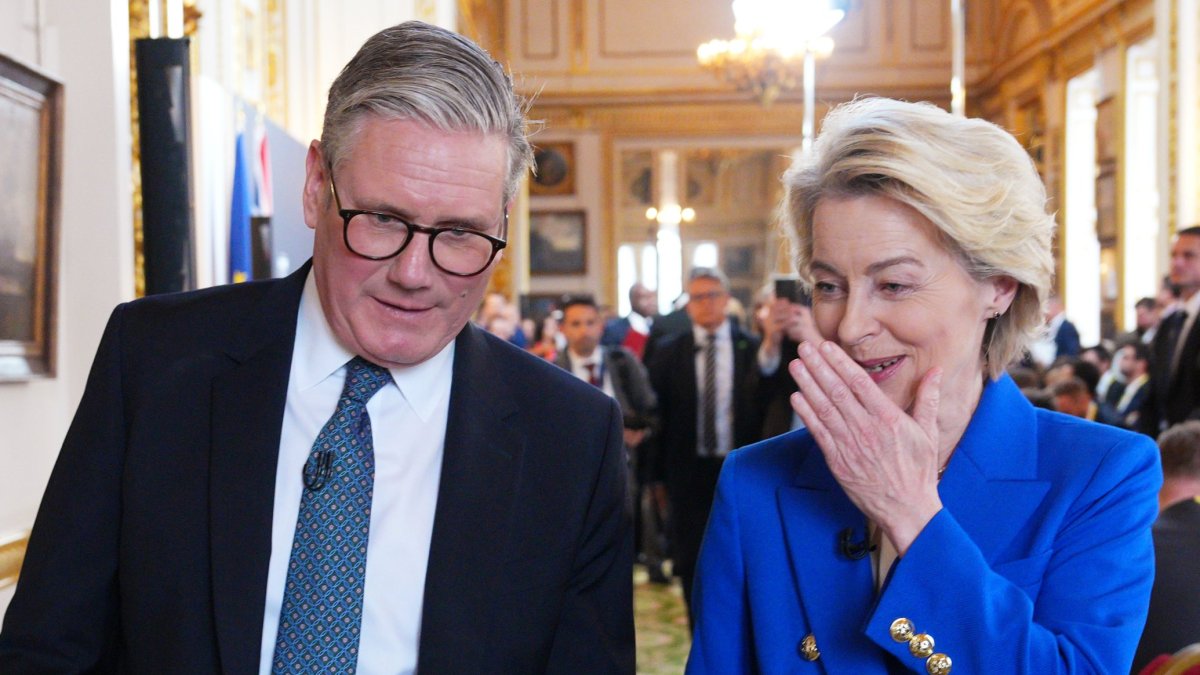
Sir Keir Starmer’s Brexit reset suffered a major blow on Friday after negotiations for the UK to join a flagship EU defence fund collapsed over Brussels’ cash demands.
UK minister for EU relations Nick Thomas-Symonds said it was “disappointing” the two sides had failed to agree a deal for the UK to join the EU’s Security Action for Europe (Safe) €150bn (£132bn) rearmament fund ahead of Sunday’s deadline for project bids.
But Thomas-Symonds concluded that EU demands for cash to participate were too high to represent “value for money”.
The scheme is intended to use low-interest loans to boost Europe’s arms production capacity and reduce reliance on US supplies in response to the growing threat from Russia and Donald Trump’s withdrawal from the continent.
New FeatureIn ShortQuick Stories. Same trusted journalism.
But, the negotiations came unstuck over EU demands for the UK to pay billions to participate, despite Brussels lowering initial demand for up to €6.5bn to €2bn to “pay to play”.
The i Paper reported on Thursday that the UK submitted a counter-offer which envisaged a pay-per-project scheme, with contributions calculated as a proportion of the value of each loan project the British defence industry was participating in.
France has taken a tougher line on UK
But the gap between the two sides proved impossible to bridge amid long-running EU splits over how important British involvement was.
France has long been said to be taking a tougher line, with Germany keener on closer ties with the UK.
Experts said this division could yet scupper negotiations in other areas of the reset including a youth mobility deal, a food and drink deal and energy cooperation, although Thomas-Symonds insisted “strong progress” was being made in these areas.
The i Paper on Thursday reported that the EU was continuing to demand a waiving of international fees in a youth mobility deal, though they were also discussing a potential compromise option amid UK resistance.
Food and drink deal clash expected
The two sides are also expected to clash over the food and drink deal, which will see the UK align with Brussels rules in this area to ease trade, as the British Government seeks exemptions from EU law in a number of areas.
The failure of Safe negotiations is a blow to the Prime Minister after he signed a security pact with the EU at May’s Brexit reset summit, which he said would “open the door” to joining Safe, “providing new opportunities for our defence industry, supporting British jobs and livelihoods”.
At the London event, European Commission President Ursula von der Leyen said a deal could be reached on Safe “within weeks”.
The Safe scheme, is designed to speed up Europe’s rearmament by enabling joint purchases of weapons systems through EU-backed borrowing.
Brussels conceived the programme to be partially open to third countries, particularly close allies like Britain.
Under default rules, British defence companies can still access up to 35 per cent of the fund’s value – a share that could have risen to 50 per cent if the UK and EU had agreed a deal.
European Commission spokesperson Thomas Regnier said discussions had been “intense” and conducted “in good faith,” but said that the UK had made no offer acceptable to the EU before Sunday’s deadline.
He emphasised that Safe, “is open by design” and that Britain “can, by default, participate… up to 35 per cent,” even without a specific deal.
While countries wishing to exceed that ceiling must sign an agreement, “our door is always open,” he added.
Regnier also said the dispute was unrelated to wider UK–EU engagement, insisting that the breakdown on Safe “will not affect” progress on other strands of security and defence cooperation, or on parallel negotiations with countries such as Canada.
Despite the collapse, EU officials insist that London could re-enter discussions in later rounds of Safe – though the bloc has tight timeframes for approving national spending plans and issuing the first tranche of funds before year-end. Regnier stressed the urgency of the programme, calling it an “emergency instrument” with a 2030 deadline for delivering new capabilities.
A UK Government source also said that Britain may still join at a later date, although it had missed the deadline for bids in the first round of Safe loans and no further talks were scheduled.
Thomas-Symonds said: “While it is disappointing that we have not been able to conclude discussions on UK participation in the first round of Safe, the UK defence industry will still be able to participate in projects through Safe on third country terms.
“Negotiations were carried out in good faith, but our position was always clear: we will only sign agreements that are in the national interest and provide value for money.
“We continue to make strong progress on the historic UK-EU May agreement that supports jobs, bills and borders. In the last fortnight, we have launched negotiations on a food and drink deal and energy deal that will bring down bills and slash red tape for business.”
The UK Government source sought to downplay the economic impact of the collapse in talks.
They said: “This Labour government has increased defence spending to record levels and we continue to strike significant bilateral defence deals, supporting jobs across the country, including a historic Norway deal that secured thousands of shipbuilding jobs on the Clyde for the next decade.”
Another Government source said that the longer negotiations dragged on, the less appealing a deal became as EU countries may not have had bids with 50 per cent UK involvement ready for the deadline on Sunday if there was uncertainty over Britain’s position in Safe.
The source said the UK was “still bullish” about the prospects for Britain’s defence industry, pointing to a £10bn deal to build warships for Norway and an £8bn deal to supply Turkey with Typhoon fighter jets.
They also insisted “UK kit is in demand” in Europe, pointing to a recent 3bn euro deal for Sweden to sell Gripen fighter jets, which are 35 per cent UK industry sourced, to Colombia.
“That is the kind of programme that would still count under Safe for a third country like the UK,” the source said.
Poland has also recently decided to purchase submarines from Sweden, which are thought to have a UK workshare of more than 20 per cent.
Defence Secretary John Healey on Friday morning contacted EU counterparts to thank those who were supportive of UK involvement in Safe and to make clear that the Government was still keen to strike bilateral deals on rearmament.
David Henig, UK director at the European Centre for International Political Economy, said the failure to reach agreement suggested “the Commission is struggling to reconcile differing member state views” and that this could have a wider effect on the reset, with the two sides still to negotiate deals to make headline political agreements a reality.
The former UK trade official told The i Paper: “If France and Germany continue to disagree so publicly on so many policies then it will make the Commission’s role as a negotiator almost impossible, including with the UK.
“So not good news, we’ll be collateral damage.”
The breakdown in negotiations triggered criticism from pro-European groups.
Naomi Smith, chief executive of Best for Britain, said that with Ukraine “standing between us and the tyrant on our doorstep,” political wrangling should not obstruct defence cooperation.
She urged both sides to “get their act together” and find a way to secure UK access to Safe at a time when Donald Trump is reportedly pressuring President Volodymyr Zelenskyy to concede territory to Russia.
“Ensuring lasting peace was the EU’s founding rationale,” she said.
This story has been updated.